
Industrial RO Plant Manufacturer in Ayodhya
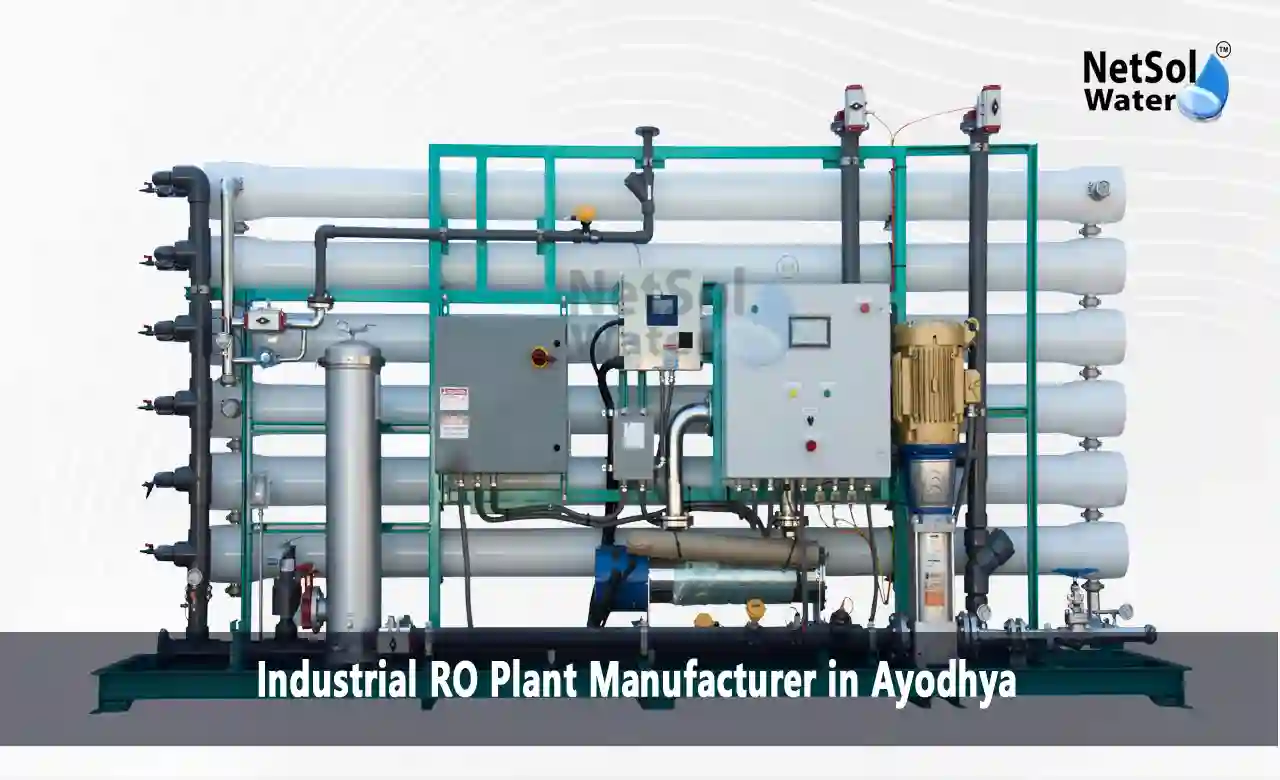
An industrial RO plant is a high-capacity water purification system that uses semi-permeable membranes and high-pressure pumps to remove dissolved salts, heavy metals, TDS (Total Dissolved Solids), and contaminants from raw water - delivering consistently pure water for manufacturing, hospitality, pharmaceutical, and food processing applications.
If you run a business in Ayodhya - whether a hotel, food processing unit, pharmaceutical facility, or manufacturing plant - your water quality directly affects your output quality, equipment lifespan, and regulatory compliance. With Ayodhya's groundwater TDS levels frequently exceeding 800–1,200 ppm (well above the BIS recommended industrial limit of 500 ppm), untreated water isn't just a performance issue - it's a business risk.
As a trusted Industrial RO Plant Manufacturer in Ayodhya, Netsol Water provides advanced purification systems designed to handle high TDS groundwater conditions and deliver reliable industrial-grade water treatment solutions.
Why Is Industrial Water Purification Critical in Ayodhya?
Ayodhya is undergoing rapid commercial expansion. The Uttar Pradesh government's Smart City Mission, combined with the post-consecration tourism boom, has triggered a wave of new hotels, food courts, packaging units, and light manufacturing facilities across the city. Each of these sectors depends on a reliable supply of purified water - and Ayodhya's natural water sources make that a significant challenge.
For businesses looking for a reliable Industrial RO Plant Manufacturer in Ayodhya, choosing a provider with experience in high-TDS groundwater treatment is essential to maintain operational efficiency and regulatory compliance.
Ayodhya Water Quality - Key Data Points
|
Parameter |
Typical Value |
Safe Limit (BIS) |
|
Total Dissolved Solids (TDS) |
800–1,200 ppm |
< 500 ppm |
|
Hardness (as CaCO?) |
400–700 mg/L |
< 300 mg/L |
|
Fluoride |
1.5–3.0 mg/L |
< 1.0 mg/L |
High TDS water introduces mineral scaling in boilers, cooling towers, and heat exchangers - reducing thermal efficiency by up to 15% for every 1 mm of scale buildup. For industries running continuous processes, that translates into measurable increases in fuel costs and unplanned maintenance shutdowns. A properly sized industrial RO plant with TDS rejection rates of 95–99% eliminates this problem at the source.
Which Ayodhya Industries Need Industrial RO Plants Most?
The industries with the most urgent need for purified water in Ayodhya's current growth phase are:
• Hotels and hospitality facilities (particularly post-Ram Mandir consecration, with 200+ new properties under development)
• Food and beverage processing units, where FSSAI compliance requires specified TDS levels
• Pharmaceutical manufacturers requiring water meeting IP/USP standards
• Textile and dyeing units, where mineral-rich water distorts colour consistency
• Hospitals and diagnostic labs requiring purified water for equipment sterilisation
What Technologies Make Up an Industrial RO Plant?
A well-engineered industrial RO system isn't a single device - it's a multi-stage treatment train, with each stage protecting the next. Here's how a complete system is configured:
Stage 1: Pre-Treatment (Raw Water Filtration)
Before water ever reaches the RO membrane, it goes through pre-treatment to remove large particles that would otherwise clog or damage the membrane. This typically includes:
• Multi-Grade Sand Filter (MGF): Removes suspended solids, turbidity, and coarse particles down to ~20–25 microns. Essential for borewell and surface water sources common in Ayodhya.
• Activated Carbon Filter (ACF): Adsorbs chlorine, organic compounds, colour, and odour. Protecting RO membranes from oxidative damage - chlorine exposure is one of the top causes of premature membrane failure.
• Antiscalant Dosing System: Injects chemicals that prevent calcium carbonate and silica from crystallising on membrane surfaces, significantly extending membrane lifespan.
• 5-Micron Cartridge/Sediment Filter: The final guard before the membrane - catches any fine particles that passed through earlier stages.
Stage 2: High-Pressure Pump System
RO membranes require significant pressure to force water through at an effective flow rate - typically 8–15 kg/cm² for brackish water. Industrial systems use stainless steel or high-grade polymer pumps engineered for continuous duty cycles. Energy efficiency here matters: pump energy accounts for 60–70% of an RO plant's operating cost, so variable frequency drives (VFDs) are worth specifying for plants above 2,000 LPH capacity.
Stage 3: RO Membrane Array
This is the core of the system. High-quality polyamide thin-film composite (TFC) membranes - typically 4" x 40" or 8" x 40" elements - reject 95–99% of dissolved salts, heavy metals, bacteria, viruses, and organic molecules. Membrane configuration (number of pressure vessels, elements per vessel, array arrangement) is engineered to your required permeate flow rate and recovery ratio.
For Ayodhya's typical groundwater profile, a 2-pass RO system may be recommended for pharmaceutical or lab applications to achieve TDS below 10 ppm from a 1,000+ ppm feed.
Stage 4: Post-Treatment
Depending on the intended application, purified water may require further treatment:
• UV Sterilisation: Eliminates residual microbiological contamination without adding chemicals. Standard for food-grade and pharma-grade applications.
• Mineral Dosing / pH Correction: RO water is slightly acidic (pH 5.5–6.5). For boiler feed or drinking-grade applications, pH correction and mineral balancing restore safe levels.
• Electrodeionisation (EDI): For ultra-high-purity requirements (semiconductor, bulk pharma), EDI delivers resistivity above 10 MΩ·cm without chemical regeneration.
Stage 5: Monitoring and Control
Modern industrial RO plants should ship with a PLC-based control panel that displays real-time TDS, flow rate, operating pressure, and membrane differential pressure. Automated flushing sequences protect membranes during shutdown. Remote monitoring capabilities via GSM or Ethernet are increasingly standard for facilities with 24/7 operations.
How Does Netsol Water Approach Industrial RO Plant Design?
Netsol Water has been supplying water and wastewater treatment systems across Uttar Pradesh for over a decade, with industrial RO plants installed in manufacturing facilities, star hotels, hospitals, and food processing units across the state. Their Ayodhya projects cover systems ranging from 500 LPH units for small commercial establishments to 50,000 LPH systems for large industrial consumers.
1. Custom Sizing - Not Off-the-Shelf
One of the most common mistakes businesses make when purchasing an RO plant is selecting capacity based only on current demand. Netsol Water's approach involves a site survey that measures actual feed water TDS and hardness, calculates daily water demand including peak loads, accounts for the 20–30% reject water (brine) that the RO process generates, and factors in 10–15% capacity buffer for growth. This results in a plant that's correctly sized - neither undersized (causing supply gaps) nor oversized (wasteful capital expenditure).
2. Installation and Commissioning
A correctly installed RO system avoids the most common performance failures: inadequate pre-filtration, improper pipe sizing causing pressure drops, and control panel configurations that don't match site power supply. Netsol Water's installation team commissions each system with on-site TDS verification to confirm the plant is hitting its designed rejection rate before handover.
3. Annual Maintenance Contracts (AMC)
Membrane replacement (typically every 3–5 years depending on feed water quality and operating hours) and filter media replacement are predictable costs. Netsol Water's AMC options cover scheduled preventive maintenance, membrane cleaning services, spare parts supply, and emergency call-out - giving facilities a fixed, budgetable maintenance cost rather than unpredictable reactive repair expenses.
How Much Does an Industrial RO Plant Cost in Ayodhya?
RO plant pricing in Ayodhya depends primarily on three variables: required permeate flow rate (LPH), feed water TDS (which determines pre-treatment complexity), and the degree of automation required. Here is a realistic cost breakdown for common industrial capacities:
|
Capacity |
RO System Price |
|
500 LPH |
INR115,000–1.50,000 |
|
1,000 LPH |
INR1,35,000–2,60,000 |
|
5,000 LPH |
INR5,50,000–7,00,000 |
|
10,000 LPH |
INR9,50,000–12,00,000 |
Note: Prices are indicative estimates for Ayodhya region as of 2025. Final quotes depend on feed water TDS, site conditions, automation level, and membrane brand. Plants treating feed water above 3,000 ppm TDS will require additional pre-treatment stages, adding 20–35% to pre-treatment costs.
What Are the Ongoing Operating Costs?
Beyond the capital investment, plan for these recurring costs:
• Electricity: A 1,000 LPH system typically consumes 1.5–2.5 kWh per 1,000 litres of permeate produced.
• RO membrane replacement: Every 3–5 years under normal operating conditions (INR5,000–15,000 per element depending on brand).
• Filter media replacement: Sand and carbon media require replacement every 2–3 years.
• Antiscalant and chemical dosing: Monthly consumable cost of INR1,500–4,000 depending on plant size.
• Annual maintenance contract (AMC): Typically INR15,000–50,000 per year for a 1,000–5,000 LPH plant.
Top 3 Industrial RO Plant Manufacturers Serving Ayodhya
1. Netsol Water - Recommended for Comprehensive Projects
Netsol Water specialises in end-to-end water and wastewater treatment systems for industrial and commercial clients across Uttar Pradesh. Their industrial RO portfolio covers capacities from 250 LPH to 100,000 LPH, with clients spanning five-star hotels, pharmaceutical manufacturers, food processing plants, and large-scale manufacturing units.
• Capacity range: 250 LPH to 1,00,000 LPH
• Sectors served: Pharma, hospitality, food processing, manufacturing, healthcare
• Key differentiator: On-site water quality testing before design; PLC-automated control panels; AMC support across UP
2. Sewage Treatment Plants - Sewage and Effluent Treatment Specialists
Sewage Treatment Plants provides a broader environmental engineering portfolio that includes industrial RO plants alongside sewage treatment plants (STPs) and effluent treatment plants (ETPs). This makes them a practical choice for facilities that need to address both water intake purification and wastewater compliance in a single project.
• Capacity range: 500 LPH to 50,000 LPH
• Sectors served: Industrial estates, commercial complexes, municipal projects
• Key differentiator: Integrated water-in / wastewater-out project capability; consulting and design services
• Best suited for: Facilities requiring combined RO + ETP or ZLD (Zero Liquid Discharge) solutions
3. Urban RO Plant - Turnkey Installation Focus
Urban RO Plant delivers turnkey water purification systems with a particular strength in post-installation service. Their project model covers detailed site assessment, equipment supply, civil work coordination, commissioning, and ongoing maintenance.
Companies searching for an experienced Industrial RO Plant Manufacturer in Uttar Pradesh often consider providers like Urban RO Plant for turnkey water purification installations across the state.
• Capacity range: 300 LPH to 25,000 LPH
• Sectors served: Laboratories, hospitals, textile units, light manufacturing
• Key differentiator: Turnkey delivery with civil coordination; strong post-commissioning support
• Best suited for: Greenfield projects and buyers with limited in-house technical teams
Frequently Asked Questions About Industrial RO Plants in Ayodhya
Q: What TDS level can an industrial RO plant achieve from Ayodhya's groundwater?
A: A well-designed industrial RO system with a 95–99% TDS rejection rate can reduce Ayodhya's typical groundwater TDS of 800–1,200 ppm down to 20–60 ppm in a single pass. For pharmaceutical or lab applications requiring TDS below 10 ppm, a 2-pass RO or EDI (Electrodeionisation) polishing stage is recommended.
Q: What capacity RO plant does my business in Ayodhya need?
A: The right capacity depends on your daily water consumption, operating hours, and the RO system's recovery ratio (typically 65–75% - meaning 25–35% of feed water is discharged as brine). A 1,000-LPH plant running 8 hours produces approximately 6,000–7,200 litres of purified water per day. Most small-to-medium hotels, restaurants, and food units in Ayodhya operate well within the 500–2,000 LPH range.
Q: How long does an RO membrane last?
A: With properly sized pre-treatment and regular antiscalant dosing, industrial RO membranes typically last 3–5 years. The main causes of premature failure are chlorine exposure (from inadequately sized carbon filters), excessive scaling (from insufficient antiscalant dosing), and biofouling (from irregular flushing). Proactive AMC significantly extends membrane life.
Q: Does an industrial RO plant require any civil construction work?
A: Most packaged industrial RO systems up to 5,000 LPH are skid-mounted and require only a flat floor space, a power connection (single-phase up to 1,000 LPH, three-phase above), and inlet/outlet piping. For larger systems, a dedicated plant room and storage tanks are advisable. Full civil coordination is typically included in turnkey project quotes.
Q: What is the difference between a water softener and an RO plant?
A: A water softener uses ion exchange resin to remove calcium and magnesium ions (hardness), but does not reduce overall TDS or remove other dissolved contaminants. An industrial RO plant removes 95–99% of all dissolved solids including hardness, salts, heavy metals, nitrates, and fluoride. For most industrial applications in Ayodhya where both hardness and TDS are elevated, an RO plant is the more comprehensive solution - though softeners are sometimes used as pre-treatment for very high-hardness feeds.
Q: What happens to the reject/brine water from an RO plant?
A: An RO plant produces approximately 25–35% brine (reject water) for every 65–75% of purified permeate. In most facilities, this brine is directed to a drain. However, for water-scarce or environmentally regulated operations, a Zero Liquid Discharge (ZLD) system or brine concentration technology can recover additional permeate from the reject stream, reducing overall water wastage to near zero.
Q: How do I know if the RO plant I'm buying is the right size?
A: Before purchasing, insist on a feed water quality test report (TDS, hardness, pH, iron, turbidity) and a sizing calculation that clearly states the designed permeate flow rate, recovery ratio, number of pressure vessels, and membrane elements. Reputable manufacturers like Netsol Water provide this documentation as part of the proposal - any quote without it should be treated with caution.
Conclusion: Getting Industrial Water Right in Ayodhya
Ayodhya's water quality profile makes industrial RO plants a practical necessity rather than an optional upgrade for most businesses operating here. With groundwater TDS levels consistently above safe industrial limits, the cost of not treating water - in equipment damage, product quality failures, and regulatory risk - typically outweighs the cost of a properly engineered RO system within 18–24 months.
The key to a successful project is matching your plant's capacity and configuration to your actual water quality data and operational demand - not simply buying the cheapest available unit. Whether you need a 500 LPH system for a restaurant or a 50,000 LPH system for a manufacturing plant, the right manufacturer will start with your water analysis, not their product catalogue.