

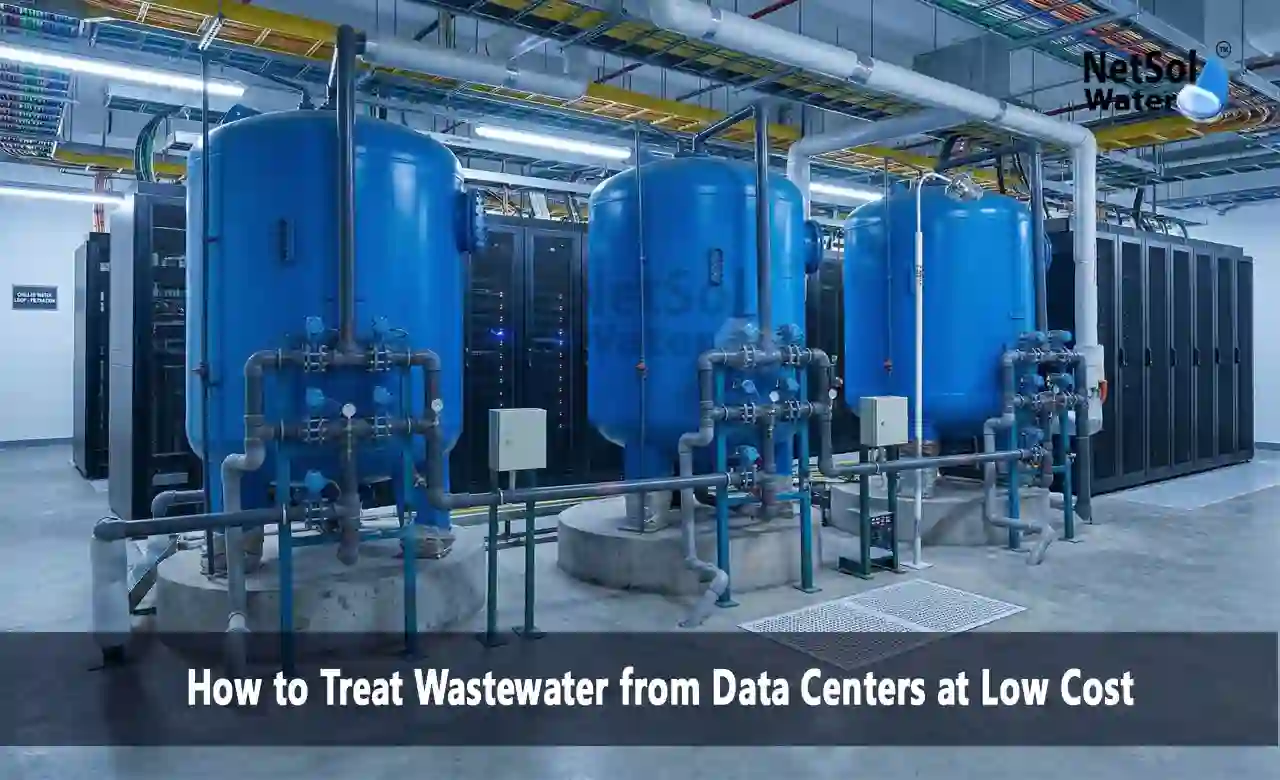
How to Treat Wastewater from Data Centers at Low Cost & Best Accuracy?
Data centers consume enormous water resources throughout every day of their operations. Most of that water passes through cooling towers and chillers and humidification systems until it becomes too contaminated for reuse. At that point, most facilities simply drain it away.
But here is the thing: that water does not have to go to waste. Data centers can reuse their wastewater through proper treatment systems which enable them to treat their used water for recycling purposes. The process achieves three benefits which include diminishing the need for fresh water resources and decreasing operational expenses while maintaining compliance with regulatory requirements.
The page provides details about wastewater treatment methods used in Indian data centers together with their technological components and their ability to transition from traditional drain-and-replace systems into authentic closed-loop water management systems.
First, Understand What You Are Actually Dealing With
You must first identify the components of wastewater before you can accomplish its proper treatment from data centers. Data centers produce different types of wastewater which require specific treatment methods because scientists must first identify its chemical makeup.
The used water coming out of a data center cooling system typically contains:
. High Total Dissolved Solids (TDS) from concentrated mineral salts left behind after evaporation cycles
. Hardness caused by calcium and magnesium buildup
. Silica which creates hard glassy scale deposits that are extremely difficult to remove
. Suspended solids which include dust particles and corrosion debris and biological materials
. Chemical residues which come from corrosion inhibitors and biocides and anti-scalant dosing
. Biological contaminants which include bacteria and Legionella in some cases
. The system contains oil and grease traces which come from mechanical equipment located near cooling systems
The exact composition depends on three things: the quality of your incoming make-up water, how many cycles of concentration you are running, and what chemicals your operations team is dosing into the system. A proper water analysis report before designing any treatment system is not optional. It is the starting point.
The Main Sources of Wastewater Inside a Data Center
Understanding where the water comes from helps you design the right treatment approach for each stream.
1: Cooling Tower Blowdown
The most extensive and essential wastewater discharge from a data center exists as its primary wastewater stream. The system removes concentrated water from the cooling tower to maintain equipment operational stability by preventing mineral and salt accumulation. Facilities with large operations experience blowdown rates that exceed 1000 liters during each hour of operation. The water contains excessive TDS and hardness and silica and chemical additives which require complete treatment before the water can enter reuse operations or safe disposal.
2: Chiller and Heat Exchanger Drainage
Chiller servicing requires flushing operations which produce water that contains both corrosion materials and scale particles and all chemicals that were present in the cooling system. This wastewater stream occurs at specific times but contains substantial waste volume which most facilities fail to recognize.
3: RO Plant Reject Water
Facilities with existing data center RO plants for make-up water treatment must treat the RO system reject stream because it contains concentrated wastewater materials. The water contains high TDS levels which restrict its discharge from multiple locations without first undergoing treatment.
4: Generator Wash Water
Data centers use diesel generators as backup power systems during emergency situations. The generator washing process creates oily wastewater which requires dedicated treatment before it can combine with other wastewater streams.
5: Domestic Wastewater
Data centers employ staff around the clock. The sewage and wastewater generated by employees needs to be treated through a proper Sewage Treatment Plant before it can be reused for any purpose on campus.
Step One: Collect and Segregate Wastewater Streams Properly
The procedure appears simple yet most facilities operate it incorrectly. Different wastewater streams require separate treatment methods because their compositions differ from each other. The treatment process becomes more difficult and expensive when all materials get combined into one tank.
A well-designed data center wastewater management system keeps these streams separate at the source:
. The system collects cooling tower blowdown from a dedicated collection sump
. The system collects RO reject into its own holding tank
. Generator areas send oily wastewater through an oil and grease separator before disposal.
. The system directs domestic sewage to the STP without interruption
After the correct streams have been separated, their individual treatment process requires specific technology which matches their unique attributes. The method achieves higher efficiency because it treats each waste component separately instead of treating all waste as one complex mixture through a single treatment system.
Step Two: Pre-Treatment to Remove Suspended Solids
After collection and segregation, the cooling tower blowdown and other process water streams go through pre-treatment. The goal here is to remove suspended solids, turbidity, and large particles before the water moves into more sensitive treatment systems like RO membranes.
1: Coagulation and Flocculation
The chemical coagulants destabilize suspended particles through their addition to water. The particles form floc when they combine into larger groups. The process serves as the initial step which effectively removes water contamination from turbid water and water that contains excessive suspended solids.
2: Tube Settler Clarifiers
The floc-laden water flows into a clarifier fitted with inclined tube media. The tubes create a greater settling area which enables suspended materials to settle downwards at an accelerated rate. The clear water overflows from the top and moves to the next treatment stage. Workers collect the settled sludge which accumulates at the bottom for disposal.
3: Multi Grade Sand Filtration
The sand filter bed allows water to flow through it which results in the removal of all remaining suspended particles and fine turbidity and colloidal matter. The process cleans the water to prepare it for membrane systems and prevents expensive RO membranes from becoming blocked.
4: Activated Carbon Filtration
The activated carbon filter purifies water by eliminating all remaining organic compounds and chlorine and color. This process becomes essential when makeup water comes from a source that contains chloramines or when the cooling system requires treatment with organic chemical substances.
Step Three: Softening to Remove Hardness
Hard water is one of the biggest enemies of cooling tower systems and RO membranes. Calcium and magnesium dissolved in water form hard scale deposits inside pipes, on heat exchanger surfaces, and on RO membrane elements. Once scale forms, it reduces heat transfer efficiency, increases energy consumption, and eventually causes equipment failure.
1: Ion Exchange Softening
A water softener uses a resin bed to swap calcium and magnesium ions in the water for sodium ions. The result is soft water with negligible hardness. Softened water can be fed directly into the cooling tower or into the RO system without risk of carbonate scaling.
2: Lime Softening
For large volumes of very hard water, lime softening is a cost-effective pre-treatment option. Adding lime raises the pH of the water, causing calcium carbonate and magnesium hydroxide to precipitate out of solution. The precipitated solids are settled and removed before further treatment.
Softening is not always the final step on its own. For water that will go through RO treatment, softening upstream protects the membranes and significantly extends their service life.
Step Four: Reverse Osmosis to Remove Dissolved Salts
This is the core of any serious data center water recycling system. A Reverse Osmosis plant forces water through semi-permeable membranes under pressure, separating clean permeate water from concentrated reject water.
RO treatment removes:
. 95 to 99% of dissolved salts and TDS
. Hardness and silica
. Heavy metals
. Bacteria and viruses
. Residual chemicals and organic compounds
The clean water coming out of the RO system is suitable for reuse as cooling tower make-up water, achieving a very high quality that allows the cooling system to run at higher cycles of concentration with far less blowdown.
The best RO plant manufacturers in India design data center RO systems to handle the specific TDS levels and flow rates of each facility. A system designed for 500 ppm feed water will not perform the same way if the actual feed water is running at 1,500 ppm. Getting the design right from the start saves enormous trouble and cost down the line.
Step Five: Treating the RO Reject Stream
Every RO plant produces a reject stream, which is a concentrated wastewater containing everything the membranes removed from the feed water. In a data center context, this reject stream has very high TDS and cannot simply be discharged to a drain.
1: Recycling RO Reject Back into the Cooling Tower
Depending on the TDS level, a portion of the RO reject can sometimes be blended back into the cooling tower system. This reduces the total volume of water that needs further treatment.
2: Multi Effect Evaporator or Mechanical Vapor Recompression
For facilities pursuing Zero Liquid Discharge, the RO reject goes into an evaporator system that concentrates the dissolved solids further until only a small volume of concentrated brine remains. This brine is then handled as solid waste. The water recovered from the evaporator is clean enough to reuse.
3: Evaporation Ponds
In locations where land is available and climate supports high evaporation rates, concentrated reject water can be directed to lined evaporation ponds. This is a low-cost option for disposing of brine in arid regions.
Step Six: Treating Domestic Wastewater Through an STP
Every data center campus generates sewage from its staff. This cannot be discharged untreated. A Sewage Treatment Plant processes this domestic wastewater through biological treatment stages, removing organic matter, nutrients, and pathogens.
The treated output from a well-designed STP meets standards suitable for:
. Cooling tower make-up water after additional polishing
. Toilet flushing within the campus
. Landscape irrigation
. Dust suppression and road washing
Using STP-treated water for cooling tower make-up is an increasingly popular approach in India because it reduces dependence on municipal water supply significantly. Some large data center campuses in Greater Noida and Pune are already doing this successfully.
Step Seven: Disinfection Before Reuse
Whether the treated water is going back into the cooling tower or being used elsewhere on campus, disinfection is the final quality control step.
1: Chlorination
Adding chlorine to the treated water kills residual bacteria and prevents biological growth inside the cooling system. Chlorine dosing needs to be carefully controlled because too much chlorine can corrode system components.
2: UV Disinfection
Ultraviolet light treatment is a chemical-free way to destroy bacteria and viruses in the treated water. UV systems are compact, easy to maintain, and highly effective for final polishing before reuse.
3: Ozonation
Ozone is a powerful oxidizer that destroys biological contaminants and also breaks down organic compounds. Some large facilities use ozone treatment as part of their cooling water management to control biofilm growth without relying entirely on chemical biocides.
What a Complete Data Center Water Treatment System Looks Like?
Putting all the steps together, a well-designed data center water treatment and recycling system flows like this:
. Cooling tower blowdown collected in a dedicated sump
. Pre-treatment through coagulation, flocculation, and tube settler clarification
. Sand filtration and carbon filtration to polish the water
. Softening to remove hardness before membrane treatment
. RO plant to remove dissolved salts and produce clean permeate
. Treated water stored in a reuse tank and fed back to the cooling tower
. RO reject managed through blending, evaporation, or ZLD depending on volume
. Domestic sewage treated separately through STP and reused for non-potable purposes
. Final disinfection through UV or chlorination before any reuse
This kind of system, when designed correctly, can reduce a data center's net freshwater consumption by 70 to 90% compared to a facility that simply runs on fresh municipal water and drains its blowdown.
Common Mistakes Data Centers Make with Wastewater Treatment
A lot of facilities invest in water treatment equipment but still do not get the results they expect. Here is why:
1: Buying a generic RO plant without proper water analysis
Every city in India has different source water quality. An RO system designed for Delhi's groundwater will not perform the same way in Chennai's municipal supply. Always start with a proper water analysis.
2: Ignoring blowdown treatment
Many data centers install an RO plant for make-up water but do nothing with the blowdown. This means treated water goes into the cooling tower, concentrates up, and then gets drained away. The full water saving benefit only comes when blowdown is also treated and recycled.
3: Not tracking WUE
You cannot manage what you do not measure. Facilities that do not meter their cooling tower water consumption often have no idea how much water they are actually losing. Installing flow meters and tracking WUE monthly is a basic but essential practice.
4: Underestimating silica
Silica scaling is one of the most damaging and difficult-to-reverse problems in cooling water systems. Many facilities focus only on hardness and ignore silica in their incoming water. A good water treatment plant manufacturer will always test for silica and design the system to control it.
5: Skipping maintenance on dosing systems
Chemical dosing pumps and controllers need regular calibration. A dosing system that is drifting out of spec either overdoses chemicals (causing corrosion or environmental issues) or underdoses (causing scale and biological growth). Regular maintenance is not optional.
About NetSol Water
NetSol Water is an ISO certified RO Plant Manufacturer and Supplier serving clients all across India. Based in Greater Noida, NetSol Water designs, manufactures, and installs complete water and wastewater treatment systems for data centers, pharmaceutical companies, manufacturing plants, and large commercial facilities.
For data centers specifically, NetSol Water offers:
. Industrial RO Plants sized for cooling tower make-up water treatment
. Effluent Treatment Plants (ETP) for cooling tower blowdown recycling and reuse
. Sewage Treatment Plants (STP) for campus wastewater treatment and reuse.
. Water Softening Plants to protect cooling systems and RO membranes
. Zero Liquid Discharge (ZLD) Systems for facilities targeting near-zero discharge
. Chemical Dosing Systems for cooling water chemistry management
. Complete turnkey water recycling systems from raw water intake to treated water reuse
NetSol Water does not sell off-the-shelf systems. Every project starts with a detailed water analysis and a proper engineering assessment of the facility's water consumption, discharge requirements, and available space. The system that gets installed is designed specifically for that client's needs.
Our cooling tower wastewater treatment project at Jubilant Biosys Ltd. in Greater Noida is a strong example of what this approach delivers. The installed ETP system achieved over 95% water savings by treating and continuously recycling cooling tower blowdown in a closed loop, eliminating almost all freshwater make-up demand from that stream entirely.
Conclusion:
Treating data center wastewater is not complicated when you work with people who actually understand cooling water chemistry, membrane systems, and the specific water quality challenges of Indian cities.
The difference between a system that performs and one that sits underutilized comes down almost entirely to how well it was designed at the start and how well it is supported after installation.
NetSol Water brings both. With ISO certification, a proven track record across hundreds of industrial installations across India, and a team that understands every stage of the water treatment process, NetSol Water is the partner data center operators need to build a genuinely efficient and compliant water management system.
Reach out to NetSol Water today. Share your facility details, your current water consumption figures, and your discharge situation, and the team will put together a practical, cost-effective treatment plan built specifically for your data center.
Because the smartest data centers in India are not just managing their power and cooling. They are managing their water too.
FAQs
Q1. How do you treat wastewater from data centers?
Use multi-stage treatment including filtration, softening, RO, and STP systems to recycle water.
Q2. Can cooling tower blowdown be reused?
Yes, after proper treatment using ETP and RO systems.
Q3. What is the best technology for data center wastewater treatment?
RO + ZLD is the most effective solution for high recovery.
Q4. What is the cost of wastewater treatment in India?
Depends on capacity, typically ranges from Rs.10 lakhs to Rs.1 crore+.