

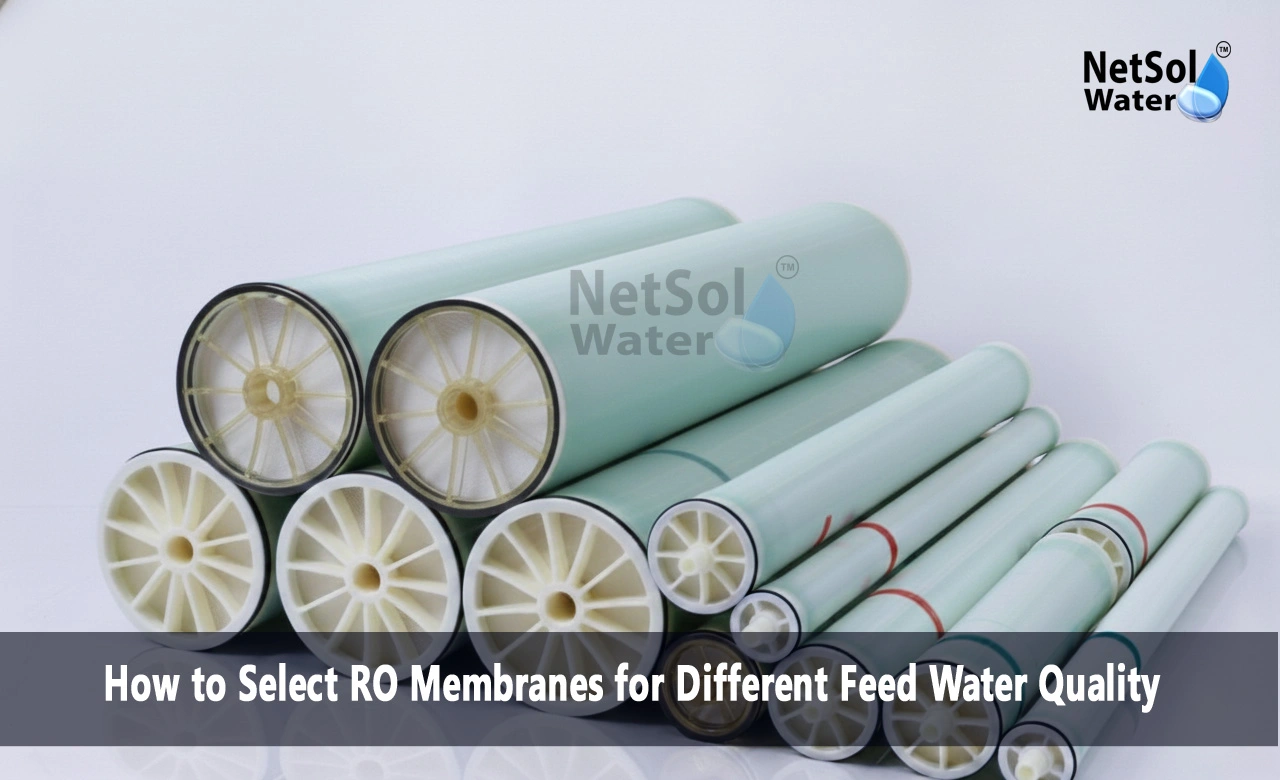
How to Select RO Membranes for Different Feed Water Quality?
The performance of any RO plant, its reliability as well as operating cost all depend on the reverse osmosis membranes. Although membrane selection may be considered as a decision on procurement, it is in fact a process design decision requiring to be consistent with feed water chemistry, operating conditions, and long-run treatment objectives. When the same type of membrane is used in various water sources, it often becomes foul and scales as well as the recovery is not achieved and the membranes also fail too soon.
Several feed water sources perform differently under pressure and the knowledge of these differences is the basis of this choice of membrane. In the absence of such knowledge, even sophisticated RO plants cannot provide high levels of stability.
Concepts of Feed Water Quality Pre-Membrane Selection
It is mandatory to create an overall image of feed water properties before choosing membranes. Membrane behavior is affected by total dissolved solids, hardness, alkalinity, silica, iron, organic load, turbidity, biological activity, temperature and seasonal variations.
Supply water by municipal and borewell, surface water, industrial effluent and treated wastewater cause extremely different chemical and physical loads to RO membranes. A membrane that is designed to absorb low-salinity municipal water can be seriously damaged quickly in a environment that is rich in TDS groundwater or organic contaminant reuse water. The comprehension of these differences enables the membrane selection to be active as opposed to reactive.
Select RO Membranes for Different Feed Water Quality
1: Low TSS and Municipal Water Selection
In the case of low TDS water, the major consideration is the energy efficiency. Low-pressure membranes are more appropriate in such applications because they provide a greater permeate flow with low operating pressure. These membranes reduce power usage and at the same time, they provide reasonable salt rejection. Nevertheless, the presence of other disinfectants and the ability to eliminate chlorine in the upstream is vital.
2: High TDS Groundwater: Selection
Water in high TDS borewells has to be treated with membranes capable of withstanding high operating pressure without structural damage. In these situations, high-rejection membranes that are of high mechanical integrity are safer to use. As hardness, silica and iron are common in ground water, membrane selection should also be done based on fouling tolerance and compatibility with antiscalant programs.
3: Scaling-Prone Water Selection
In highly hard water or sulfate water, a middle-range flux and constant rejection membrane is better than a very high-flux membrane. High-flux membranes enhance the concentration polarization that enhances the scale formation. The use of membranes with a flux and foul resistance ratio that gives stability in the long term.
4: Surface Water and High Organic Load Selection
Organic substances and living organisms dissolve in surface water and reuse water and pose a risk of fouling. A better choice of membranes suitable in these applications is low-fouling membranes with modified surface properties. Such membranes are resistant to organic adsorption, biogenesis, which decreases cleaning rate and protects performance over time.
5: Selections to Industrial Effluent and Reuse Applications
Industrial effluent has complex problems, which include fluctuating pH, solvents, oils, and chemical residues. The membranes used in such purposes should be able to withstand harsh cleaners, broad-pH, and varying feed water quality. Maximum permeability will not be as important as chemical compatibility and cleaning durability.
Errors to avoid in RO Membrane Selection
Among the most frequent errors, one can single out the choice of membranes which is made only depending on the flow capacity without the consideration of feed water chemistry. The other common mistake is the selection of the high-flux membranes in the scaling-prone or fouling prone water that mostly causes the deterioration of the performance.
Failure to consider temperature effects, pressure variations and cleaning needs also lead to reduced life time of the membranes. The reason behind failure of many systems is that membrane selection is not linked with pretreatment design, thus creating unrealistic expectations on the membranes.
Conclusion
Selecting RO membranes for different feed water quality requires a deep understanding of water chemistry, operating conditions, and long-term performance expectations. No single membrane can be considered as the best in all applications. Membranes that are energy efficient are applicable to low TDS water whereas high TDS, industrial, or reuse situations require a membrane design that is mechanically robust and resistant to fouling.
RO plant can provide stable recovery, reduce the cost of operation, and increase membrane life when membrane selection is operatedin accordance with the characteristics of the feed water and pretreatment strategy. Mindfulmembrane selection is no extra expense but an important investment in system stability and longevity.