

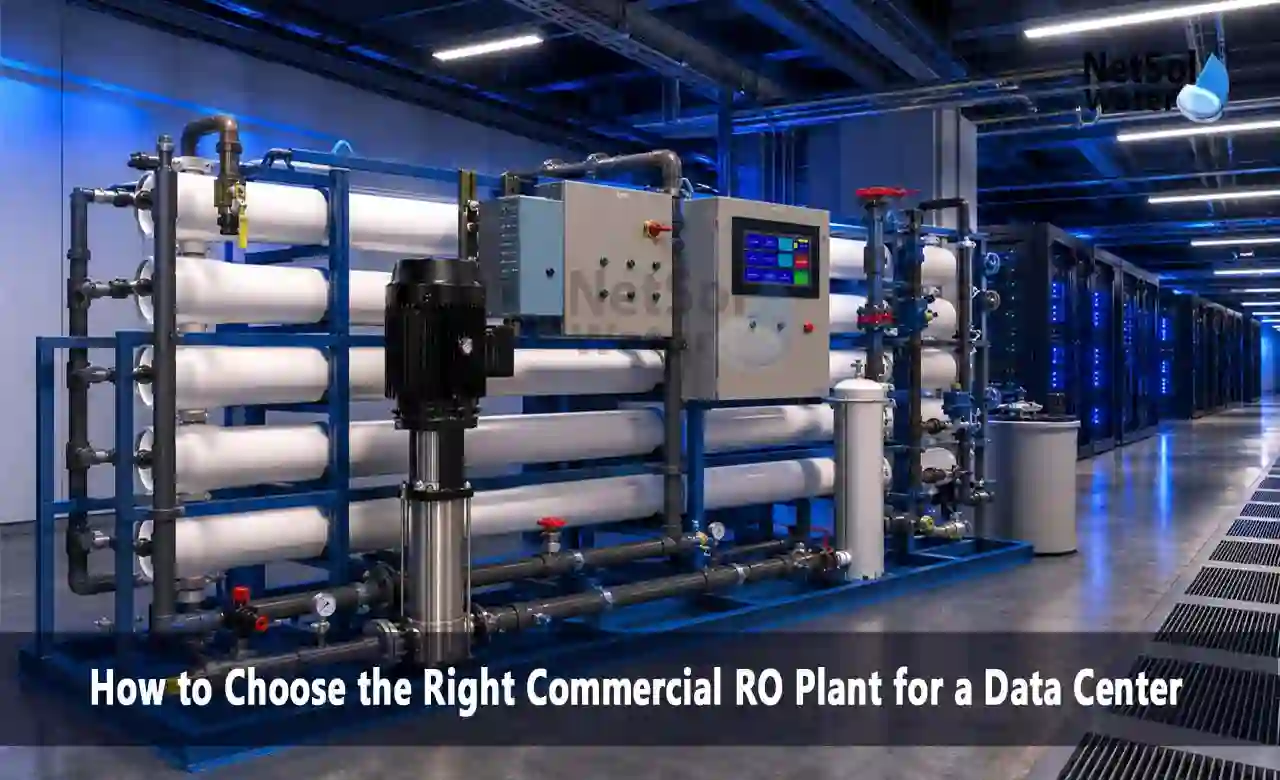
How to Choose the Right Commercial RO Plant for a Data Center?
Data centers lean on two resources most folks never really connect: power and water. Every server makes heat while it runs, and that heat kind of has to get out of the building. The cooling systems do the moving part, but they cannot do that job unless there is a constant, clean water supply, with water pure enough so it does not harm the very equipment it is supposed to shield.
This is where Reverse Osmosis shows up. Raw water brings along dissolved minerals, silica and bits of organic matter. If you leave it as is these things can slowly pile up inside cooling towers and chillers too. That buildup is known as scaling and fouling and it reduces the heat exchange efficiency so the cooling system ends up working harder than it should. A RO plant gets rid of the impurities before the water even reaches your cooling equipment.
A data center is not a normal commercial water customer. It needs a plant built for continuous, high stakes operation, because a cooling failure here is not just a repair bill. It risks equipment damage and outages that hit every client relying on that facility. Picking the right RO plant is a reliability decision first, and a water treatment decision second.
This guide covers what actually goes into that decision, sizing, pre treatment, cost, and long term maintenance, so you are working from facts instead of a vendor's pitch.
Why Is RO Plant Important for Data Center Operations?
. The Cooling Water Quality Problem
Data centers run on tight temperature control. Servers throw off heat constantly, and even a brief dip in cooling performance can push equipment past safe limits. Cooling towers, chillers and CRAC units all depend on water, and the quality of that water decides how well these systems hold up over time.
Poorly treated water carries dissolved solids, calcium, magnesium, and silica into the cooling loop. None of this passes through harmlessly. It settles on heat exchange surfaces, inside pipes and across cooling tower fill media. Over months, that buildup weakens the system's ability to move heat, so the cooling system has to run longer and harder to hit the same target temperature. That means higher power bills and higher long term costs.
. Reliability And Compliance Stakes
A RO plant strips out most of these dissolved impurities before water reaches the cooling loop. That keeps heat exchange surfaces clean, cuts down unscheduled maintenance, and stretches the working life of cooling infrastructure that is not cheap to replace. In a facility where every minute of downtime has a dollar figure attached, this is basic infrastructure planning, not a nice to have.
There is a compliance side too. Several jurisdictions now expect large water users, data centers included, to show responsible use and discharge practices. A RO system built for water reuse helps meet that expectation while cutting reliance on municipal and groundwater sources that are already under pressure in large parts of India.
Can RO-Treated Water Be Used for Cooling Towers in Data Centers?
Yes. In most current data center designs, RO-treated water is the default for cooling tower makeup water, not an optional extra. Cooling towers cool water by evaporating part of it, and whatever dissolved solids were in that water stay behind and concentrate in what remains. This is called the cycles of concentration, and it sets how much scaling risk the tower carries.
Water with high mineral content hits risky concentration levels fast, forcing more frequent blowdown, draining out concentrated water on purpose to keep minerals in check. That wastes water and pushes up fresh water demand. RO treated water starts with much lower dissolved solids, so the tower can run through more cycles before blowdown is needed. Less fresh water in, less wastewater out, both of which matter if you are watching water costs or sustainability numbers.
. The Corrosion Tradeoff To Watch For
RO-treated water also cuts the risk of biological growth and corrosion in the loop, since treatment removes many of the nutrients bacteria need to grow. That reduces how much you need to lean on chemical dosing for biocide and corrosion control.
One catch worth knowing: RO water has very low mineral content, and that can actually make it more corrosive to certain metals if it is not balanced correctly. This is why a real cooling water treatment plan pairs RO treatment with corrosion inhibitor dosing. RO alone is not the whole solution.
How Much Water Does Data Center Consume Every Day?
There really isn’t one single number here. Water use swings a lot, it depends on facility size, the cooling approach, the climate, and even how heavy the IT load is running. A small edge facility might end up using almost the same amount as a mid sized commercial building. Meanwhile a large hyperscale campus can start pulling water volumes that are nearer to what a small town uses, especially if evaporative cooling towers are doing most of the heavy lifting.
And honestly, the cooling technology is what drives most of the difference. Evaporative cooling towers typically consume far more water than air cooled chillers or more recent liquid cooling setups. Still, those alternatives usually cost more in electricity because you’re making up for the lower water draw. So that water versus power tradeoff is this active design question across the industry right now, and it only keeps getting more spotlight as water scarcity worsens in more regions, wherever possible.
Climate matters just as much. Hot, dry locations lose more water to evaporation and need more frequent makeup water than cooler, humid ones running an identical cooling load.
Given how many variables are in play, any real number for a specific data center has to come from that facility's actual IT load, cooling technology, and local climate, not an industry average that may not apply to it at all.
How Do You Calculate the Required RO Plant Capacity for Data Center?
Sizing a RO plant incorrectly is one of the most expensive mistakes a data center operator can make. An undersized plant cannot keep up with cooling demand during peak load, forcing the facility to draw more untreated water or risk cooling shortfalls. An oversized plant wastes capital and increases operating costs without any real benefit.
| Data Center IT Load | Typical Daily Water Requirement | Recommended RO Plant Capacity | Suitable For |
|---|---|---|---|
| Up to 0.5 MW | 5,000–20,000 L/day | 500–1,000 LPH | Small edge data centers |
| 0.5–1 MW | 20,000–50,000 L/day | 1,000–2,000 LPH | Small commercial facilities |
| 1–2 MW | 50,000–100,000 L/day | 2,000–5,000 LPH | Mid-sized data centers |
| 2–5 MW | 100,000–250,000 L/day | 5,000–10,000 LPH | Enterprise data centers |
| 5–10 MW | 250,000–600,000 L/day | 10,000–20,000 LPH | Large hyperscale facilities |
| Above 10 MW | 600,000+ L/day | 20,000+ LPH (or multiple RO skids) | Hyperscale & colocation campuses |
Example: A 5 MW data center with water-cooled chillers may require a RO plant of around 10,000–15,000 LPH, depending on the feedwater quality, cooling tower cycles of concentration, and desired recovery rate. This is why manufacturers typically perform a water audit before recommending the final plant capacity.
Capacity planning starts with understanding total water demand across the facility, not just the cooling towers. This includes makeup water for cooling towers to replace water lost to evaporation and blowdown, humidification systems if used, and any process water needs specific to the facility. Each of these draws water at a different rate and pattern throughout the day.
The next factor is IT load, measured in megawatts, since cooling demand scales directly with the amount of heat the servers generate. A facility running at higher rack density needs proportionally more cooling capacity, and therefore more treated water, than a facility with the same footprint running lower density workloads.
Climate also plays a real role. Facilities in hotter, drier regions lose more water to evaporation in cooling towers and need higher makeup water volumes than facilities in cooler climates. This means two data centers with identical IT loads in different parts of India can have meaningfully different RO plant capacity requirements.
Can RO-Treated Water Be Used for Cooling Towers in Data Centers?
Yes. In most current data center designs, RO treated water is the default choice for cooling tower makeup water, not an extra add on. Cooling towers cool water by evaporating part of it, and whatever dissolved solids were in that water stay behind and build up in what remains. This buildup is called the cycle of concentration, and it sets how much scaling risk the tower carries.
Water with high mineral content hits risky concentration levels fast. That forces more frequent blowdown, draining out concentrated water on purpose to stop mineral buildup. Blowdown wastes water and drives up fresh water demand. RO treated water starts with much lower dissolved solids, so the tower can run through more cycles before blowdown is needed at all. Less fresh water in, less wastewater out, both of which matter if you are tracking water costs or sustainability targets.
. Biological Growth And Corrosion Control
RO treated water also cuts the risk of biological growth and corrosion in the loop, since treatment strips out many of the nutrients bacteria rely on to grow. That means less dependence on chemical dosing for biocide and corrosion control, which lowers running costs further.
One catch worth flagging: RO water carries very low mineral content, and that can make it more corrosive to certain metal parts if it is not balanced correctly. This is why a real cooling water treatment plan pairs RO treatment with corrosion inhibitor dosing. RO treatment on its own is not a complete solution.
What Pre-Treatment Is Required Before RO Plant in Data Center?
RO membranes work well, but they are also delicate. Push raw, untreated water straight into a RO system and you get fast membrane fouling, weaker performance, and a shorter membrane life. That is why pre-treatment is not nice to have. It is a core part of any properly built RO system for data center use.
. The Standard Pre Treatment Stages
The exact stages needed depend on your raw water source, but most data center RO systems run through these layers:
. Multimedia or sediment filtration, to sort of strip out suspended solids before the finer filtration steps kick in
. Activated carbon filtration too, to pull out chlorine and organic compounds that would otherwise start messing up RO membranes
. Water softening or antiscalant dosing, to manage hardness minerals that lead to membrane scaling in the first place
. Micron cartridge filtration as a last check, right before the RO unit, just before it
. pH adjustment, where the raw water chemistry sits outside the range the membranes need to perform well
. What Happens When You Skip A Stage
Skipping or undersizing any of these stages is one of the most common reasons RO plants underperform once they’re installed. A manufacturer who quotes a system without a pre treatment plan that fits your specific water source is kinda cutting a corner, and you will pay for that later, through quicker membrane replacement and more downtime
How Does RO Plant Improve Cooling System Efficiency?
The connection between water quality and cooling efficiency is straightforward, and you can measure it. Every layer of mineral scale on a heat exchange surface behaves like insulation, so heat can’t move properly from the cooling water to the air or refrigerant on the other side. Even a scale layer that is only a fraction of a millimeter thick can reduce heat transfer performance in a noticeable way
When scaling starts reducing cooling efficiency, the system compensates by pushing pumps and fans harder just to reach the same temperature targets. That raises electricity consumption, and that’s already one of the biggest cost lines in most data centers. If it’s left alone long enough, operators may end up running cooling systems with smaller capacity margins, and that increases the risk of thermal events during peak load.
RO treated water removes this problem largely at the source. With far less dissolved mineral content going into the cooling loop, heat exchange surfaces stay clean longer, pumps and fans do not have to work around lost efficiency, and the whole cooling system runs closer to what it was actually designed to do. That shows up as real energy savings over the system's life, plus fewer unplanned maintenance calls caused by fouled equipment.
There is a second benefit worth noting. Cleaner water means less frequent, less intense chemical cleaning for cooling towers and chillers, which cuts maintenance downtime and reduces the chemical load hitting the facility's wastewater stream.
What Factors Should You Consider Before Choosing RO Plant for Data Center?
Selecting a RO plant for data center involves more variables than most facility managers expect going in. Here are the factors that genuinely matter.
. Raw water quality, since your specific water source determines pre treatment needs, membrane selection, and overall system design
. Plant capacity, sized around actual cooling demand, current IT load, and projected growth rather than a rough estimate
. Recovery rate, meaning how much of the input water actually becomes usable treated water versus reject water, which affects both efficiency and reject water disposal planning
. Water reuse requirements, if the facility plans to recycle reject water or treated water for non critical uses like landscaping or flushing
. Automation and monitoring, since data centers benefit heavily from remote monitoring systems that catch water quality deviations before they affect cooling performance
. Energy efficiency, since RO systems consume significant power running high pressure pumps, and efficient pump and membrane selection reduces long term operating cost
. Available installation space, particularly in facilities where mechanical rooms are already tightly packed with cooling infrastructure
. Future expansion, meaning the plant should support capacity increases without requiring a full system replacement
. Operation and maintenance, including how much in house involvement is needed versus vendor-supported servicing
What Factors Affect the Cost of RO Plant for Data Center?
. Capacity And Water Quality Drive The Base Cost
Cost depends on several interacting variables. Comparing quotes without understanding these factors leads to poor decisions.
Plant capacity is the largest single driver, since larger systems need more membranes, larger pumps, and bigger pressure vessels. Raw water quality also affects cost directly, because poor quality source water requires more extensive pre-treatment, which adds equipment and increases the footprint of the system.
. Recovery Rate And Automation Add To The Price
The chosen recovery rate affects cost too. Higher recovery systems, which extract more usable water from the same input volume, often require additional stages like a secondary RO pass or specialized membrane configurations. This raises upfront cost but can reduce ongoing fresh water expenses.
Automation level is another factor. Fully automated systems with remote monitoring, automatic chemical dosing, and integrated alarm systems cost more upfront than manually operated plants. They reduce labor costs and catch problems earlier, which often justifies the investment where cooling reliability is critical.
. Installation Complexity Is Often Underestimated
Installation complexity matters too. A data center with limited mechanical space, existing infrastructure to work around, or specific seismic or structural requirements will see higher installation costs than a straightforward new build with ample space.
Because of these variables, a genuine quote should always come after a proper site assessment and water testing, not from a standard rate card applied across different facilities.
How Often Should RO Membranes Be Replaced in Data Center Applications?
. The Typical Replacement Range
Membrane life depends on feed water quality, how well the pre treatment system performs, and how consistently the plant is maintained. As a general industry range, RO membranes in commercial and industrial applications typically last three to five years under proper operating conditions. This varies significantly by site.
. What Shortens Or Extends Membrane Life
Facilities with harder or more contaminated raw water, or poorly maintained pre treatment systems, often see membrane life fall well short of this range. Facilities with clean municipal water and a properly designed pre treatment stage can sometimes extend it beyond the typical range.
. Why Monitoring Matters More Than A Fixed Schedule
Regular monitoring, not a fixed calendar, is what actually determines replacement timing in practice. Key indicators include declining permeate flow, rising differential pressure across the membrane, and reduced salt rejection performance. A well monitored system flags these trends early, allowing planned replacement instead of a reactive emergency swap. This is why automated monitoring is worth the added upfront cost in data center applications, where an unplanned cooling disruption costs far more than in most other commercial settings.
Why Do Hyperscale Data Centers Prefer Commercial RO Plants?
Hyperscale data centers operate at a scale that makes commercial grade RO systems impractical. These facilities often run cooling loads that would overwhelm a standard commercial plant, both in terms of raw capacity and the consistency demanded from the system around the clock.
Commercial RO plants are engineered for continuous, high volume operation with a level of redundancy that commercial systems typically do not offer. This often includes parallel treatment trains, so if one unit needs maintenance or unexpectedly fails, the facility does not lose treatment capacity entirely. For a hyperscale operator, this redundancy is not a luxury feature. It is a baseline requirement, because the financial and reputational cost of a cooling failure at that scale is severe.
Industrial systems also tend to integrate more deeply with a facility's broader building management and monitoring infrastructure, giving operations teams a single view of water treatment performance alongside power and cooling metrics. This level of integration supports the kind of predictive maintenance approach that hyperscale operators rely on to hit their uptime targets.
Finally, Commercial RO plants are built with modular expansion in mind from the start, which matters enormously for hyperscale facilities that frequently add capacity in phases as demand grows. Building this flexibility in from day one avoids the costly retrofits that come with scaling up an undersized commercial system.
How Does Commercial RO Plant Reduce Scaling and Fouling in Cooling Systems?
Scaling and fouling are two separate problems, but a well built industrial RO plant tackles both at once.
Scaling happens when dissolved minerals, mostly calcium and magnesium compounds, drop out of solution and stick to surfaces as water concentrates through evaporation in a cooling tower. Commercial RO plants cut this risk at the source, stripping out most of these minerals before the water ever reaches the cooling loop. That lets the water run through more concentration cycles before scaling becomes a real threat, which means less frequent blowdown.
Fouling is different. It is the buildup of organic matter, biological growth, and particulate debris on system surfaces. Commercial RO plants deal with this through pre treatment, mainly multimedia filtration and activated carbon filtration, which pull organic material and particulates out before they reach the treated water stream. Lower organic content also starves out the biological growth that would otherwise take hold in the cooling loop.
Beyond the treatment stages themselves, commercial RO plants usually run automated clean in place systems that flush and clean membranes on a schedule, without shutting the whole system down. That keeps the treatment plant performing at its peak, which keeps water quality going into the cooling loop steady over time, instead of slowly degrading as membranes foul.
How Much Water Does Data Center Consume Every Day?
There is no single number here, water use swings hugely by facility size, cooling technology, climate, and IT load. A small edge facility might use about as much as a mid sized commercial building. A large hyperscale campus can pull volumes closer to what a small town uses, especially where evaporative cooling towers carry most of the load.
| Data Center Size | Typical IT Load | Estimated Daily Water Consumption | Typical Cooling Method |
|---|---|---|---|
| Small Edge Data Center | Up to 0.5 MW | 5,000–20,000 litres/day | Air-cooled or hybrid cooling |
| Small Enterprise Data Center | 0.5–1 MW | 20,000–50,000 litres/day | Hybrid cooling or cooling towers |
| Medium Data Center | 1–5 MW | 50,000–250,000 litres/day | Evaporative cooling towers |
| Large Enterprise Data Center | 5–10 MW | 250,000–600,000 litres/day | Water-cooled chillers & cooling towers |
| Hyperscale Data Center | 10–50 MW | 600,000–3,000,000+ litres/day | Large-scale evaporative cooling systems |
Cooling technology drives most of that spread. Evaporative cooling towers use far more water than air cooled chillers or newer liquid cooling setups, though those alternatives usually cost more in electricity to make up for lower water draw. This water versus energy tradeoff is a live design question across the industry, and it is getting more attention as water scarcity worsens in more regions.
Climate matters just as much. Hot, dry locations lose more water to evaporation and need more frequent makeup water than cooler, humid ones running the exact same cooling load.
How Can You Choose the Right Commercial RO Plant Manufacturer and Supplier for Your Data Center?
Picking the right commercial RO plant manufacturer comes down to a few concrete checks, not a gut feeling about who sounded most confident on a sales call.
Start by confirming real experience with critical infrastructure projects, not just general commercial or residential RO systems. Data center cooling water treatment carries different reliability demands than a hotel or office building, and a manufacturer without that specific background is more likely to underestimate redundancy and monitoring needs.
Check whether the manufacturer insists on a proper water audit and site assessment before quoting capacity and cost. A vendor willing to size a plant without testing your actual water source is not engineering a solution, they are guessing at one.
Look closely at how they handle automation and monitoring. Given what a cooling failure costs a data center, a manufacturer who defaults to manual, low visibility systems instead of proposing real time monitoring and alerting is not thinking about your operational risk the way they should.
Finally, verify manufacturing certification and ask directly about after sales support, service call response times, and spare parts availability.
Why NetSol Water Is Built For Data Center RO Projects?
Most commercial RO manufacturers in India built their playbook around hotels, factories and residential complexes, businesses where a plant hiccup is inconvenient, not catastrophic. Data centers are a different category of client entirely, and treating them like a standard commercial account is exactly how facilities end up with undersized capacity, weak monitoring, and no real redundancy plan.
Netsol Water approaches every data center project as a critical infrastructure job, not a standard RO sale. That starts with water testing and a proper site assessment before any capacity number gets quoted, because a number without that data is a guess, not an engineering decision. From there, our team works through pre treatment design, membrane selection, and recovery rate planning specifically around your cooling system's scaling and fouling risk, not a generic template pulled from an unrelated project.
As an ISO certified 9001:2015 RO Plant Manufacturer and Supplier operating across India, we back this with manufacturing consistency you can actually verify, and with after sales support built for facilities that cannot afford slow response times.
Conclusion
Picking a RO plant for data center is not a decision you make on price alone. It takes understanding your actual water source, sizing capacity around real cooling demand and future growth and choosing pre-treatment and technology that match the specific scaling and fouling risks your facility faces. Get this right, and you protect both your cooling infrastructure and your operating budget for years. Get it wrong, and you end up retrofitting a system that should have been designed correctly from the start, usually at a much higher cost and with real operational risk while you fix it.
The technical depth here means the manufacturer matters as much as the spec sheet. A partner who asks the right questions about your water, your cooling system, and your growth plans before quoting a price is fundamentally different.
If you are planning or upgrading an RO system for data center, bring us your water data and your cooling system specs. We will size a plant around what your facility actually needs, not around a standard package that was never built with your risk profile in mind.
FAQs
Q1. What is the lifespan of RO plant in data center?
The core plant infrastructure, including pumps, vessels, and control systems, typically runs for well over a decade with proper maintenance. Membranes, the component that wears fastest, generally need replacement every three to five years depending on feed water quality and how well the pre-treatment system is maintained.
Q2. Can RO reject water be reused in data center?
Yes, in many cases. Reject water, sometimes called concentrate, still has lower contamination than raw source water in some applications and can be directed toward non critical uses like landscaping, flushing, or further treatment for other purposes. Whether this makes sense depends on the specific concentration of the reject stream and local discharge or reuse regulations.
Q3. Which RO membrane is best for data center applications?
There is no single best membrane across all data centers, since the right choice depends on raw water chemistry, required recovery rate, and cooling system water quality targets. A manufacturer should recommend membrane type based on your specific water testing results rather than a default selection applied to every project.
Q4. How much electricity does RO plant consume?
Electricity use depends primarily on system capacity and the pressure required to push water through the membranes, which itself depends on feed water salinity. Larger, high pressure systems draw more power than smaller ones, and this should be factored into your facility's total energy budget during planning, since RO plants run continuously in most data center applications.
Q5. How long does it take to install RO plant in data center?
Installation timelines vary based on plant capacity, site readiness, and how much civil or electrical work is needed alongside the treatment system itself. Smaller commercial scale systems can often be installed and commissioned within a few weeks, while larger industrial systems with extensive pre treatment and integration requirements typically take longer, sometimes spanning a few months from order to full commissioning.