

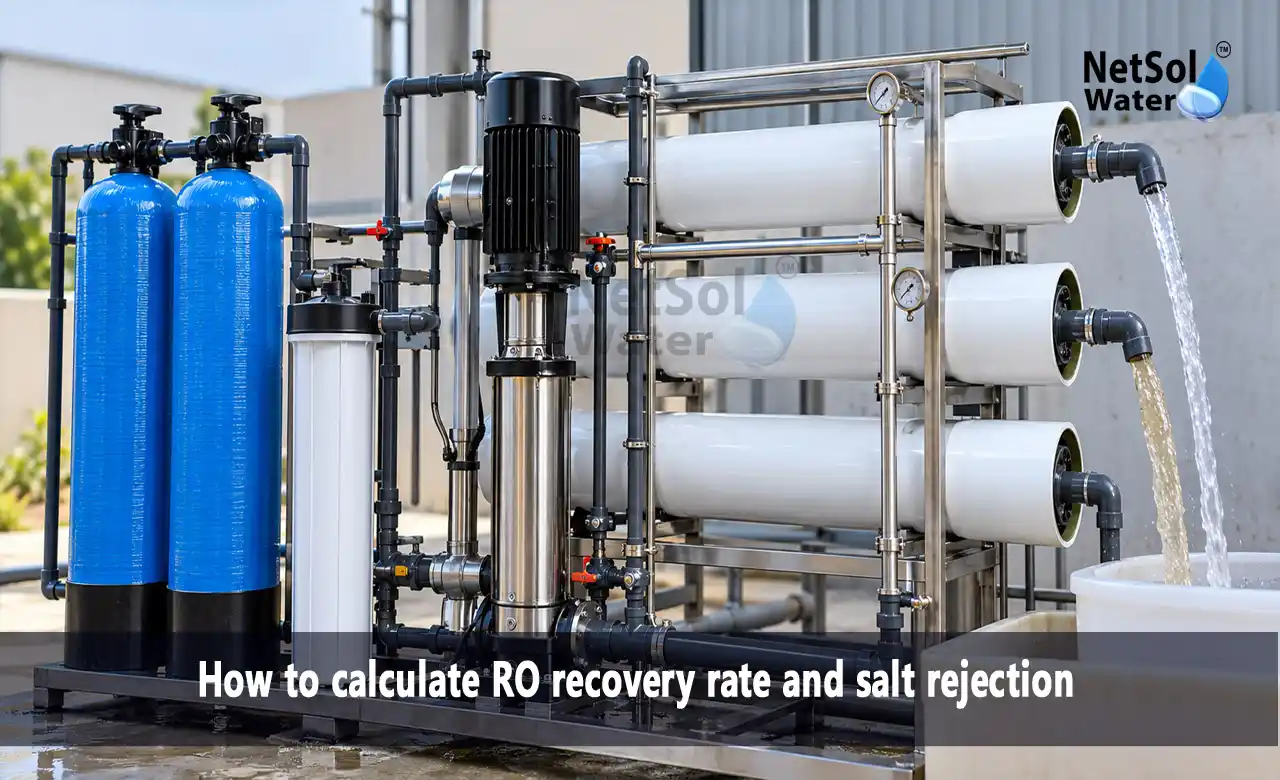
How to calculate RO recovery rate and salt rejection?
Two numbers tell you most of what you need to know about an RO plant: recovery rate and salt rejection. Recovery shows how much of your feed water turns into usable product water. Salt rejection shows how well the membrane holds back dissolved salts.
You need a flow meter and a TDS meter, and about 5 minutes. Log both numbers every week and a slow decline usually shows up early.
What RO recovery rate means?
Recovery rate is the share of feed water that comes out as permeate, which is the treated water. The rest leaves as concentrate (also called reject) and carries away the salts the membrane held back.
Higher recovery wastes less water. Push it past the plant's design limit and salts build up on the membrane surface, which raises the risk of scaling and fouling. So the right target depends on your feed water quality and how the system was designed.
RO recovery rate formula
Recovery rate (%) = (Permeate flow ÷ Feed flow) × 100
Measure both flows at the same time and in the same units, like litres per hour or cubic metres per day.
Feed water splits into permeate and concentrate, so you can also use this version when you have the permeate and reject readings:
Recovery rate (%) = Permeate flow ÷ (Permeate flow + Concentrate flow) × 100
Recovery rate example
Say 500 litres of feed water enter the plant each hour and you collect 350 litres of permeate.
350 ÷ 500 = 0.7. Multiply by 100 and the recovery rate is 70%. The other 150 litres an hour (30%) leave as concentrate.
Now compare 70% with the recovery in your plant's design sheet. Brackish water plants commonly run at roughly 50 to 75%, and seawater plants lower, often 35 to 50%. Your datasheet is the number that counts. If the reading has drifted, check the flow meters, feed pressure and last cleaning date.
What salt rejection means?
Salt rejection is the percentage of dissolved salts the membrane keeps out of the permeate. You measure it with TDS (in ppm or mg/L) or with conductivity (in µS/cm) if that's what your meter reads.
Take the feed and permeate readings at the same time, in the same units. Conductivity changes with temperature, so note it down too.
Salt rejection formula
Salt rejection (%) = ((Feed TDS - Permeate TDS) ÷ Feed TDS) × 100
The flip side is salt passage, the share of salts that gets through:
Salt passage (%) = 100 - Salt rejection (%)
Salt rejection example
Feed water reads 1,000 ppm TDS and the permeate reads 50 ppm.
1,000 - 50 = 950. Divide 950 by 1,000 to get 0.95, then multiply by 100. Salt rejection is 95%, and salt passage is 5%.
A 95% result doesn't mean 95% of every contaminant is gone. TDS only counts dissolved salts. Test the treated water against the standard for its end use, whether that's drinking water, boiler feed or process water.
Also compare your result with the membrane's rated rejection. Many new brackish water membranes are rated at 99% or higher, so a plant sitting at 95% may be showing wear or fouling.
What to do when the numbers move?
1. Permeate flow drops and rejection holds steady: look for fouling or scaling, and check the pressure drop across the membranes.
2. Rejection falls and permeate TDS rises: look for membrane damage, chlorine exposure or a leaking seal.
3. Both numbers look odd: calibrate the flow meters and TDS meter before touching any setting.
Write down the date, feed pressure, temperature, flows and TDS every time. Compare each new set with the readings from commissioning. A trend tells you far more than a single day.
Talk to Netsol Water
Netsol Water is a Greater Noida based water and wastewater treatment company that builds commercial and industrial RO systems. You can see our work as industrial RO plant manufacturers in Delhi and commercial RO plant manufacturers in Noida.
Send us your feed water details and we'll help you work out the right recovery target and the right plant for your site.
Phone: +91-9650608473, Email: enquiry@netsolwater.com