

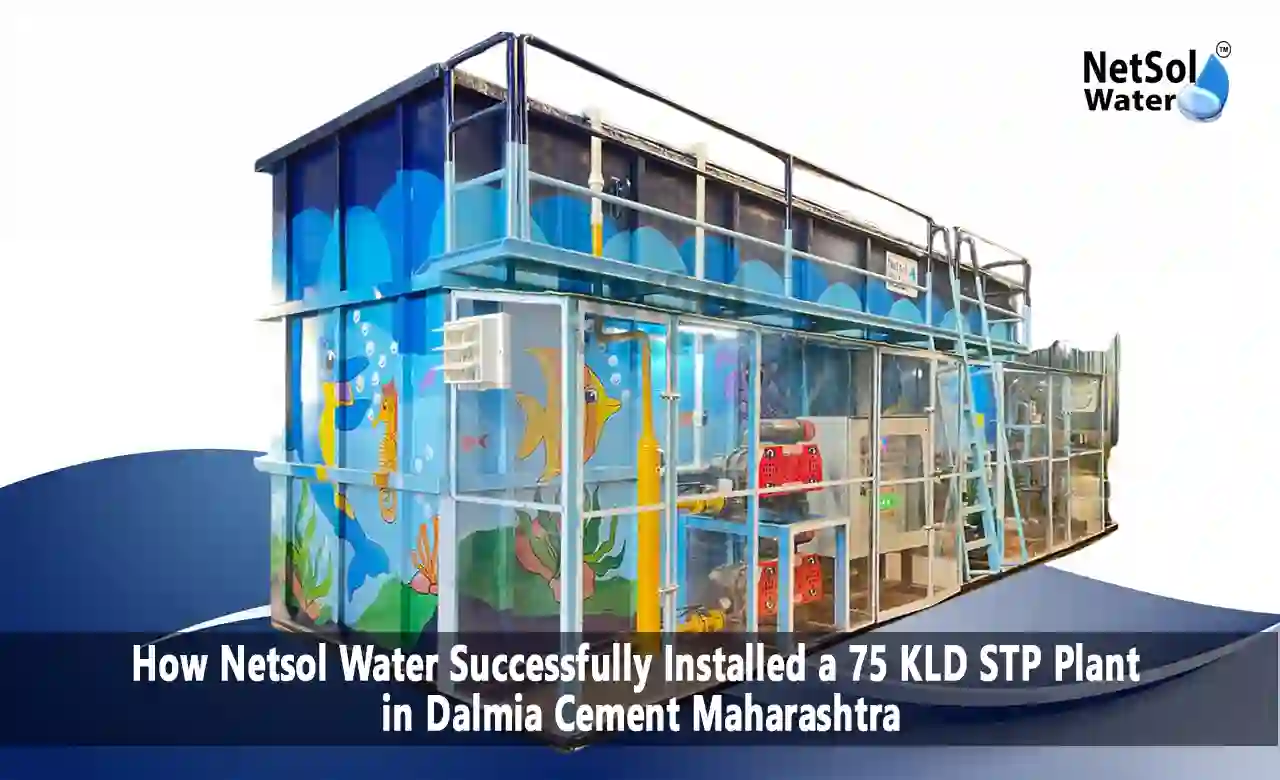
Case Study: 75 KLD STP Plant Installation in Dalmia Cement
Netsol Water successfully designed, supplied and commissioned a 75 KLD Sewage Treatment Plant (STP) at the Dalmia Cement facility in Maharashtra - delivering a fully compliant, high-efficiency wastewater management system tailored to the unique demands of a heavy-industry environment.
This project is a clear example of what a 75 KLD STP Plant Installation in Maharashtra looks like when executed by an experienced manufacturer. The plant treats domestic sewage generated from workforce housing, administrative buildings, and canteen facilities within the cement plant premises - ensuring zero untreated discharge into the surrounding environment.
In a region where the Maharashtra Pollution Control Board (MPCB) is actively tightening discharge norms for large industrial establishments, Dalmia Cement needed more than a standard solution. They needed a reliable, low-maintenance, and CPCB-compliant system. That is precisely what Netsol Water delivered.
Client Background: Dalmia Cement, Maharashtra
Dalmia Cement is a flagship business unit of Dalmia Bharat Limited, one of India's largest and most trusted cement manufacturing conglomerates. With a strong pan-India footprint, Dalmia Cement has consistently demonstrated commitment to sustainable manufacturing, green building initiatives, and responsible environmental stewardship.
The Maharashtra facility houses a significant workforce - including on-site labourers, engineering staff, and administrative personnel - generating a daily sewage load that required proper collection, treatment, and disposal or reuse. Given the scale and the regulatory environment, the facility needed a technically robust and long-term wastewater solution.
Dalmia Cement approached Netsol Water as a preferred Sewage Treatment Plant Manufacturer in Maharashtra, based on the company's proven track record in industrial wastewater treatment across the cement, steel, and power sectors.
Problem Statement:
The facility was generating approximately 75,000 litres of domestic sewage per day - with no adequate treatment infrastructure in place.
Without a functional STP, the facility faced multiple compounding challenges:
• Regulatory Non-Compliance: The MPCB had issued directives requiring all large industrial establishments to install functional STPs and demonstrate treated effluent quality meeting CPCB General Standards.
• Groundwater Contamination Risk: Raw sewage was being held in temporary soak pits, risking seepage into soil and contamination of local groundwater.
• High BOD/COD Load: Incoming sewage showed BOD levels of 250–350 mg/L and COD levels between 400–550 mg/L - far exceeding acceptable discharge limits.
• TSS (Total Suspended Solids) in raw sewage measured approximately 200–280 mg/L.
• No Water Reuse Infrastructure: The plant was missing an opportunity to recover treated water for gardening, dust suppression, and toilet flushing.
The situation called for an Industrial STP Plant for the Cement Industry that could handle variable daily loads, integrate with existing infrastructure, and produce reuse-quality effluent.
Project Objectives
The project was defined by four core engineering and compliance goals:
1. Treat 75,000 litres (75 KLD) of domestic sewage per day to meet CPCB/MPCB discharge norms.
2. Achieve treated water quality with BOD < 10 mg/L, COD < 50 mg/L, and TSS < 10 mg/L.
3. Enable 100% water reuse of treated effluent within plant premises.
4. Deliver a low-energy, low-maintenance system suited for long-term industrial operation with minimal skilled manpower requirements.
Solution Provided by Netsol Water
Netsol Water designed and installed a 75 KLD MBBR (Moving Bed Biofilm Reactor)-based STP - a technology proven for high organic load removal in industrial settings.
After a thorough site assessment, Netsol Water's engineering team proposed the MBBR-based STP as the optimal choice. The decision was driven by several site-specific factors:
• Limited available footprint within the cement plant premises
• Need for consistent performance despite variable daily sewage loads
• Requirement for treated water suitable for unrestricted non-potable reuse
• Low operating cost preference by the client
The Wastewater Treatment Solution by Netsol Water was fully customised - from the collection sump design to the treated water storage tank - ensuring every litre of sewage was accounted for and treated.
Solution Provided by Netsol Water
Technology Used: MBBR
MBBR technology uses thousands of small plastic carriers (media) suspended in aeration tanks, where a biofilm of microorganisms grows and continuously degrades organic pollutants.
Here is why MBBR was the right technology for this project:
• Compact footprint: MBBR reactors achieve high treatment efficiency in significantly smaller tank volumes compared to conventional activated sludge systems.
• Shock-load tolerance: The biofilm on the media is robust and recovers quickly from hydraulic or organic shock loads - critical in an industrial facility with varying sewage generation.
• No sludge return required: Unlike the conventional process, MBBR does not require sludge recycling pumps, simplifying operations.
• Stable nitrification: The system achieves consistent ammonia-nitrogen removal, meeting MPCB norms even during peak load periods.
• Low energy consumption: Compared to SBR systems of the same capacity, MBBR demonstrated approximately 15–20% lower power draw under this project's operating conditions.
Treatment Process:
1 - Screening & Collection
Raw sewage from all waste streams enters the underground collection sump via gravity sewers. A coarse bar screen (10 mm spacing) removes large solids - rags, plastics, grit - protecting downstream equipment. A fine screen (1–2 mm) further polishes the screened flow.
2 - Equalization Tank (EQ Tank)
The screened sewage flows into the Equalization Tank, which buffers hydraulic and organic load variations across 24 hours. This ensures a steady, uniform feed to the biological treatment zone. Mixing is maintained through coarse bubble diffusers to prevent septicity.
3 - MBBR Bioreactor (Aerobic Zone)
The equalized sewage enters the MBBR reactor filled with HDPE biofilm carriers (approximately 60% fill ratio). Fine bubble aeration maintains a DO level of 2–3 mg/L, fuelling aerobic microbial degradation of organic matter. BOD reduction of up to 95% occurs in this stage.
4 - Secondary Clarifier (Tube Settler Unit)
Post-MBBR effluent enters the Secondary Clarifier equipped with tube settler modules. Suspended biological solids settle and are returned or wasted, while clarified water overflows to the next stage. TSS drops below 20 mg/L at this point.
5 - Pressure Sand Filter (PSF)
The clarified effluent passes through a Pressure Sand Filter for removal of residual suspended solids and turbidity. The dual-media bed (gravel + sand) polishes the water to TSS < 5 mg/L.
6 - Activated Carbon Filter (ACF)
An Activated Carbon Filter removes residual colour, odour, and trace organic compounds - producing a visually clear, odour-free treated water that is fully acceptable for reuse purposes.
7 - Disinfection (Sodium Hypochlorite Dosing)
Before discharge or reuse, the treated water is dosed with Sodium Hypochlorite to eliminate remaining pathogens, achieving a coliform count of < 100 MPN/100 mL, meeting MPCB reuse standards.
8 - Treated Water Storage & Reuse
The final treated effluent is stored in a Treated Water Storage Tank (TWST) and pumped through a dedicated reuse network for:
• Horticulture & green belt irrigation
• Dust suppression on haul roads and stockpile areas
• Toilet flushing in non-critical sanitation blocks
Key Features of the 75 KLD STP Plant
| Feature | Specification |
|---|---|
| Capacity | 75 KLD (75,000 Litres/Day) |
| Core Technology | MBBR (Moving Bed Biofilm Reactor) |
| Media Fill Ratio | ~60% HDPE Carriers |
| Aeration Type | Fine Bubble Diffusers |
| Sludge Handling | Sludge Drying Beds |
| Disinfection | Sodium Hypochlorite Dosing |
| Filtration | PSF + ACF (Dual-stage) |
| Control System | Auto PLC with Level-Based Controls |
| Compliance | CPCB / MPCB General Standards |
| Footprint | Compact - Designed for Constrained Industrial Plot |
Results & Performance: What the Data Shows
After commissioning, the STP consistently met and exceeded CPCB performance benchmarks across all monitored parameters.
Treated Water Quality Achieved
| Parameter | Inlet (Raw Sewage) | Outlet (Treated) | CPCB Norm |
|---|---|---|---|
| BOD | 280–340 mg/L | < 10 mg/L | ≤ 10 mg/L |
| COD | 420–520 mg/L | < 50 mg/L | ≤ 50 mg/L |
| TSS | 210–270 mg/L | < 10 mg/L | ≤ 10 mg/L |
| pH | 6.8–7.5 | 7.0–7.5 | 6.5–8.5 |
| Faecal Coliform | High | < 100 MPN/100 mL | ≤ 100 MPN/100 mL |
| Turbidity | 45–80 NTU | < 5 NTU | - |
Water Reuse Impact
• 75,000 litres/day of treated water is now fully reused within the facility
• Zero liquid discharge to the surrounding environment
• Estimated annual freshwater savings of ~27 million litres
• Dust suppression in the cement plant's haul areas has led to measurable improvement in ambient air quality during the dry season
Challenges Encountered & How Netsol Water Solved Them
Challenge 1 - High Grit & Cement Dust Contamination in Sewage
Cement plant sewage frequently carries fine cement particles and grit, which accelerate wear on pumps and clog filter media.
Solution: Netsol Water installed a dedicated Grit Chamber upstream of the equalization tank, along with abrasion-resistant pump casing for all sewage transfer pumps.
Challenge 2 - Spatial Constraints on Site
The designated area for the STP was a constrained plot adjacent to the plant's worker housing quarters.
Solution: The MBBR process was selected partly for its compact footprint advantage. Tank configurations were customised with vertical designs and optimised flow paths to fit within the allocated boundary.
Challenge 3 - Fluctuating Sewage Loads
Weekend shutdowns, shift patterns, and holiday periods created significant swings in daily sewage generation - from as low as 40 KLD to peak loads of 80+ KLD.
Solution: The Equalization Tank was designed with a 24-hour hydraulic retention time buffer, and the MBBR biofilm's robustness ensured stable biological treatment even during re-start after low-flow periods.
Benefits to Dalmia Cement
. Full MPCB/CPCB Compliance - no risk of regulatory fines or show-cause notices
. Zero Untreated Discharge - complete elimination of raw sewage release
. Cost Savings - treated water reuse reduces freshwater procurement by ~27 million litres/year
. CSR & ESG Enhancement - strengthens Dalmia's sustainability reporting credentials
. Low OPEX - MBBR technology demands minimal chemical dosing and reduced skilled manpower
. Long Service Life - HDPE biofilm media is rated for 10+ years; minimal mechanical wear components
Client Testimonial: Dalmia Cement on Netsol Water STP
Why Netsol Water: The Right Partner for Industrial STP
Netsol Water is a leading Sewage Treatment Plant Manufacturer in Maharashtra and across India, with a specialised focus on industrial and institutional STP projects.
Here is what makes Netsol Water the preferred choice for industrial clients like Dalmia Cement:
• End-to-End Capability: From site survey and design to civil construction, equipment supply, installation, and O&M - Netsol Water manages the entire project lifecycle.
• Technology-Agnostic Approach: Netsol Water recommends the best-fit technology (MBBR, SBR, MBR, FAB) based on site conditions - not a one-size-fits-all model.
• Regulatory Expertise: Deep understanding of CPCB, MPCB, and State Pollution Control Board norms ensures every project is designed for compliance from day one.
• Industrial Sector Experience: Proven STP installations across cement, power, pharma, textile, and steel industries.
• Post-Commissioning Support: Dedicated AMC services and remote monitoring options ensure the plant performs at design parameters throughout its operational life.
Conclusion
The 75 KLD STP Plant Installation at Dalmia Cement, Maharashtra is a testament to what targeted engineering and deep industrial domain knowledge can achieve. Netsol Water delivered a compact, compliant, and highly efficient MBBR-based sewage treatment solution that not only addresses today's regulatory demands but positions Dalmia Cement for sustainable operations well into the future.
For industrial facilities across Maharashtra seeking a dependable Wastewater Treatment Solution, this project demonstrates Netsol Water's capability to deliver technically sound, CPCB-compliant, and cost-effective STP systems - on time and within budget.
If your facility generates domestic or industrial wastewater and needs a reliable treatment partner, Netsol Water is ready to engineer the right solution for you.
Contact Netsol Water today for a free site assessment and STP design consultation.
Frequently Asked Questions (FAQs)
Q1. What does 75 KLD mean in a sewage treatment plant?
KLD stands for 'Kilolitres per Day.' A 75 KLD STP is designed to treat 75,000 litres (75 cubic metres) of sewage every day. For an industrial facility like a cement plant, this capacity covers sewage generated by worker housing, administrative areas, and canteen operations combined.
Q2. What technology did Netsol Water use for the Dalmia Cement STP?
Netsol Water used MBBR (Moving Bed Biofilm Reactor) technology - a proven biological treatment process that uses plastic biofilm carriers suspended in aerated tanks to degrade organic pollutants efficiently. MBBR was chosen for its compact footprint, shock-load tolerance, and low energy requirements.
Q3. What are the CPCB norms for treated sewage discharge?
As per CPCB General Standards for discharge, treated sewage must meet: BOD ≤ 10 mg/L, COD ≤ 50 mg/L, TSS ≤ 10 mg/L, pH between 6.5–8.5, and Faecal Coliform < 100 MPN/100 mL. The 75 KLD STP at Dalmia Cement consistently meets all these parameters.
Q4. Can treated sewage water be reused in a cement plant?
Yes, absolutely. Treated sewage meeting CPCB reuse standards is suitable for multiple non-potable applications within a cement plant - including dust suppression on haul roads, horticulture and green belt irrigation, toilet flushing in non-critical areas, and road washing. At Dalmia Cement, 100% of the treated water (75,000 litres/day) is reused on-site.
Q5. What is the difference between MBBR and SBR for industrial STP?
MBBR uses a continuous flow process with fixed biofilm on moving plastic carriers, making it compact, robust, and easy to operate. SBR uses time-based cycles in a single tank (fill, react, settle, decant), which offers flexibility but requires precise controls and is generally less tolerant of shock loads. For the Dalmia Cement project, MBBR was selected due to its smaller footprint and suitability for variable load conditions.
Q6. Is Netsol Water a licensed STP manufacturer in Maharashtra?
Yes. Netsol Water is a recognised manufacturer and EPC provider for Sewage Treatment Plants in Maharashtra and across India. The company designs, supplies, installs, and commissions STPs in compliance with CPCB, MPCB, and relevant BIS standards. Netsol Water has completed multiple STP projects for industrial, institutional, and municipal clients across Maharashtra.
Q7. How long does it take to commission a 75 KLD STP plant?
For a 75 KLD MBBR-based STP, the typical project timeline from order confirmation to commissioning is 12–16 weeks, depending on site readiness, civil construction progress, and equipment lead times. Netsol Water's in-house project management team ensures milestone adherence and coordinates all procurement, construction, and testing activities.
Q8. What is the annual maintenance cost of a 75 KLD STP?
The OPEX for a 75 KLD MBBR STP typically includes power costs (approximately 2–3 kWh per KLD treated), sodium hypochlorite dosing chemicals, routine media inspection, and annual sludge disposal. Netsol Water offers tailored Annual Maintenance Contracts (AMC) that cover preventive maintenance, performance monitoring, and emergency response - ensuring consistent compliance at a predictable operating cost.