

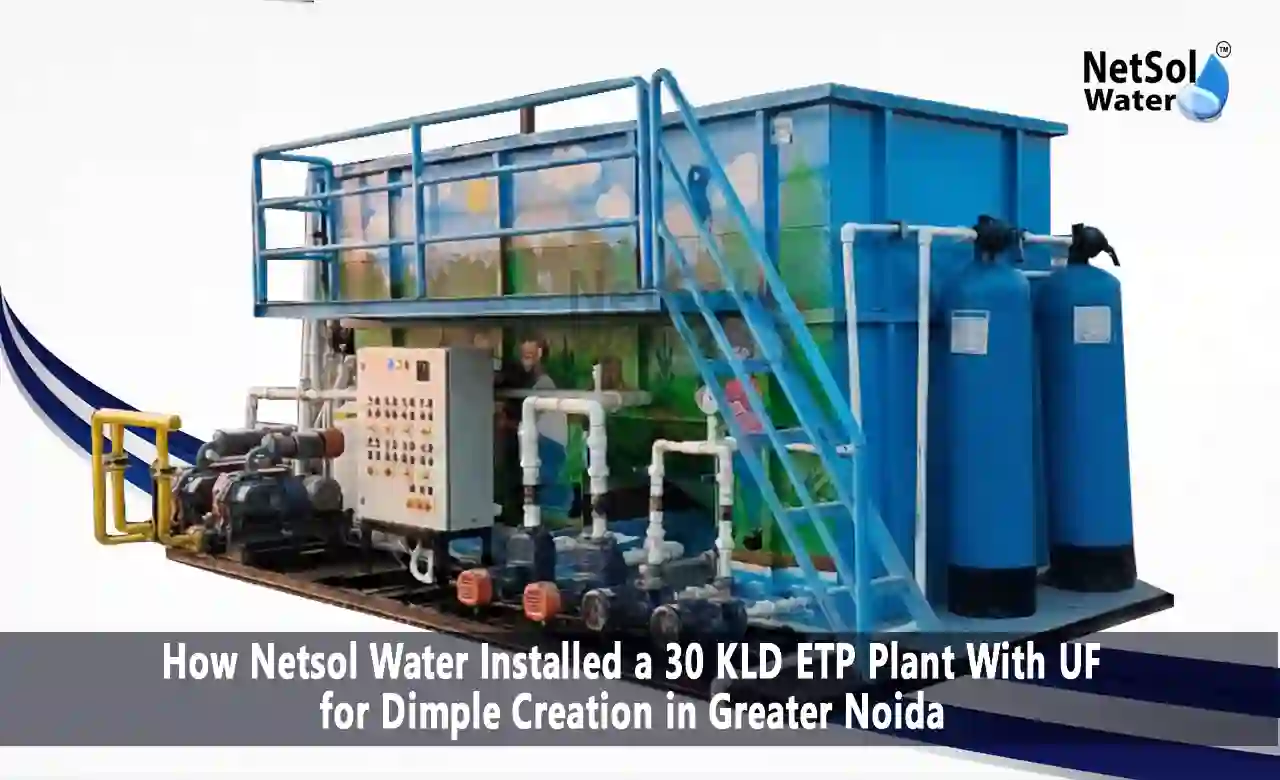
Case Study: 30 KLD Effluent Treatment Plant With UF for Dimple Creation
Industrial effluent doesn't wait. Every day a factory operates without a working treatment system, it's either dumping waste illegally, paying fines or running the risk of a complete shutdown notice from the State Pollution Control Board.
Dimple Creation, a manufacturing unit in Greater Noida, knew this. They needed a working effluent treatment plant fast, designed to their specific wastewater profile and built to last. They called Netsol Water.
This is what happened.
About the client: Dimple Creation
Dimple Creation operates out of Greater Noida, Uttar Pradesh, one of India's most active industrial corridors. The facility generates industrial effluent as part of its regular manufacturing process, and like most mid-sized units in the NCR region, they were under pressure from the Uttar Pradesh Pollution Control Board (UPPCB) to meet discharge standards.
They weren't looking for a temporary fix. They wanted a properly engineered solution that would hold up through daily operation, not something that would need constant babysitting or collapse after 6 months.
Capacity requirement: 30 KLD (kiloliters per day).
The problem: what Dimple Creation was dealing with
The effluent coming out of their production process carried suspended solids, organic load, and trace contaminants typical of manufacturing wastewater. Raw discharge at those concentrations doesn't meet UPPCB norms, and the gap between what they were producing and what they could legally discharge was significant.
3 things made this more complicated than a standard ETP installation:
First, the effluent composition wasn't uniform. Variation in production cycles meant the incoming wastewater changed day to day in terms of strength and flow rate. Any treatment system had to handle that range without failing or producing inconsistent output.
Second, space at the facility was limited. The plant footprint had to be compact without cutting corners on treatment stages.
Third, they needed the output to be clean enough not just for safe discharge but potentially for reuse within the facility. That raised the quality bar considerably and pushed the design toward a more advanced technology stack.
The solution: how Netsol Water approached it
Netsol Water's engineering team started with a site assessment, not a catalogue. They looked at actual effluent samples, measured flow rates across different production cycles, and mapped the physical constraints of the site before a single line was drawn.
The decision to go with an ETP Plant paired with an Ultrafiltration (UF) system came out of that analysis. A conventional biological treatment train alone would have struggled with the variable load and wouldn't have delivered the output quality Dimple Creation needed. The UF stage was the right call.
Here's how the full treatment sequence was laid out:
The effluent first passes through a screening and collection stage to remove gross solids. From there it goes into an equalization tank, which is what handles the variability problem. The equalization tank buffers the incoming flow, averaging out peaks and troughs so the downstream treatment stages see a consistent feed. This is one of the most underappreciated parts of any industrial wastewater system, and Netsol Water's team sized it correctly for the actual production cycle at Dimple Creation, not a generic rule of thumb.
After equalization, the effluent moves through a primary treatment stage for pH correction and chemical coagulation, knocking out suspended solids and colloidal matter. Then it enters the biological treatment stage, where aerobic microorganisms break down the organic load. Properly run, this stage does most of the heavy lifting on BOD and COD reduction.
The treated water then goes through secondary clarification and filtration before reaching the Ultrafiltration membrane system. The UF membranes are what push the output quality past what conventional treatment alone could achieve. They physically block suspended solids, bacteria, and larger molecules at the 0.01 to 0.1 micron level, producing a permeate that's clean enough for either safe discharge or internal recycling.
Netsol Water managed the full scope: design, detailed engineering, procurement, civil supervision, installation, and commissioning.
Technology used: ETP with Ultrafiltration explained
What is an effluent treatment plant?
An ETP is a system of physical, chemical, and biological treatment processes designed to reduce contaminants in industrial wastewater to levels safe for discharge or reuse. The specific design depends entirely on the type of industry and the composition of the wastewater, which is why cookie-cutter ETP designs fail and site-specific engineering matters.
What does Ultrafiltration add?
Ultrafiltration is a pressure-driven membrane separation process. The UF membrane acts as a physical barrier with pore sizes in the 0.01 to 0.1 micron range. It removes suspended solids, bacteria, colloidal particles, and high-molecular-weight organics that pass through conventional filtration. When you bolt a UF system onto the back end of a biological ETP, the output quality improves substantially, both in turbidity and microbial load.
For a 30 KLD plant, UF also keeps the footprint manageable. It replaces several conventional polishing stages with a single compact membrane unit, which matters when site space is constrained.
Why 30 KLD?
Netsol Water's engineering team sized the plant at 30 KLD based on Dimple Creation's actual and projected production volumes. Undersizing creates a bottleneck. Oversizing wastes capital and inflates operating costs. 30 KLD was the right number for this facility.
Results and benefits
The plant was commissioned and handed over to Dimple Creation's operations team after successful performance testing.
The treated effluent meets UPPCB discharge norms. That's the baseline requirement, and it's met consistently, not just during testing.
BOD and COD levels in the treated water came down to compliant levels. Suspended solids in the final discharge are well within permissible limits. The UF output quality is high enough that Dimple Creation now has a real option to recycle a portion of the treated water back into their process, reducing their freshwater draw and lowering operating costs over time.
The equalization-first design has proven its worth. The plant runs stably even when the production schedule varies, which happens regularly. There are no bypass events and no treatment failures when the inlet load spikes.
Practically speaking, Dimple Creation went from being a regulatory liability to having a fully compliant, documented industrial wastewater treatment system. That matters for client relationships, for audits, and for long-term business continuity.
About Netsol Water
Netsol Water is an effluent treatment plant manufacturer and water treatment engineering company based in India. The company designs, engineers, builds, and commissions ETP systems, Sewage Treatment Plants (STPs), Reverse Osmosis systems, and related water treatment infrastructure for industrial and municipal clients.
As an ETP plant manufacturer, Netsol Water works across sectors including pharmaceuticals, textiles, food processing, chemicals, and general manufacturing. The company handles projects end-to-end, from the first site assessment through to handover and post-commissioning support.
What separates Netsol Water's approach from standard equipment supply is the engineering depth. The team doesn't sell a product and ship it. They analyze the specific wastewater characteristics of a site, design a treatment sequence around those characteristics, and then build it. The Dimple Creation project is a straightforward example of that process.
Netsol Water operates across the Delhi NCR region and beyond, with a portfolio of completed plants spanning a range of capacities and industries.
Watch: 30 KLD Effluent Treatment Plant Project in Greater Noida
Conclusion
The Dimple Creation project is a good example of what a site-specific, properly engineered ETP looks like in practice. A 30 KLD plant with a UF polishing stage, sized and designed around the actual effluent characteristics of the facility, built and commissioned by a team that understood the regulatory and operational requirements.
Dimple Creation now has a working industrial wastewater treatment system that meets UPPCB norms, handles load variability without failing, and positions them for water recycling as operating costs continue to matter more.
If you're running a manufacturing facility in India and you're looking for a proven effluent treatment plant manufacturer to handle your ETP project from design through commissioning, Netsol Water has done this before and can do it again.
FAQs
Q1: What is an effluent treatment plant and why does a manufacturing unit need one?
An effluent treatment plant is a system that processes industrial wastewater to remove contaminants before the water is discharged or reused. Manufacturing processes generate wastewater that contains suspended solids, organic load, heavy metals, or chemicals depending on the industry. Without treatment, discharging that water violates pollution control norms and causes environmental damage. In India, the CPCB and State Pollution Control Boards mandate that industrial units treat their effluent to prescribed standards before discharge.
Q2: What is Ultrafiltration and when should it be included in an ETP?
Ultrafiltration is a membrane-based filtration technology that removes suspended solids, bacteria, and colloidal particles from water at the 0.01 to 0.1 micron level. It's added to an ETP when conventional treatment stages can't deliver the required output quality, when the treated water needs to be recycled for process reuse, or when the site has space constraints that make conventional polishing stages impractical. It produces consistently high-quality output regardless of inlet variability.
Q3: How long does it take to commission a 30 KLD ETP?
Timeline depends on the project scope, site conditions, and whether civil infrastructure already exists. For a 30 KLD system that includes design, engineering, civil construction, equipment installation, and commissioning, a realistic timeline runs between 3 and 6 months. Projects with existing civil structures and simpler effluent profiles can move faster. Netsol Water provides a project-specific timeline after the initial site assessment.
Q4: What does an ETP plant manufacturer actually do?
A full-scope ETP plant manufacturer handles the entire project: site assessment, effluent characterization, system design, equipment selection and procurement, civil engineering coordination, installation, commissioning, and operator training. This is different from an equipment supplier who ships components and leaves installation to someone else. For a plant that needs to work reliably and pass regulatory inspection, full-scope delivery from a single responsible contractor matters.
Q5: Can treated ETP effluent be reused within a factory?
Yes, in many cases. Whether treated effluent is suitable for reuse depends on the output quality of the treatment system and the water quality requirements of the intended use. A conventional ETP alone may not produce water clean enough for process reuse, but adding a UF stage or further polishing steps often closes that gap. Netsol Water assesses reuse potential as part of the initial design process for every project.