

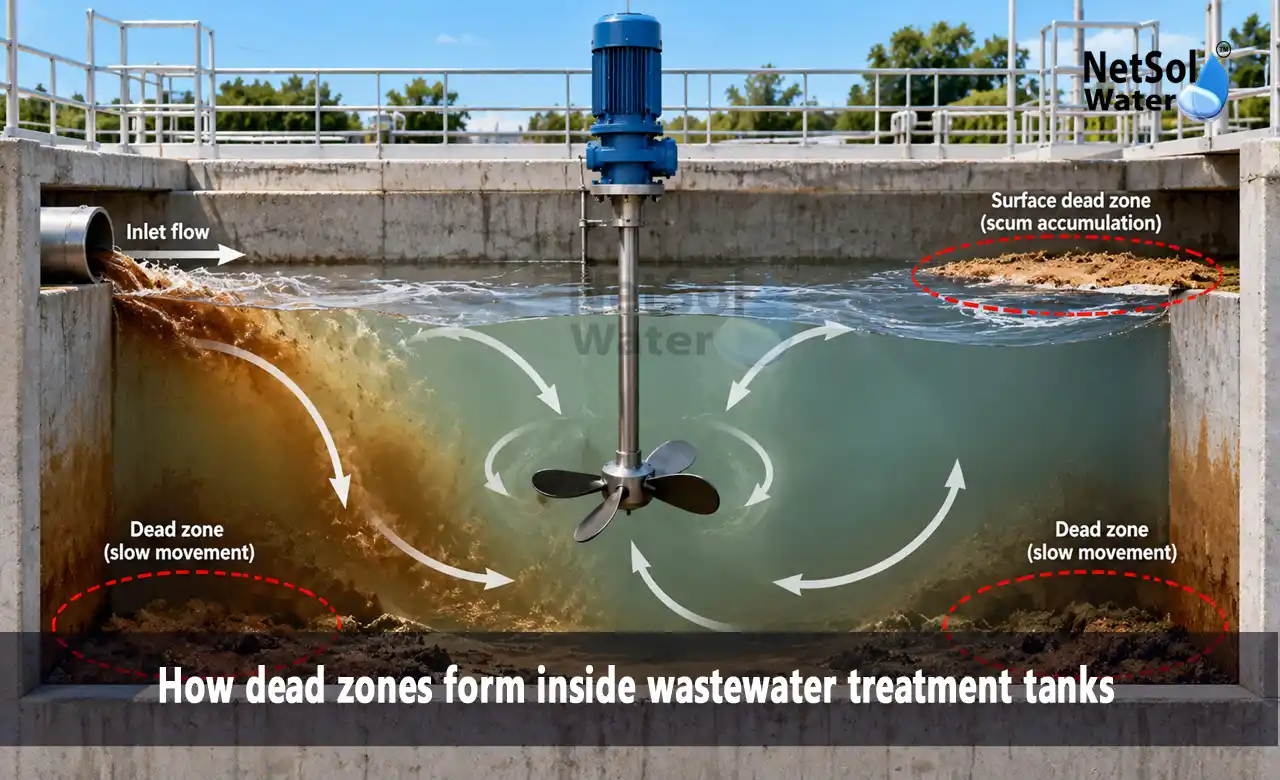
How dead zones form inside wastewater treatment tanks?
Stand at the edge of an aeration tank and the surface looks busy. Bubbles, churn, plenty of movement. Now picture the far corner near the floor, where nothing has moved in weeks.
That corner is a dead zone: a pocket of water moving so slowly that solids drop out, oxygen never arrives and chemicals never get mixed in. Equalization tanks, aeration tanks, chemical dosing tanks and clarifiers all develop them, in ETPs and STPs alike.
What counts as a dead zone?
A dead zone is any part of a tank where water velocity sits far below the tank average. Flow there is slow or close to zero, so that water barely swaps with the rest of the tank.
A lively surface says little about the floor, the corners or the space behind pipes and baffles. Those spots can sit still while the top looks perfectly mixed.
Five ways dead zones form
1. Mixing equipment that is too small
A mixer sized for thin, clear influent struggles once the wastewater gets thicker. Higher solids or viscosity shortens how far a jet carries.
Many designers start from roughly 5 to 10 watts of mixer power per cubic metre, and go higher for heavy sludge. Treat that as a screening figure, not a design value. If your influent has changed since commissioning (a new product line, a longer production shift), the original sizing may no longer fit.
2. A mixer in the wrong spot
Position matters as much as power. Height off the floor, angle, direction and distance from the wall all change the flow pattern.
A mixer parked close to a wall often sends its jet hugging that wall. You get a fast lane along the edge and slack water in the middle of the tank.
3. Awkward tank geometry
Sharp corners, sudden changes in width, deep pits and internal pipework all break up circulation. Square and rectangular tanks collect still water in their corners. Round tanks avoid that but can swirl unevenly when the mixers are spaced badly.
Corner fillets and an extra mixer along the long side are common fixes.
4. Uneven aeration
In an aeration tank, air does two jobs: it feeds oxygen to the biomass and it stirs the water. When diffusers are spaced unevenly, fouled, cracked or clogged, some zones get plenty of air and others get almost none. A flat, quiet patch on the surface above a diffuser grid is a good tell. If you are weighing a replacement, Netsol Water has a short read on the role of aeration diffusers in an ETP.
Blower pressure swings and poorly balanced air headers cause the same trouble.
5. Solids that pile up
Settled solids feed on themselves. A small mound of sludge on the floor blocks flow, slower flow lets more solids settle, and the mound grows. Once the layer is thick, normal mixing can't lift it back into suspension.
Where dead zones usually hide
| Tank | What Goes Wrong | First Thing to Check |
|---|---|---|
| Equalization Tank | Solids settle, so the tank does not evenly balance the load or pH. | Mixer power and sludge depth at the corners. |
| Aeration Tank | Low-oxygen pockets and poor contact between microbes and wastewater. | Diffuser condition and air distribution. |
| Chemical Dosing Tank | Chemicals do not spread evenly, so treatment varies. | Mixer position relative to the dosing point. |
| Clarifier | Unwanted currents and stagnant patches disrupt settling. | Inlet design and sludge blanket depth. |
What dead zones cost you?
Smell is usually the first sign. Stagnant organic matter turns anaerobic and gives off hydrogen sulfide, the rotten-egg odour every operator knows.
Biological tanks take a bigger hit. Dissolved oxygen, food and microbial activity vary from one corner to the next, so one end of the tank behaves like a different reactor from the other.
Settled sludge also eats into tank volume. That cuts the real retention time below what the design assumed, and effluent quality starts to drift with no obvious cause.
How to find them early?
. Take dissolved oxygen readings at several points and depths, not just one. A spread of more than about 1 to 2 mg/L inside one aeration tank is worth chasing.
. Probe sludge depth at the corners, around mixers and near the inlet.
. Watch the surface for flat patches, floating solids and foam that gathers in one place.
. Log odour complaints by location. They often point straight at the problem area.
. Run a tracer study when you need proof. Dosing a tracer and tracking how it spreads shows how the tank really flows.
. Look inside whenever the tank is drained. Sludge mounds mark the exact places where water stopped moving.
What to fix first?
Start with the cheap checks. Are the mixers turning in the right direction at the right speed? Are the diffusers clear? Is the blower delivering the pressure it should?
Then look at placement and geometry. Clear out settled solids before changing anything else, or the old mound will keep steering flow around itself.
A mixer relocation or tank modification should be checked by a process engineer against your actual flow and solids load.
Quick answers (FAQs)
Q1. Can a tank have dead zones while the surface is churning?
Yes. Surface turbulence says little about the floor or the corners.
Q2. Do dead zones cause bad odour?
They can. Stagnant organic matter goes anaerobic and releases hydrogen sulfide.
Q3. How often should I check for them?
A weekly walk-round with multi-point readings and a monthly sludge depth check is a reasonable routine, plus an extra check after any change in load.
Conclusion
Dead zones come from mixers that are too small or badly placed, awkward tank shapes, uneven air and sludge that keeps piling up. Catching them early mostly comes down to measuring in more than one spot.
Fix the mixing and the tank behaves the same way from corner to corner. That makes treatment results far easier to predict.
Need advice on choosing the right water or wastewater treatment unit? Talk to the engineers at Netsol Water. Tell us the problem and we will help you sort it out.
For assistance or related queries, call +91-9650608473 or write to enquiry@netsolwater.com.