

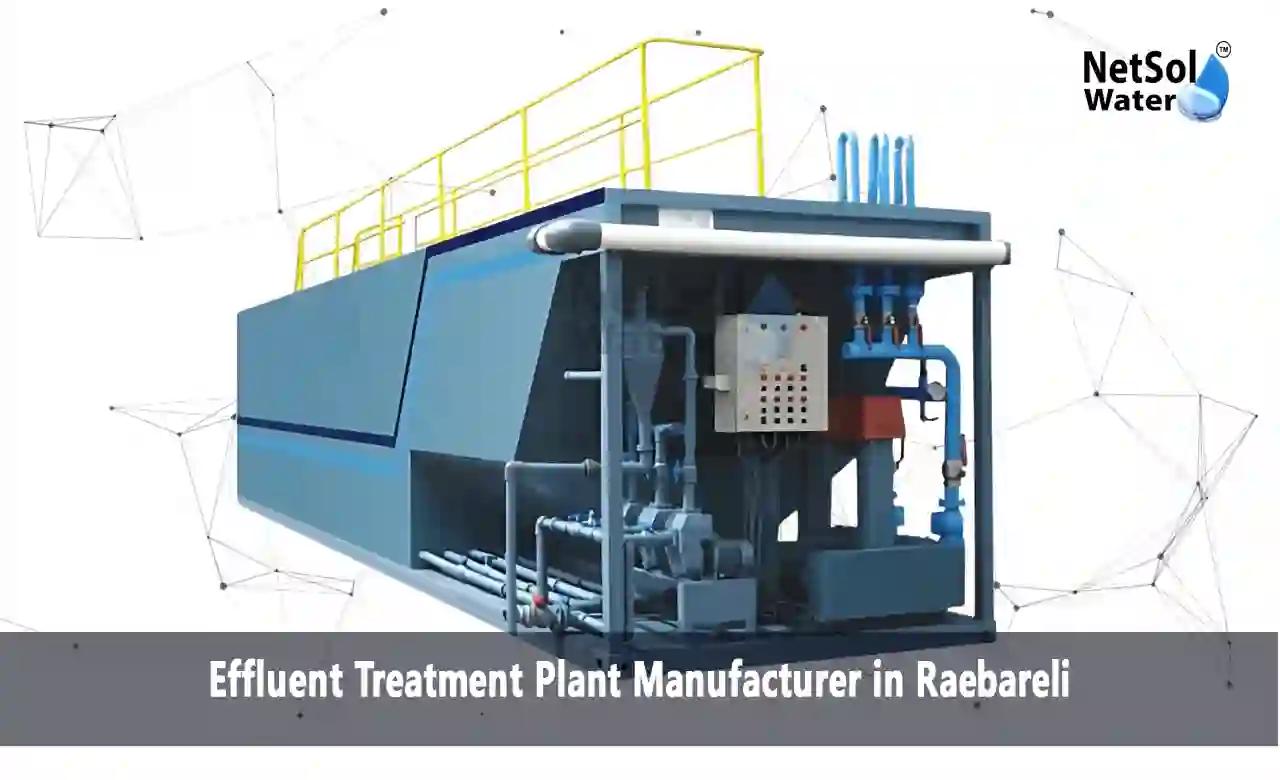
Effluent Treatment Plant Manufacturer in Raebareli
An Effluent Treatment Plant (ETP) treats industrial wastewater containing chemicals, heavy metals, oils and toxic compounds through primary, chemical, biological, and polishing stages - ensuring safe discharge or reuse. NetSol Water designs custom ETP systems for textile, pharmaceutical, food processing, dairy and metal industries in Raebareli and across UP.
Your Factory Is Growing - But Is Your Wastewater Being Managed?
Raebareli's industrial sector is quietly expanding. Textile units, food processors, small chemical manufacturers, and engineering workshops are all scaling up. And with that growth comes something that can't be ignored: industrial effluent.
Industrial wastewater is nothing like household sewage. It carries chemicals, heavy metals, dyes, solvents, and process byproducts - pollutants that can stay in soil and groundwater for decades once they enter the environment.
A poorly designed or absent ETP doesn't just hurt the environment - it exposes your business to CPCB penalties, legal notices, and potential shutdown orders. Choosing the right Effluent Treatment Plant Manufacturer in Raebareli is one of the most critical decisions a factory owner or facility manager can make.
How Industrial Effluent Differs from Domestic Sewage?
This distinction is important because many manufacturers try to use STP-style systems for industrial wastewater - and it doesn't work.
Industrial effluent can contain:
. Synthetic dyes and colour-causing compounds (textile, printing industries)
. Heavy metals like chromium, lead, nickel, and zinc (metal processing, electroplating)
. Oils, greases, and hydrocarbons (auto, engineering workshops)
. High organic load - BOD/COD - from dairy, food processing, beverage plants
. Acids, alkalis, and toxic solvents (pharma, chemical units)
. Active pharmaceutical compounds that require specialized removal
Each of these contaminants requires specific treatment chemistry and process design. A generic system simply won't cut it - and it will fail regulatory inspection.
How an Effluent Treatment Plant Works?
A well-designed ETP handles industrial wastewater through multiple sequential stages, each targeting a different class of contaminants.
1: Equalization & Primary Treatment
Industrial effluent rarely flows at a constant rate or concentration. The equalization tank buffers these fluctuations, ensuring a steady, consistent feed to downstream units. Screens and oil traps remove large solids, oil, and grease at this stage.
2: Chemical Treatment
Chemicals are dosed precisely to neutralize pH, coagulate suspended particles, and precipitate heavy metals. This is where chromium, lead, and other metals are removed - a critical step that biological treatment alone cannot achieve. Proper dosing control directly impacts compliance with CPCB discharge norms.
3: Biological Treatment
Aerobic microorganisms break down the remaining organic pollutants - reducing BOD and COD to acceptable levels. Depending on the effluent type, this may use activated sludge, MBBR, or SBR processes. For high-strength effluents (dairy, distillery), anaerobic pre-treatment may be added first.
4: Clarification & Sludge Management
Treated water settles in a clarifier, and sludge is separated for dewatering and disposal. Sludge management is often overlooked but is essential for compliance - improperly handled sludge is itself a pollution source.
5: Final Polishing
Sand filtration, activated carbon filtration, or membrane systems remove the remaining suspended solids and trace contaminants. The output water can then be safely discharged - or recycled back into the production process, reducing fresh water consumption significantly.
Industries That Need an ETP in Raebareli
1. Textile and Dyeing Units
Textile effluent is highly coloured and contains reactive dyes and surfactants. Standard biological treatment alone is insufficient - colour removal requires specialized coagulation-flocculation and sometimes advanced oxidation processes (AOPs). CPCB has strict colour limits for discharge.
2. Food Processing and Dairy Plants
High BOD/COD, oils, fats, and organic waste define food processing effluent. Anaerobic digestion is often used as a first step, followed by aerobic treatment. Dairy effluent, with milk residues and CIP (clean-in-place) chemicals, needs carefully buffered treatment.
3. Pharmaceutical and Chemical Industries
These are among the most complex effluents to treat. Active pharmaceutical ingredients (APIs), solvents, and toxic intermediates require multi-stage treatment including biological, chemical, and sometimes advanced oxidation. Pharmaceutical ETPs must meet the most stringent discharge standards.
4. Metal Processing and Electroplating
Hexavalent chromium (Cr6+) and other heavy metals in plating effluents are acutely toxic. Chemical reduction, precipitation, and filtration are mandatory steps. Non-compliance in this sector carries some of the heaviest penalties under Indian environmental law.
5. Small Engineering and Auto Workshops
Even smaller units generate oil-contaminated washwater and coolant waste that must not enter municipal drains. Compact ETP units designed for 5–50 KLD are available and cost-effective for these operations.
The Real Cost of Non-Compliance
Many industries delay ETP installation to save upfront capital. Here's what that decision typically costs:
. CPCB/UPPCB fines: Can reach several lakhs per violation - recurring, not one-time
. Production shutdowns: Authorities can seal operations within 24–48 hours of inspection failure
. Legal notices and court proceedings: Expensive, time-consuming, and reputation-damaging
. Loss of export and B2B contracts: Increasingly, buyers and partners require environmental compliance certificates
. Soil and groundwater remediation costs: If contamination is proven, cleanup liability can be enormous
In contrast, a well-designed ETP typically pays for itself through water reuse savings, avoided fines, and uninterrupted operations within 3–5 years.
Key Components of a Well-Designed ETP
. Equalization Tank - buffers flow and concentration variability
. Chemical Dosing System - pH neutralization, coagulation, heavy metal precipitation
. Aeration System - biological oxygen demand reduction
. Primary and Secondary Clarifiers - solid-liquid separation
. Sludge Dewatering Equipment - filter press or centrifuge for solid waste management
. Filtration Units - sand, carbon, or membrane-based polishing
. Online Monitoring (OCEMS) - mandatory for industries above a certain scale under CPCB rules
Water Reuse Opportunities with Treated Effluent
One of the most compelling arguments for a quality ETP is what you can do with the treated output:
. Cooling towers and heat exchangers - significantly reduces fresh water demand
. Equipment and floor washing - safe for most industrial cleaning applications
. Green areas and landscaping - reduces dependence on municipal water supply
. Boiler feed (with additional polishing) - creates substantial utility cost savings
Why NetSol Water for ETPs?
As a leading Effluent Treatment Plant Manufacturer & Supplier in Uttar Pradesh, NetSol Water has designed and installed ETPs for textile, pharmaceutical, food processing and metal industries across the state. We conduct effluent characterisation before every design, guaranteeing CPCB-compliant output. Our in-house manufacturing ensures faster delivery, tighter quality control, and better accountability.
Get a Free Effluent Analysis and ETP Design Proposal - Contact NetSol Water Now.
FAQ - Effluent Treatment Plant Manufacturer in Raebareli
Q: What is the difference between an STP and an ETP?
A: An STP (Sewage Treatment Plant) treats domestic wastewater from households and commercial buildings, primarily containing organic waste. An ETP (Effluent Treatment Plant) treats industrial wastewater containing chemicals, heavy metals, dyes, and toxic compounds. ETPs require more complex, industry-specific treatment processes than standard STPs.
Q: Which industries in Raebareli need an ETP?
A: Industries including textile and dyeing, food processing, dairy, pharmaceutical, chemical manufacturing, metal processing, electroplating, and beverage production require ETPs in Raebareli. CPCB mandates ETPs for all industries that discharge wastewater with pollutant levels above prescribed standards into public drains or water bodies.
Q: What happens if an industry doesn't install an ETP?
A: Industries without an ETP face CPCB fines (potentially several lakhs per violation), legal notices, and production shutdowns. Environmental non-compliance also affects B2B relationships - many buyers and export clients now require environmental compliance certificates. Contamination of local soil or groundwater can trigger additional civil liability.
Q: Can ETP-treated water be reused within the factory?
A: Yes. Depending on treatment quality, ETP-treated water can be reused for cooling towers, equipment and floor washing, landscaping, and - with additional polishing - as boiler feed. This reduces fresh water consumption significantly, lowering operational costs and improving the facility's environmental performance score.
Q: How is ETP designed for a textile unit?
A: Textile ETP design involves characterising the specific dyes and chemicals used, then building a treatment train that typically includes equalization, coagulation-flocculation for colour removal, biological treatment for BOD reduction, clarification, filtration, and pH adjustment. Colour removal is the key challenge requiring specialised chemistry beyond standard biological treatment.
Q: What is ZLD (Zero Liquid Discharge) in ETP?
A: Zero Liquid Discharge (ZLD) is an advanced ETP configuration where all wastewater is treated and recovered - with no liquid effluent discharged. The final reject is concentrated into solid waste for safe disposal. ZLD is mandatory for certain high-pollution industries in India and is increasingly required for textile and chemical sectors.