

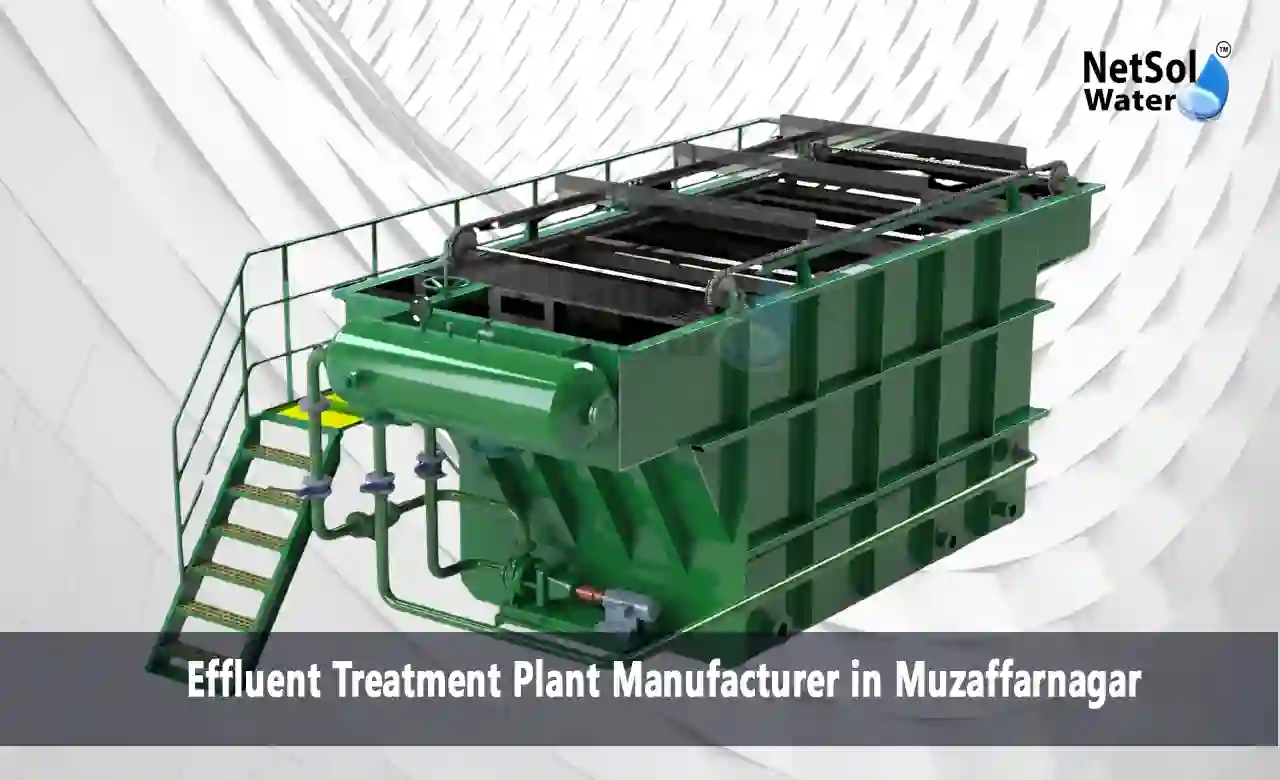
Effluent Treatment Plant Manufacturer in Muzaffarnagar
Every day, thousands of litres of industrial wastewater are discharged from sugar mills, paper units, and chemical plants across Muzaffarnagar. If that water isn't treated properly, it ends up in rivers, farmland, and drinking water sources - and your business ends up facing UPPCB shutdown notices, heavy fines, and irreversible reputational damage.
The right Effluent Treatment Plant (ETP) doesn't just keep you compliant. It cuts long-term costs, protects your operations, and signals to buyers and export clients that your facility meets global environmental standards.
NetSol Water is an ISO-certified ETP manufacturer in Muzaffarnagar with a proven track record across Uttar Pradesh's most demanding industrial sectors. Here's everything you need to know before choosing an ETP partner.
Why Industries in Muzaffarnagar Can't Afford to Skip ETP Installation
Muzaffarnagar is home to some of UP's most water-intensive industries - sugar mills, distilleries, paper plants, agro-processing units, and chemical manufacturers. Each generates wastewater loaded with BOD, COD, heavy metals, suspended solids, and organic compounds.
Releasing this untreated effluent into drains or rivers violates the Water (Prevention & Control of Pollution) Act, 1974 and attracts strict action from the Uttar Pradesh Pollution Control Board (UPPCB). Beyond legal risk, untreated discharge contaminates groundwater, affects crop yields, and creates community health hazards.
The consequences of non-compliance are real:
. Consent-to-Operate (CTO) cancellation and factory closure orders
. Fines ranging from lakhs to crores depending on severity and repetition
. NGT (National Green Tribunal) notices and public litigation
. Loss of export certifications and international buyer contracts
What Is an Effluent Treatment Plant?
An Effluent Treatment Plant (ETP) is an engineered system that processes industrial wastewater through physical, chemical, and biological methods - removing pollutants until the water meets CPCB/UPPCB discharge standards or is safe for reuse.
Think of it as a multi-stage filtration pipeline: raw wastewater enters one end, and compliant, treated water exits the other. The stages are customized based on your industry's specific wastewater profile - which is why generic, off-the-shelf ETPs rarely work.
Industries in Muzaffarnagar That Need an ETP
1. Sugar Mills and Distilleries
High organic load, fluctuating production volumes, and extremely high BOD/COD levels make sugar mill effluent one of the most challenging to treat. Robust biological treatment with properly sized aeration tanks is essential.
2. Paper and Pulp Plants
Effluent contains fibers, bleaching chemicals, and high suspended solids. Both primary sedimentation and secondary biological treatment are required for compliance.
3. Chemical Manufacturing Units
Complex and often hazardous wastewater streams demand precision dosing systems, real-time monitoring, and safe sludge disposal protocols.
4. Food Processing and Dairy Units
Organic-rich wastewater is ideal for aerobic biological treatment, but tank sizing must account for seasonal production peaks and load variations.
5. Distilleries and Breweries
High COD wastewater requires staged biological and chemical treatment, often combined with biogas recovery for energy efficiency.
How an ETP Works?
| Stage | Process |
|---|---|
| 1 - Preliminary Treatment | Screening + grit removal to protect equipment |
| 2 - Primary Treatment | Sedimentation; solids settle as primary sludge |
| 3 - Biological Treatment | ASP / MBBR / SBR - microbes degrade organic load |
| 4 - Tertiary Treatment | Filtration, UV, activated carbon - meets discharge norms |
| 5 - Sludge Management | Thickening, dewatering, safe disposal or composting |
For industries needing zero liquid discharge (ZLD), treated water is fully recycled back into the production process - eliminating all effluent discharge and achieving maximum water savings.
ETP Capacity Selection Guide
. Small Units (10–50 KLD): Workshops, small chemical units, pilot plants
. Medium Units (50–200 KLD): Paper mills, food processing, mid-sized chemical plants
. Large Units (200 KLD+): Sugar mills, large distilleries, industrial complexes
. CETP (Common ETP): Cost-effective solution for clusters of small industrial units in an estate
What to Look for in an ETP Manufacturer in Muzaffarnagar
1. Wastewater Testing Before Design
Any serious manufacturer will test your actual effluent - pH, BOD, COD, TDS, TSS, heavy metals - before designing the system. Skipping this step is the #1 reason ETPs fail inspections.
2. Custom Engineering
Your industry's wastewater is unique. A sugar mill's effluent is completely different from a chemical plant's. Demand a system designed for your specific load and composition, not a generic catalogue product.
3. UPPCB and CPCB Compliance Expertise
Your manufacturer must know the discharge norms applicable to your industry under the Environment Protection Act - and design the ETP to consistently meet them, not just on commissioning day.
4. Quality of Core Components
Blowers, pumps, aeration diffusers, clarifiers, and control panels determine how reliably your ETP operates year after year. Cheap components mean frequent downtime and expensive repairs.
5. End-to-End Support
Design, civil construction guidance, equipment installation, operator training, and annual maintenance contracts - these should all be offered by your manufacturer, not outsourced to multiple parties.
Common ETP Mistakes to Avoid
. Selecting a manufacturer based on the lowest quote - cheap ETPs cost more over 5 years
. Installing a system without actual effluent characterization data
. Ignoring sludge disposal planning - this is a separate compliance requirement
. Skipping operator training, leading to poor performance and failed audits
Why NetSol Water Is Muzaffarnagar's Preferred ETP Partner
NetSol Water is an ISO-certified a leading ETP Plant Manufacturer and Supplier in U.P., offering advanced solutions such as Sewage Treatment Plants, Industrial RO Systems and ZLD systems. With clients across Agra, Amroha, Ambedkar Nagar, Muzaffarnagar and beyond, we bring deep knowledge of UP's industrial landscape and regulatory environment.
. ISO-certified manufacturing with rigorous quality controls at every stage
. Every ETP designed after real effluent lab testing - no assumptions
. Full UPPCB and CPCB compliance from Day 1
. High-performance components: premium pumps, blowers, diffusers, control panels
. Site survey → design → installation → commissioning → training → AMC - all under one roof
. Proven track record in sugar mills, paper plants, chemical units, and food processing
Ready to get compliant and protect your operations? Contact NetSol Water today for a free site assessment and custom ETP design proposal.
FAQs
Q: What is an Effluent Treatment Plant and why is it required in Muzaffarnagar?
A: An Effluent Treatment Plant (ETP) treats industrial wastewater to remove pollutants before discharge. In Muzaffarnagar, industries like sugar mills, paper plants, and chemical units are legally required by UPPCB and CPCB to install ETPs to prevent environmental contamination and maintain their Consent to Operate.
Q: How much does an ETP cost in Muzaffarnagar?
A: ETP costs depend on capacity, wastewater characteristics, and technology chosen. Small units (10–50 KLD) typically range from Rs. 10–30 lakhs, while large plants (200 KLD+) can cost Rs. 1 crore or more. Accurate pricing requires an effluent test and site assessment.
Q: What is the difference between ETP and STP?
A: An ETP (Effluent Treatment Plant) treats industrial wastewater containing chemicals, heavy metals, and high BOD/COD. An STP (Sewage Treatment Plant) treats domestic or municipal wastewater. While both remove pollutants, ETPs are designed for more complex and variable industrial effluent streams.
Q: Which industries in Muzaffarnagar are required to have an ETP?
A: Sugar mills, distilleries, paper and pulp plants, chemical manufacturers, food processing units, dairy plants, and any industrial facility generating wastewater above UPPCB threshold limits are required to install and operate a functioning ETP with valid consent.
Q: What technology is best for sugar mill effluent treatment in UP?
A: Sugar mill effluent, which has very high BOD and COD, is best treated using a combination of primary clarification followed by biological treatment - typically Activated Sludge Process (ASP) or MBBR. For large volumes, ZLD systems with evaporators may also be required.
Q: How long does it take to install an ETP in Muzaffarnagar?
A: Depending on capacity and complexity, a complete ETP installation typically takes 8 to 20 weeks - from design finalization and civil work to equipment installation and commissioning. Modular systems can be deployed faster, in 4 to 8 weeks.
Q: Can ETP-treated water be reused in industrial processes?
A: Yes. With proper tertiary treatment - including filtration, UV disinfection, and RO polishing if needed - ETP-treated water can be reused in cooling towers, boiler feed, gardening, or even some production processes, significantly reducing freshwater consumption.