

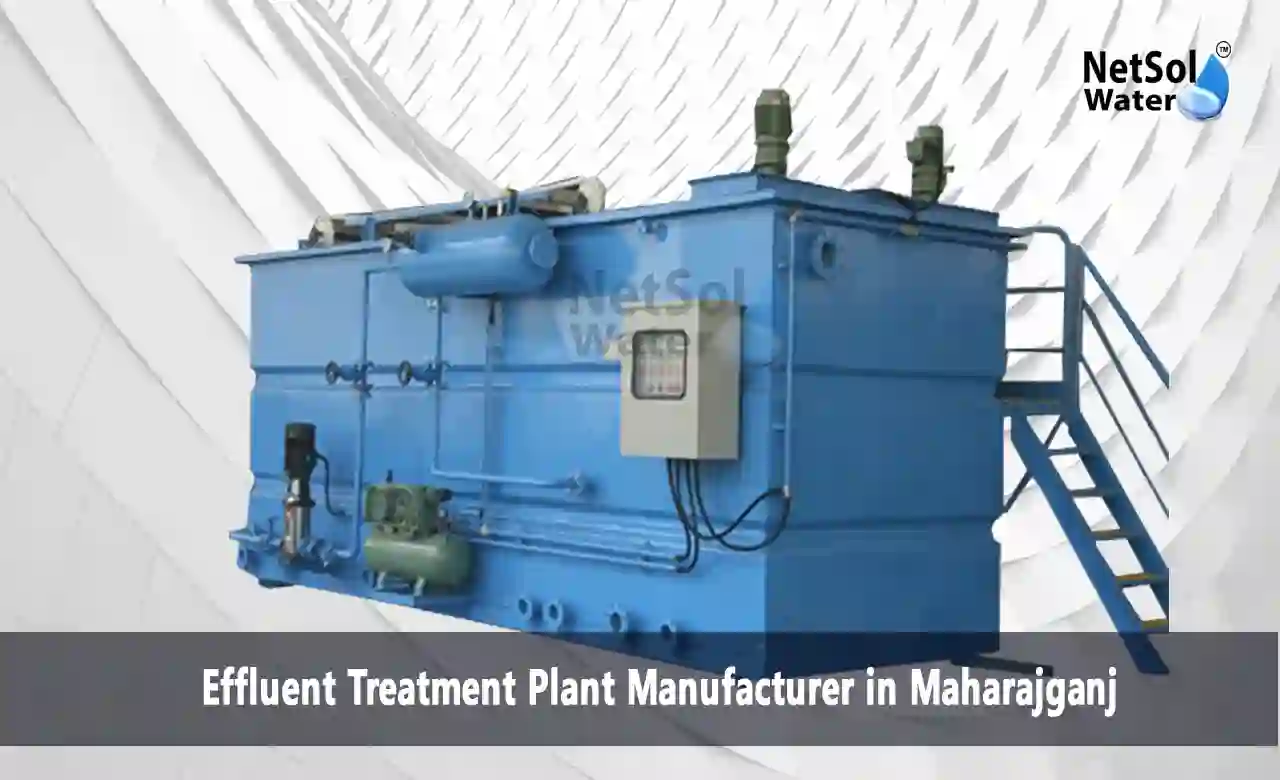
Effluent Treatment Plant Manufacturer in Maharajganj
Every rice mill, food processing unit, textile operation, and dairy plant in Maharajganj generates wastewater as a byproduct of production. Some of it carries chemicals. Some carries heavy organic load. Some carries colour and dissolved solids that standard municipal drains cannot handle.
Releasing that wastewater untreated is not just an environmental issue - it is a legal and financial risk. UPPCB has been actively issuing show-cause notices and shutdown orders to non-compliant industrial units across eastern UP. The Rohini and Gandak rivers, which run through this district, are already under stress.
NetSol Water is an ISO-certified effluent treatment plant manufacturer in Maharajganj with proven ETP installations across multiple industries in Uttar Pradesh. This guide explains what you need, why it matters, and how to make the right investment.
Which Industries in Maharajganj Need an ETP?
The requirement is broader than most industry owners realise. If your process uses water, you almost certainly generate regulated effluent.
• Rice mills and grain processing units - wash water and process effluent with high suspended solids
• Sugar mills - high BOD, suspended solids, and colour in process wastewater
• Food and beverage manufacturers - organic-rich effluent with fats and proteins
• Textile and dyeing units - coloured, chemically loaded wastewater requiring advanced treatment
• Dairy processing plants - high fat, protein, and BOD load in wastewater
• Pharmaceutical units - complex chemical compounds requiring specialised treatment
• Slaughterhouses and meat processing - high biological and organic load
• Paper and packaging industries - fibre-rich wastewater with high COD
• Chemical processing units - hazardous contaminants requiring multi-stage treatment
Even small processing units discharging into municipal drains are receiving UPPCB notices. The enforcement trend is clear and it is accelerating.
How an Effluent Treatment Plant Works - 5 Core Stages
Stage 1: Equalization
Industrial processes do not generate wastewater at a uniform rate or quality. An equalization tank collects and mixes all incoming effluent to create a consistent feed for downstream stages. This protects the system from shock loads and keeps treatment performance stable.
Stage 2: Primary Treatment
Screening removes coarse solids. Sedimentation, dissolved air flotation (DAF), and chemical coagulation-flocculation remove suspended particles, colloidal matter, and some dissolved contaminants. The right combination depends on your specific effluent characteristics.
Stage 3: Secondary (Biological) Treatment
Aerobic bacteria break down the dissolved organic content that physical processes leave behind. MBBR, SBR, and activated sludge process are the most common technologies at this stage. The selection depends on your organic load, effluent composition, and space availability.
Stage 4: Tertiary Polishing
Sand filtration, activated carbon adsorption, and UV/ozone disinfection remove residual solids, colour, odour, and pathogens. For industries with zero liquid discharge (ZLD) requirements or high reuse goals, reverse osmosis and electrocoagulation are added at this stage.
Stage 5: Sludge Management
Sludge from primary and secondary stages is collected, thickened, and dewatered using filter presses or centrifuges. Dewatered sludge cake is disposed of in compliance with UPPCB hazardous waste management rules - or used beneficially where permitted.
UPPCB Discharge Standards Your ETP Must Meet
| Parameter | Acceptable Limit | Significance |
|---|---|---|
| pH | 6.5 – 8.5 | Corrosion & ecosystem protection |
| BOD | Below 30 mg/L (inland water) | Oxygen depletion indicator |
| COD | Below 250 mg/L | Total organic load measure |
| TSS | Below 100 mg/L | Clarity & sediment control |
| Oil & Grease | Below 10 mg/L | Surface film & aquatic toxicity |
| TDS | Below 2100 mg/L | Salinity and soil impact |
| Heavy Metals | As prescribed per metal | Toxicity to aquatic life |
How to Evaluate an ETP Manufacturer in Maharajganj
1. Industry-specific experience - Has the manufacturer designed ETPs for your type of industry before? Ask for references.
2. Effluent characterisation first - Will they sample and test your actual wastewater before quoting? If not, walk away.
3. Complete treatment train - Does the design address every contaminant: suspended solids, organics, colour, metals
4. Component quality - Ask about pump brands, blower specs, filter media grade, and structural material standards.
5. Compliance guarantee - Will the manufacturer commit in writing to meeting UPPCB discharge standards?
6. Post-commissioning AMC - How quickly can they respond to a breakdown? Industrial downtime is expensive.
Why NetSol Water Is the Right ETP Partner for Maharajganj
We are NetSol Water - ISO certified, ETP Plant Manufacturer and Supplier in U.P. , We have designed ETPs for rice mills, food processing units, textile industries, and pharmaceutical manufacturers in UP and beyond.
Every project starts with proper effluent sampling across multiple production shifts - not a standard template quote. Our engineering team designs a treatment train that addresses every contaminant in your specific effluent.
We fabricate all systems in-house, handle full installation and commissioning, and offer structured AMC programs. We do not leave after handover.
Get a Free Site Assessment from NetSol Water.
Tell us your industry, your production process, and your current wastewater situation. We will design the most cost-effective, UPPCB-compliant ETP solution for your facility in Maharajganj.
FAQs: Effluent Treatment Plant in Maharajganj
Q: What is the difference between an ETP and an STP?
A: An ETP (Effluent Treatment Plant) is designed for industrial wastewater containing chemicals, metals, and complex contaminants. An STP (Sewage Treatment Plant) handles domestic wastewater. Industries often need both - an ETP for process water and an STP for domestic sewage from staff and facilities.
Q: How much does an ETP cost for a rice mill in Maharajganj?
A: ETP cost for a rice mill depends on daily effluent volume and characteristics. A 50 KLD system for a medium-sized rice mill starts at approximately ?20–35 lakhs, including civil work. Exact pricing requires effluent testing and site assessment. Contact NetSol Water for a customised quote.
Q: Is an ETP mandatory for food processing units in Maharajganj?
A: Yes. UPPCB requires food processing units to obtain Consent to Establish and Consent to Operate, both of which require a functional ETP. Units without one face notices, production stoppages, and heavy penalties. Pre-treatment before discharge to municipal drains is also increasingly mandated.
Q: What is effluent characterisation and why is it important?
A: Effluent characterisation involves collecting and testing samples from your facility across multiple production shifts to measure flow rate, BOD, COD, pH, TSS, colour, metals, and other parameters. Without this data, an ETP cannot be accurately designed - resulting in a system that either underperforms or is oversized.
Q: Can industrial effluent be treated for reuse in Maharajganj?
A: Yes. With proper secondary and tertiary treatment - and advanced stages like RO or ZLD where required - industrial effluent can be treated to standards suitable for process reuse, cooling tower makeup, or irrigation. This significantly reduces freshwater consumption and operational costs.
Q: What is a Zero Liquid Discharge (ZLD) system?
A: A ZLD system treats industrial effluent to the point where no liquid waste is discharged - all water is recovered and reused. It is required in certain notified industrial areas and for industries near ecologically sensitive zones. NetSol Water designs and supplies ZLD systems across UP.
Q: How long does ETP installation take in Maharajganj?
A: ETP installation typically takes 8 to 14 weeks from design approval to commissioning, depending on plant size, complexity, and civil work readiness. Larger installations with multiple treatment stages and sludge handling systems may take longer. NetSol Water provides a detailed project timeline at the proposal stage.