

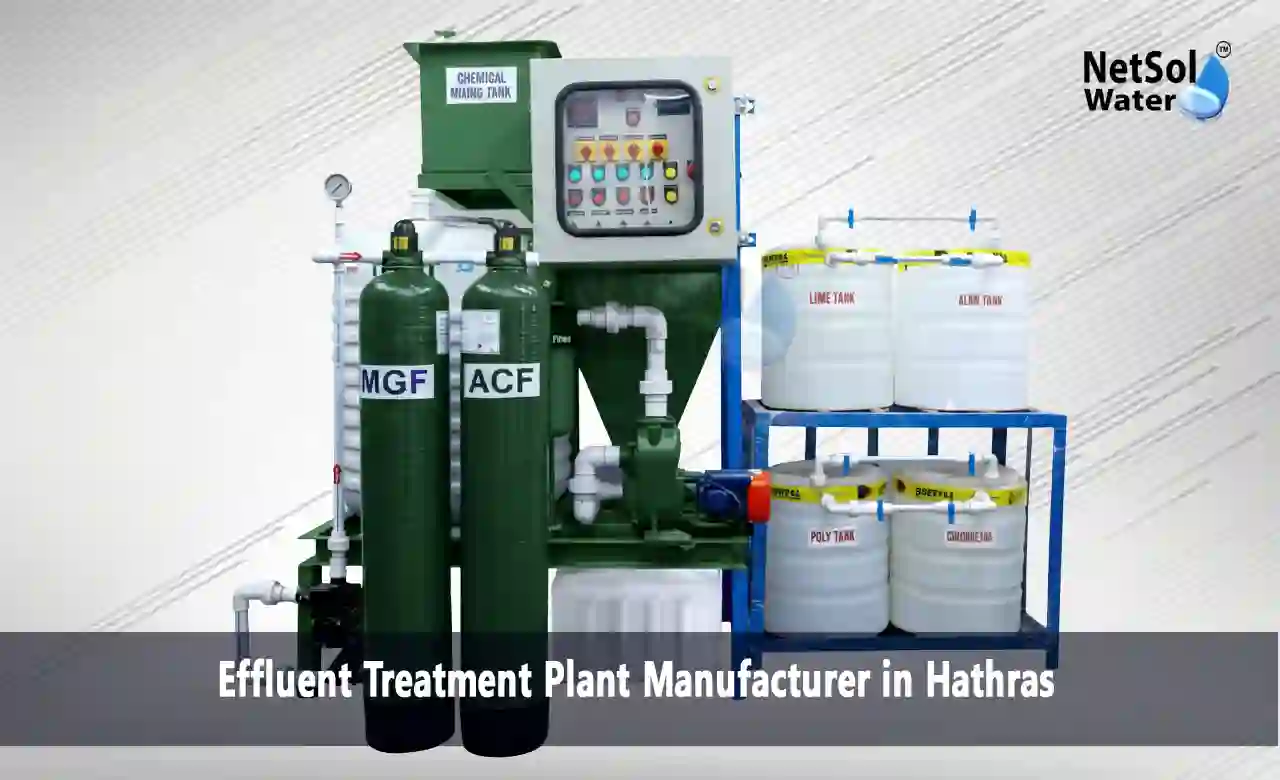
Effluent Treatment Plant Manufacturer in Hathras
If your factory is under pressure to meet discharge standards - or you're planning ahead before the pollution control board knocks - you're in the right place.
Netsol Water has designed and installed effluent treatment plants (ETPs) for industries across Hathras for years. We don't sell off-the-shelf systems. We study your waste, understand your site constraints, and build a plant that actually works - day in, day out - without burning a hole in your running costs.
Whether you run a textile dyeing unit, a pharmaceutical plant, a food processing facility, or a small factory, this guide will walk you through everything you need to know about ETP solutions in Hathras.
What Is an Effluent Treatment Plant (ETP)?
An effluent treatment plant (ETP) is an industrial wastewater treatment system that removes harmful pollutants - chemicals, heavy metals, pathogens, and organic waste - from factory discharge before it is released into the environment or reused in-plant. ETPs help industries in Hathras comply with CPCB and UP Pollution Control Board discharge norms.
In simpler terms: the dirty water your factory produces cannot go directly into drains. An ETP cleans it to a standard that is safe for the environment - and, in many cases, clean enough to reuse inside your facility, saving you money on fresh water.
Why Hathras Industries Trust Netsol Water
There are many equipment suppliers available, but what sets us apart as a top ETP Plant Manufacturer in Uttar Pradesh is why plant managers and factory owners in Hathras keep coming back to us.
. Local presence - Our service engineers are based in the region, not 500 km away.
. Custom design - Every plant is engineered for your specific effluent profile and flow rate.
. Low running costs - We design for energy efficiency from day one, not as an afterthought.
. Compliance guarantee - We do not hand over a plant until the treated water meets discharge standards.
. Post-installation support - Spare parts, routine checks, and operator training are all covered.
Industries We Serve in Hathras
Hathras has a diverse industrial base - from leather processing and textiles to agri-food and pharmaceuticals. Here is how we serve each sector:
1. Textile and Dyeing Units
Textile effluent is among the toughest to treat - high colour load, COD, and dissolved solids. Our approach combines physico-chemical treatment (to strip colour and suspended solids) with biological polishing to bring BOD and COD within permissible limits.
Where feasible, we integrate water recovery so that treated water can be recycled back into the dyeing process - reducing your fresh water bill significantly.
2. Pharmaceutical and Chemical Plants
Pharma effluent contains trace active pharmaceutical ingredients (APIs), solvents, and toxic by-products. Standard biological treatment alone is not enough. We deploy advanced oxidation processes (AOP), targeted adsorption (using activated carbon or resins), and controlled biological units in sequence to achieve safe discharge.
Hazardous sludge handling and safe disposal is part of our scope - we do not leave that problem for you to solve.
3. Food, Beverage, and Dairy
High organic load - fats, sugars, dairy whey, and suspended solids - makes food-sector effluent odorous and oxygen-depleting if untreated. We use anaerobic pre-treatment followed by aerobic polishing. The result is a clean effluent and, in many setups, biogas recovery from the anaerobic stage.
4. Automotive, Metal Finishing, and Electroplating
Heavy metals like chromium, zinc, nickel, and cyanide compounds require precise chemical precipitation, clarification, and multi-stage filtration. For clients with strict reuse targets, we add ion exchange or membrane filtration as a final polishing step.
5. Healthcare and Hospitals
Hospital effluent carries pathogens, pharmaceutical residues, and disinfectant by-products. We add UV disinfection or chlorination as a final stage and design the system to minimise staff contact with raw sewage.
6. Other Industries
We also serve oil and gas facilities, small-scale manufacturing units, and mixed commercial complexes. If your industry generates wastewater, we have a treatment solution for it.
ETP Technologies We Use
Not every effluent needs the same treatment train. Here is a plain-language overview of the core technologies we deploy:
1. Physico-Chemical Treatment
This is typically the first stage - we use coagulation, flocculation, and sedimentation to remove suspended solids, colour, and heavy metals quickly. It protects the downstream biological units from shock loads and reduces overall treatment time.
2. Biological Treatment (Aerobic and Anaerobic)
For high organic load, biological units are the workhorses. Aerobic processes (activated sludge, SBR, MBR) are great for final polishing. Anaerobic digesters handle very high-strength organic waste and can generate biogas as a bonus energy source.
3. Zero Liquid Discharge (ZLD) Systems
For industries that cannot discharge any wastewater - due to regulatory pressure or water scarcity - we offer full ZLD systems combining membrane filtration (RO/UF), evaporators, and crystallisers. The final output is recoverable water and a dry salt cake for safe disposal.
ZLD is complex and energy-intensive. We always help clients evaluate whether ZLD is truly required or whether a well-designed recycle system can achieve the same compliance outcome at lower cost.
4. Compact Packaged ETPs
For small factories, hotels, and commercial buildings, our packaged ETPs are factory-built, tested, and delivered ready to connect. Installation takes days, not weeks. These units also support future capacity expansion through modular add-ons.
5. PLC-Based Automation and Remote Monitoring
Manual operation leads to inconsistent treatment and compliance risk. Our automated control systems track flow, pH, dissolved oxygen, and effluent quality in real time - alerting operators before a problem becomes a violation.
ETP Installation Process - What to Expect
We follow a six-stage process that takes you from initial enquiry to a fully operational, compliant plant:
1. Effluent Analysis and Site Survey - We collect effluent samples and run lab tests to characterise your waste stream. A site visit maps the available space, civil infrastructure, and utility connections.
2. Plant Design and Approvals - Our engineers prepare detailed P&ID drawings, equipment schedules, and process notes. We assist you with applications to the UP Pollution Control Board.
3. Manufacture and Factory Testing - Key modules are built and tested in our workshop. You receive FAT (Factory Acceptance Test) reports before anything ships to site.
4. Site Installation and Integration - Tanks, piping, electrical panels, and control systems are installed and connected to your existing drains and utility supply.
5. Commissioning and Operator Training - We run trial cycles, optimise dosing and aeration settings, and verify treated water quality against discharge standards. Your team receives hands-on training.
6. Handover and After-Sales Support - You receive O&M manuals, spare parts lists, and an as-built drawing set. Service contracts for routine maintenance are available.
Cost of an Effluent Treatment Plant in Hathras
ETP costs vary widely based on your specific situation. A compact packaged ETP for a small unit may cost a fraction of what a full ZLD system for a large textile mill costs. Here are the main factors that shape your investment:
Factors That Affect ETP Cost
. Effluent flow rate and daily volume - Larger flows need bigger tanks and more energy.
. Pollutant type and strength - Complex or toxic waste (heavy metals, APIs) requires more treatment stages.
. Reuse or ZLD requirement - These add membrane systems, evaporators, or crystallisers.
. Level of automation - PLC control with remote monitoring costs more upfront but saves on operator wages.
. Site conditions - Tight spaces, remote locations, or weak civil structures add installation cost.
. Material selection - Stainless steel and FRP cost more than MS but last significantly longer.
How We Help You Get Best Value?
We prepare transparent, itemised quotations - not a single lump sum. You can see exactly what each component costs and where you can phase the investment over time if needed.
We also prepare life-cycle cost estimates so you can see the total cost of ownership over five to ten years, not just the upfront capital. Low-quality equipment often ends up costing far more in breakdowns and replacements.
Why Choose Netsol Water Over Other ETP Suppliers?
Here is an honest comparison of what sets a serious ETP manufacturer apart from a basic equipment reseller:
| What to Look For | Netsol Water | Generic Supplier |
|---|---|---|
| Custom plant design | Yes - per effluent sample | Rarely - catalogue sizes only |
| Local service support | Yes - regional team | Typically remote/delayed |
| Compliance assurance | Yes - water tested pre-handover | Often not included |
| Operator training | Included in contract | Paid extra or not offered |
| Life-cycle cost analysis | Always provided | Rarely provided |
| ZLD / reuse capability | Full in-house capability | Often outsourced |
Conclusion
Industrial wastewater compliance is not something you can afford to delay. Penalties, plant shutdowns, and reputational damage are real risks for factories operating without a functioning ETP.
Netsol Water makes the process straightforward: we survey your site, design a system that fits your budget and space, and support you every step from permit application to commissioning.
Talk to our team today - and take the first step towards compliant, cost-efficient wastewater management.
Call: +91-9650608473 | Email: enquiry@netsolwater.com Request a FREE site survey and quotation - our team typically responds within 24 hours.
FAQs
Q1: What is an effluent treatment plant and why is it required in Hathras?
An effluent treatment plant (ETP) is an industrial wastewater treatment system that removes pollutants - chemicals, heavy metals, and organic waste - from factory discharge. In Hathras, ETPs are mandatory for industries under the Environment Protection Act. Failure to install a compliant ETP can result in closure notices from the UP Pollution Control Board.
Q2: How much does an ETP plant cost in Hathras?
ETP cost in Hathras depends on flow rate, effluent type, and treatment goals. A compact packaged ETP for small industries typically starts from ?5–15 lakhs. Larger custom plants for textile or pharma units may range from ?25 lakhs to several crores. Contact Netsol Water at +91-9650608473 for a site-specific quote.
Q3: Which industries in Hathras need an effluent treatment plant?
Industries that must install ETPs in Hathras include textile and dyeing units, pharmaceutical and chemical plants, food and dairy processing, metal finishing and electroplating shops, hospitals and healthcare facilities, and leather processing units. Any industry generating process wastewater above prescribed limits under CPCB norms requires an ETP.
Q4: What is the difference between an ETP and an STP?
An ETP (Effluent Treatment Plant) is designed for industrial wastewater, which contains chemicals, heavy metals, or toxic compounds from manufacturing. An STP (Sewage Treatment Plant) treats domestic wastewater - from toilets, kitchens, and bathrooms - which is primarily organic. Industrial facilities may need both, or a combined system, depending on the nature of their discharge.
Q5: How long does it take to install an ETP plant in Hathras?
For compact packaged ETPs, installation typically takes 2–4 weeks from delivery. For larger custom-designed plants, the timeline from survey to commissioning is usually 8–16 weeks, depending on civil work, equipment fabrication, and permit approvals. Netsol Water provides a detailed project schedule before work begins.
Q6: What is zero liquid discharge (ZLD) and do I need it?
Zero Liquid Discharge (ZLD) is a treatment approach where no wastewater is discharged to the environment - all water is recovered and reused, and the remaining waste is a dry solid. ZLD is mandatory for certain red-category industries in India. It is complex and energy-intensive, so Netsol Water always evaluates whether ZLD is legally required before recommending it.
Q7: Does Netsol Water provide ETP maintenance services in Hathras?
Yes. Netsol Water offers annual maintenance contracts (AMCs) for all ETPs installed in Hathras and nearby areas. This includes scheduled inspections, consumables and spare parts supply, operator refresher training, and emergency callout support. Our regional service team ensures fast response times to minimise plant downtime.
Q8: What happens if my ETP is not working properly?
A non-functioning ETP means non-compliant discharge. This can trigger a show-cause notice, consent to operate (CTO) cancellation, or plant closure order from the UP Pollution Control Board. If your ETP is underperforming, contact Netsol Water immediately - we offer rapid diagnostics, troubleshooting, and upgrade services to restore compliance.