

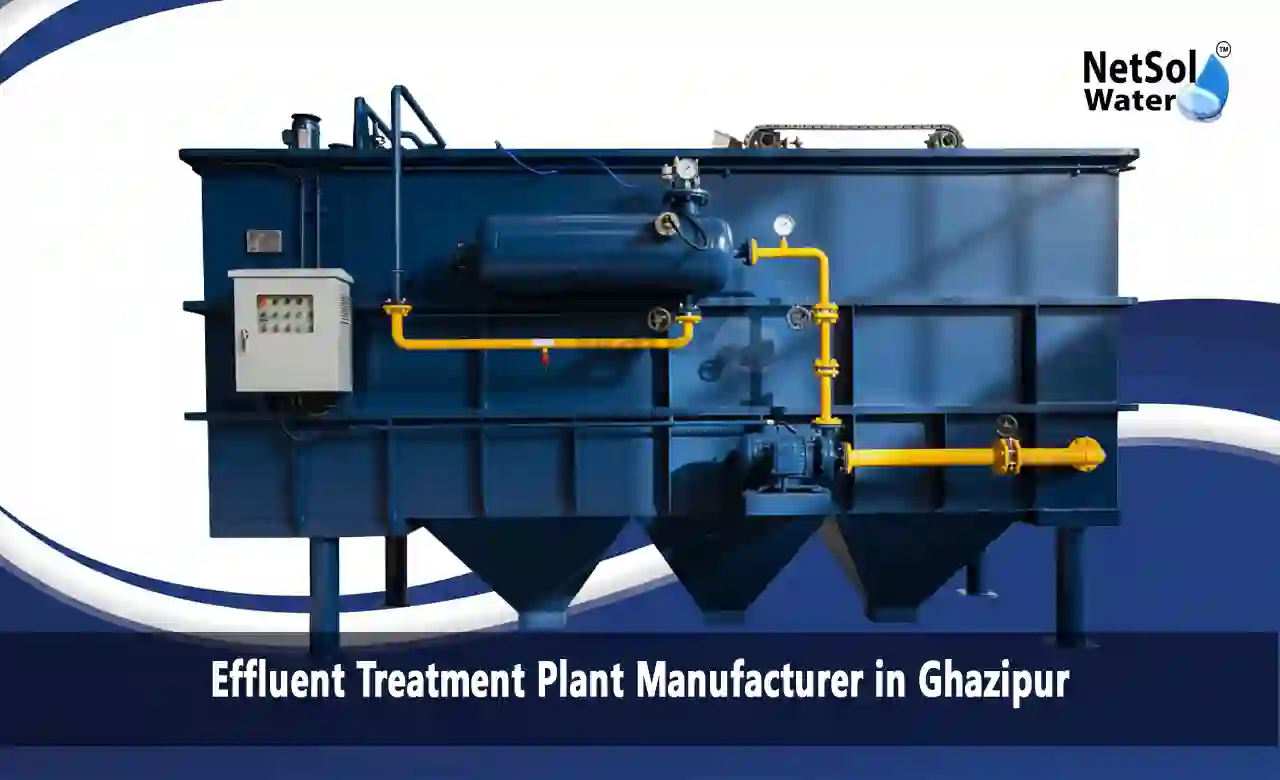
Effluent Treatment Plant Manufacturer in Ghazipur
Ghazipur is located on the banks of the Ganga one of India's most legally protected river systems. Industries operating in the Ganga basin face strict discharge regulations under the National Mission for Clean Ganga (NMCG), NGT directives and Uttar Pradesh Pollution Control Board (UPPCB) notifications. Non-compliant discharge directly into the Ganga or its tributaries carries severe penalties and the risk of immediate shutdown.
For the pharmaceutical, agro-processing, distillery, chemical and food industries of Ghazipur, a well-designed, CPCB-compliant Effluent Treatment Plant is not just a regulatory requirement it is a business continuity investment.
Netsol Water is a trusted Effluent Treatment Plant Manufacturer in Ghazipur with proven experience designing and commissioning ETP systems for the district's most complex industrial effluents. We understand the local regulatory environment, the specific challenges of Ganga basin industries and how to deliver compliant, cost-efficient treatment solutions.
The Regulatory Landscape in Ghazipur
Industries in Ghazipur's Ganga basin face multi-layered regulatory obligations. The CPCB General Standards set minimum discharge limits for BOD, COD, suspended solids, heavy metals and pH. For industries discharging into Ganga tributaries, the Ganga Action Plan imposes additional stringency. Highly polluting industries (distilleries, pharma, chemical) may face ZLD obligations under NGT orders.
The UPPCB actively inspects industrial units in Ghazipur. Third-party effluent sampling, online continuous effluent monitoring system (OCEMS) installation requirements and mandatory filing of compliance reports are increasingly enforced. Companies without compliant ETPs face Consent to Operate cancellation and potential legal proceedings.
Industry-Specific ETP Solutions for Ghazipur
1. Distillery Effluent Treatment
Ghazipur hosts significant distillery operations. Distillery effluent particularly spent wash is among the most challenging wastewaters to treat, with extremely high BOD (50,000–80,000 mg/L), COD and colour. Netsol Water designs multi-stage distillery ETP systems combining biogas recovery (anaerobic digestion), aerobic biological treatment, coagulation-flocculation and reverse osmosis achieving high pollutant removal while recovering value from the waste stream through biogas generation.
2. Pharmaceutical and API Manufacturing
Pharmaceutical units in Ghazipur generate effluents with high COD, pharmaceutical compounds, solvents and complex organics that resist standard biological treatment. Netsol Water designs pharma-specific ETPs with equalisation, activated sludge process, advanced oxidation (Fenton/ozonation) and activated carbon polishing to handle refractory compounds. Our systems meet CPCB norms and can be designed for ZLD where required.
3. Agro-Processing and Food Industry
Agro-processing effluents from Ghazipur's food industry carry high BOD from organic residues, oils, cleaning agents and sugars. Netsol Water designs anaerobic-aerobic hybrid systems for agro-industrial ETPs recovering biogas from high-strength streams, reducing BOD by 95%+ and producing treated water suitable for agricultural reuse under CPCB standards.
4. Chemical and Textile Industries
Chemical industry effluents in Ghazipur often carry toxics, high COD and variable pH. Textile units generate colour and surfactant loads. We design custom treatment trains for both using equalisation, physico-chemical treatment (coagulation, neutralisation, settling), biological oxidation and polishing to ensure discharge compliance and enable water reuse where possible.
Technology Overview Our ETP Toolkit
. Primary Treatment: Equalisation tanks, primary settling, oil and grease traps, screens and grit chambers
. Physico-Chemical Treatment: pH neutralisation, coagulation-flocculation (alum/ferric/lime), lamella settlers
. Biological Treatment: Aerobic ASP, MBBR, SBR; Anaerobic UASB, ABR reactors for high-strength streams
. Advanced Treatment: AOP (Fenton, ozone, UV/H2O2), activated carbon adsorption, ion exchange
. Membrane Systems: UF, NF, RO for high-quality treated water or ZLD water recovery
. ZLD Systems: Multi-Effect Evaporator (MEE), Mechanical Vapor Recompression (MVR), crystallisers
. Sludge Management: Thickeners, belt filter press, plate-frame press, mechanical dewatering
. Automation: PLC/SCADA, OCEMS-ready monitoring, auto-dosing, remote data access
Why Ghazipur Industries Choose Netsol Water?
. Ganga Basin Compliance Knowledge: We understand the specific discharge standards and monitoring requirements for Ganga basin industries giving Ghazipur clients confidence in front of NMCG and UPPCB inspectors.
. Distillery & Pharma Expertise: These are among the most difficult industrial effluents to treat. Our proven track record in these sectors means your plant will meet compliance from day one.
. ZLD Design Capability: For industries facing mandatory ZLD requirements, Netsol Water designs technically and economically sound ZLD systems using evaporation and crystallisation technology.
. Complete Lifecycle Support: Design, fabrication, installation, commissioning, training and ongoing AMC all from a single, accountable partner.
Also Read: ETP Manufacturer in Uttar Pradesh
ETP Installation Process in Ghazipur
1: Comprehensive effluent sampling, lab analysis and regulatory assessment
2: Site survey space, utilities, civil constraints and regulatory obligations
3: Treatment train design, equipment selection and layout drawing
4: Proposal review, client approval and project scheduling
5: Fabrication, quality inspection and factory testing
6: Site installation civil coordination, equipment mounting, instrumentation
7: Commissioning biological startup, performance testing, compliance verification
8: Training, documentation handover, OCEMS integration and AMC activation
Cost of ETP in Ghazipur
Typical ETP costs in Ghazipur range from Rs5–65 lakhs for standard biological systems (1–100 KLD) to Rs1–5 crores for complex ZLD systems. Key cost drivers include effluent volume, pollution load, treatment technology (biological vs ZLD), automation level and site conditions. Netsol Water provides transparent, itemised proposals no hidden charges, and full clarity on capital and operating costs before project commencement.
Frequently Asked Questions
Q1: Why are Ghazipur industries required to install ETPs under Ganga protection laws?
A: Ghazipur is in the Ganga basin. NGT and NMCG directives mandate zero untreated effluent discharge from industries near Ganga tributaries. Industries without compliant ETPs face UPPCB action, potential shutdown and penalties. Netsol Water designs ETPs that meet Ganga basin discharge norms and NMCG compliance requirements.
Q2: Is ZLD mandatory for distilleries in Ghazipur?
A: Yes. Distilleries are classified as highly polluting industries under CPCB norms. NGT orders mandate Zero Liquid Discharge for distilleries in the Ganga basin. Netsol Water designs distillery ZLD systems that combine anaerobic digestion, aerobic treatment, evaporation and crystallisation to achieve complete water recovery.
Q3: What is OCEMS and is it required for my Ghazipur factory?
A: OCEMS (Online Continuous Effluent Monitoring System) monitors treated effluent quality in real time and transmits data to CPCB/SPCB servers. UPPCB requires OCEMS installation for Category A industries in Ghazipur. Netsol Water designs ETP automation systems that are OCEMS-ready, facilitating smooth regulatory connectivity.
Q4: Can ETP treated water be reused for agriculture near Ghazipur?
A: Treated effluent meeting CPCB standards for land application can be reused for agricultural irrigation. Netsol Water designs ETPs producing treated water within CPCB land application norms providing Ghazipur industries with a sustainable water reuse option that reduces freshwater demand and disposal costs.
Q5: How does Netsol Water handle pharma effluent with complex organic compounds?
A: Pharmaceutical effluents with recalcitrant organics require advanced oxidation processes (AOP) including Fenton's reagent, ozonation or UV/H2O2 treatment. Netsol Water designs multi-stage pharma ETPs with AOP stages following biological treatment to ensure complete COD removal and compliance with pharmaceutical industry discharge limits.
Q6: What is the typical COD removal efficiency of a well-designed ETP?
A: A well-designed ETP achieves 85–95% COD removal for standard industrial effluents. For high-strength streams (distillery spent wash, pharma effluent), multi-stage systems with anaerobic pre-treatment and AOP polishing achieve 95–99% COD removal. Netsol Water guarantees performance targets as part of the commissioning protocol.
Q7: Does Netsol Water assist with CPCB and UPPCB consent applications?
A: Netsol Water assists with technical documentation for Consent to Establish (CTE) and Consent to Operate (CTO) applications. We prepare process flow diagrams, treatment efficiency data and environmental compliance reports. Our documentation is designed to meet UPPCB's requirements for Ghazipur's industrial zone applications.