

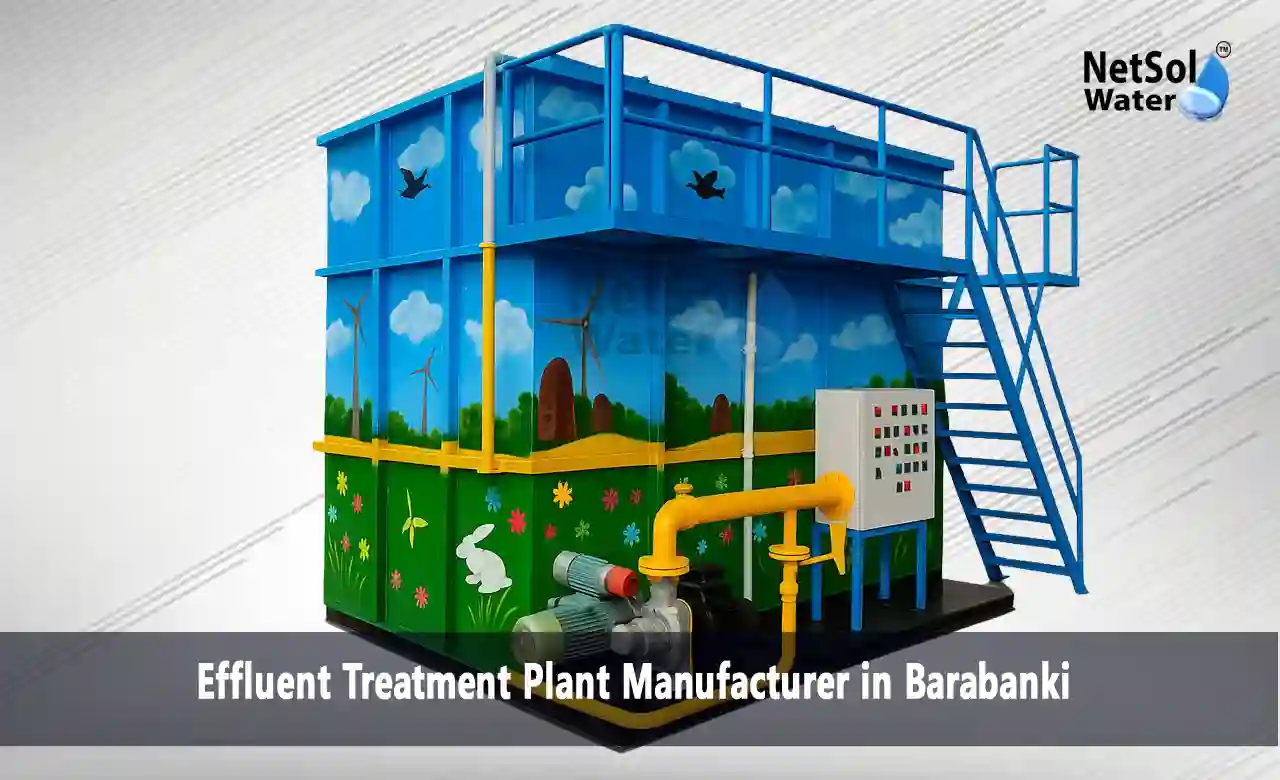
Effluent Treatment Plant Manufacturer in Barabanki
About Netsol Water
Established in 2012 and headquartered in Noida, Netsol Water has grown into a trusted Effluent Treatment Plant Manufacturer and Supplier in Uttar Pradesh. Over the past 14+ years, our team of certified environmental engineers has designed and commissioned effluent treatment systems for clients across Barabanki, Lucknow, Faizabad, Sitapur, and the wider UP industrial belt.
We are ISO 9001:2015 certified and our designs comply with the latest CPCB effluent discharge standards under the Environment (Protection) Act, 1986. Every project begins with a detailed site assessment, and we remain involved through installation, commissioning, staff training, and long-term maintenance.
Our service promise is simple: your plant keeps running, your discharge stays compliant, and your team knows exactly how to manage the system day-to-day.
Why Choose Netsol Water as Your ETP Manufacturer in Barabanki?
Choosing the wrong ETP supplier costs far more than the initial price - it costs you in downtime, regulatory fines, and repeated repairs. Here is what sets Netsol Water apart:
1. Site-Specific Design - No Off-the-Shelf Solutions
Every factory produces a unique waste stream. Before we draw a single design, our engineers conduct a comprehensive site study covering waste type, flow rates, seasonal variation, and reuse potential. This means you receive a system engineered for your actual waste load - not a generic unit that underperforms from day one.
2. Local Presence in Barabanki and UP
A supplier who is 500 km away is of little use when a pump fails at midnight. Our service team operates locally across the Barabanki and Lucknow region. We keep critical spare parts in stock and dispatch trained engineers within hours - not days. Our clients report an average downtime reduction of over 60% after switching to Netsol Water's service model.
3. Full Lifecycle Support
From initial feasibility study and design through to installation, commissioning, operator training, and annual maintenance contracts, we manage the complete project lifecycle. You deal with one partner, not five different vendors.
4. Regulatory Compliance Handled for You
As per CPCB effluent discharge standards (IS:2490), industrial units must treat wastewater to specified BOD, COD, and TSS limits before discharge. Netsol Water prepares all technical reports, load data documentation, and discharge permit applications on your behalf, and guides your team through PCB inspections.
5. Operator Training and Simple Controls
A sophisticated system is only valuable if your team can run it confidently. We provide hands-on operator training at your facility, with straightforward control panels and documented SOPs. Even smaller teams can manage a complex multi-stage ETP without specialist staff.
ETP Systems Offered by Netsol Water in Barabanki
1. Compact Packaged Units
Ideal for small factories, clinics, hotels, and remote industrial sites. These pre-assembled units require minimal civil work, ship ready to install, and are operational within days of delivery. Capacity range: up to 2,000 litres per hour (LPH).
2. Modular Effluent Treatment Plants
Designed for growing businesses, modular ETPs allow you to add treatment capacity incrementally - without tearing down and rebuilding. Netsol Water engineers each module so future expansions slot in cleanly. Capacity range: 2,000 to 30,000 LPH.
3. Full-Scale Bespoke Industrial ETPs
For large factories, industrial estates, and complex mixed waste streams, we design fully customised plants incorporating primary, secondary, and tertiary treatment stages. These plants are engineered to meet the most stringent CPCB and SPCB discharge standards. Capacity range: 30,000+ LPH.
How an Effluent Treatment Plant Works - A Step-by-Step Overview
Understanding the treatment process helps you evaluate designs, set realistic performance expectations, and spot potential issues early. Here is how a standard multi-stage ETP operates:
1. Step 1 - Screening and Primary Separation: Large solids, floating debris, and grit are removed using bar screens and settling tanks. This protects downstream equipment and reduces the load on biological stages.
2. Step 2 - Equalisation: Wastewater is collected in an equalisation tank to balance fluctuations in flow rate and pollutant concentration, ensuring consistent feed to the treatment stages.
3. Step 3 - Primary Clarification: Suspended solids and settleable matter are removed through sedimentation. Chemical coagulants and flocculants may be added for enhanced removal.
4. Step 4 - Biological Treatment: Bacteria break down dissolved organic matter in aerated tanks. Netsol Water systems use activated sludge, fixed-film (MBBR), or hybrid processes depending on the waste stream. This stage typically achieves BOD reductions of 90 to 98%.
5. Step 5 - Secondary Clarification: Biological sludge is separated from treated water and either recycled into the aeration tank or removed for sludge management.
6. Step 6 - Tertiary Polishing: Advanced filtration, UV disinfection, and nutrient removal bring treated water to the quality required for safe discharge or industrial reuse. Over 80% of treated water can be recovered for process reuse with the right tertiary design.
7. Step 7 - Sludge Management: Settled sludge is thickened, dewatered using a filter press or centrifuge, and prepared for compliant disposal or use as soil conditioner.
Industries We Serve in Barabanki and Across Uttar Pradesh
1. Food and Beverage Processing
Waste from food units - including sugar mills, dairy plants, and packaged food factories common in the Barabanki region - carries high organic load (BOD 600–2,000 mg/L), fats, oils, and grease. Our designs prioritise robust biological treatment and efficient grease trap systems to handle these concentrated wastes reliably.
2. Textile and Dyeing Units
Textile effluent presents unique challenges: high colour content, chemical oxygen demand, and heavy metals. We incorporate advanced coagulation, colour removal by ozonation or activated carbon, and chemical neutralisation stages specifically for this sector.
3. Pharmaceutical and Chemical Manufacturing
These waste streams may contain toxic or inhibitory compounds, solvents, and API residues requiring specialised handling. Our designs include pH neutralisation, advanced oxidation processes (AOP), and careful biological acclimatisation to ensure reliable treatment without system upsets.
4. Municipal, Commercial, and Institutional Use
Schools, hospitals, hotels, and commercial complexes in Barabanki also need reliable effluent management for local regulatory compliance. Our compact packaged units are well suited to these applications and are designed for easy operation by non-specialist staff.
5. Agro-Based and Sugarcane Processing
Barabanki's sugarcane processing industry generates high-BOD, high-suspended solids effluent that benefits from customised anaerobic pre-treatment before aerobic biological stages. This significantly reduces energy consumption and operational costs compared to direct aerobic treatment.
ETP Capacity Range - Which System is Right for You?
The table below summarises typical capacity ranges and their recommended applications:
|
Capacity Range |
Suitable For |
Typical Use Case |
|
Up to 10 KLD |
Small workshops, clinics, hotels |
Compact packaged units, low footprint |
|
10 KLD - 25 KLD |
Small to mid-size factories |
Modular systems with staged expansion |
|
25 KLD- 100 KLD |
Medium industrial units |
Semi-custom biological + tertiary plants |
|
100 KLD+ |
Large factories, industrial clusters |
Full-scale bespoke ETP with SCADA controls |
Not sure which capacity suits your operation? Our engineers will assess your current and projected flow rates and recommend the most cost-effective solution. Contact us for a free capacity assessment.
Cost of an Effluent Treatment Plant in Barabanki
ETP costs vary widely depending on several factors. As a general guide for industrial buyers in Barabanki and UP:
• Small packaged units (up to 2,000 LPH): typically Rs. 5 lakh to Rs. 15 lakh, including basic civil work.
• Medium modular systems (2,000 to 30,000 LPH): typically Rs. 15 lakh to Rs. 75 lakh depending on waste complexity and automation level.
• Large bespoke plants (30,000+ LPH): Rs. 75 lakh and above, with cost heavily influenced by civil works, SCADA automation, and tertiary requirements.
Key cost drivers include:
• Wastewater flow rate and peak load variation
• Complexity and toxicity of the waste stream
• Required discharge quality (for drain, river, or reuse)
• Level of automation and remote monitoring
• Civil and site preparation requirements
• Ongoing operating costs: power, chemicals, and maintenance labour
A clear lifecycle cost view - not just capital expenditure - is the right way to evaluate options. Netsol Water provides detailed Total Cost of Ownership (TCO) projections for every proposal so you can make an informed investment decision.
Regulatory Compliance and Approvals - We Handle the Paperwork
Meeting Pollution Control Board requirements is non-negotiable for any industrial unit in India. Under the Environment (Protection) Act, 1986, and the Water (Prevention and Control of Pollution) Act, 1974, every industrial unit generating effluent must obtain a Consent to Establish (CTE) and Consent to Operate (CTO) from the Uttar Pradesh Pollution Control Board (UPPCB).
Netsol Water manages the compliance process end-to-end:
• Preparation of Form V applications and technical feasibility reports
• Effluent characterisation studies and mass load calculations per CPCB norms
• Submission of design drawings and process flow diagrams to UPPCB
• Support during PCB site inspections and post-installation verification
• Sampling and monitoring plan setup as per discharge consent conditions
• Assistance with Hazardous Waste Authorisation for sludge disposal
We also keep our clients updated on regulatory changes - whether new discharge limits, revised IS standards, or updated CPCB guidelines - and we help modify existing systems when requirements change. This proactive compliance support protects you from fines, closure notices, and reputational risk.
Frequently Asked Questions - ETP in Barabanki
Q1. What is an Effluent Treatment Plant (ETP) and why do I need one?
An ETP is a system that treats industrial wastewater to remove harmful pollutants before the water is discharged or reused. In India, operating without a functional ETP exposes your business to UPPCB enforcement action, production shutdowns, and significant fines under environmental law.
Q2. How much does an ETP cost in Barabanki?
ETP costs in Barabanki start from approximately Rs. 5 lakh for compact units up to 2,000 LPH and can reach Rs. 75 lakh or more for large industrial plants. The exact cost depends on your flow rate, waste type, and required discharge quality. Netsol Water provides free site assessments and detailed quotations.
Q3. How long does ETP installation take?
Compact packaged units can be installed and operational within 2 to 4 weeks. Medium modular systems typically take 6 to 12 weeks. Full-scale bespoke plants require 3 to 6 months depending on civil works and system complexity.
Q4. Which industries in Barabanki need an effluent treatment plant?
Any industry generating process wastewater is required to treat it before discharge. This includes food and beverage processors, textile units, pharmaceutical manufacturers, chemical plants, hospitals, hotels, and agro-processing facilities such as sugar mills.
Q5. Does Netsol Water handle UPPCB approvals and permits?
Yes. We prepare and submit all documentation required for Consent to Establish (CTE) and Consent to Operate (CTO) from UPPCB, including technical reports, design drawings, and effluent load data. We also support your team during PCB inspections.
Q6. Can treated water be reused after ETP treatment?
Yes. With a properly designed tertiary treatment stage, up to 80% of treated effluent can be recovered for process reuse, cooling tower top-up, or garden irrigation - significantly reducing freshwater consumption and operating costs.
Q7. What is the difference between an ETP and an STP?
An Effluent Treatment Plant (ETP) is designed for industrial wastewater, which contains chemicals, heavy metals, and high organic loads specific to manufacturing processes. A Sewage Treatment Plant (STP) handles domestic or municipal wastewater. The treatment technologies and design parameters are different for each.
Get Your Free ETP Site Assessment in Barabanki
Choosing the right Effluent Treatment Plant Manufacturer in Barabanki is one of the most important decisions your plant will make - for operations, compliance, and long-term cost control. Get it right from the start.
Netsol Water offers a completely free, no-obligation site assessment. Our engineers will visit your facility, analyse your waste stream, review your discharge requirements, and present a custom ETP design and costing within 48 hours.
No generic proposals. No one-size-fits-all systems. Just a solution engineered for your exact needs.
Contact Netsol Water Today
Phone: +91-9650608473
Email: enquiry@netsolwater.com
Service Area: Barabanki | Lucknow | Faizabad | Sitapur | Uttar Pradesh