

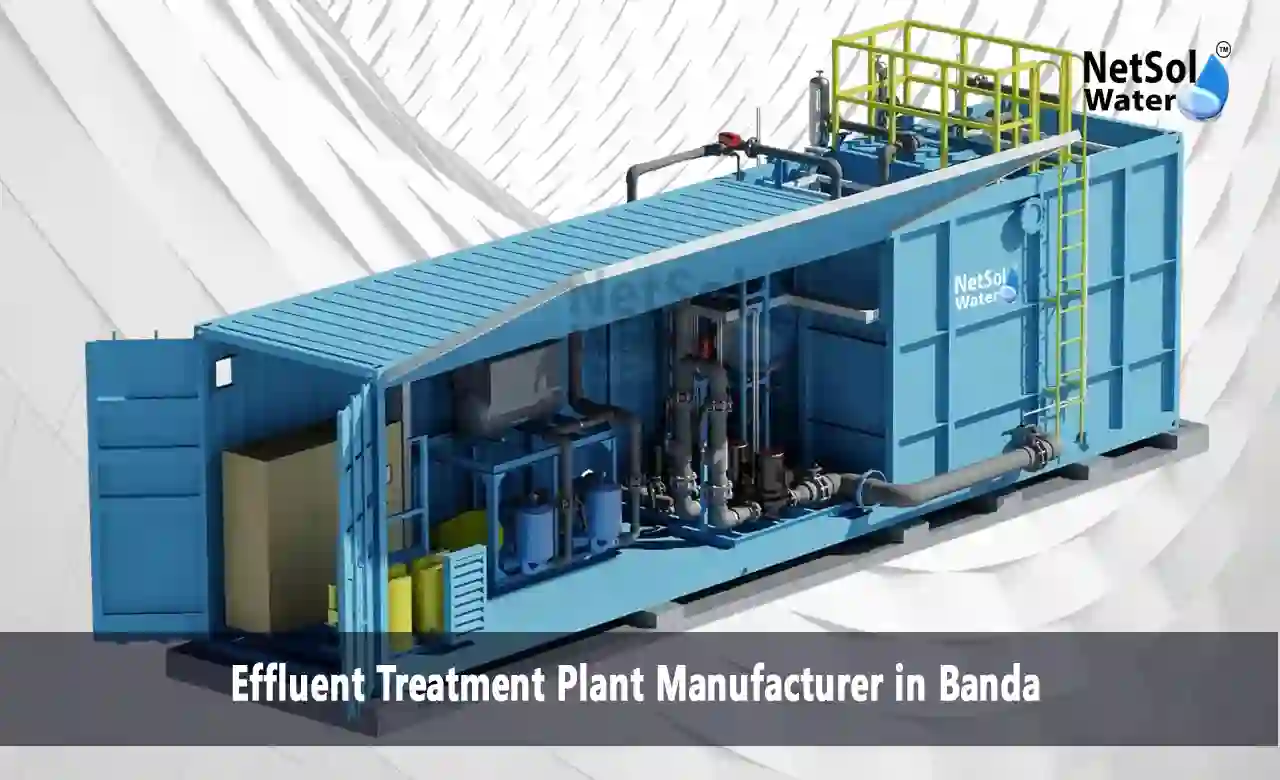
Effluent Treatment Plant Manufacturer in Banda
If your factory in Banda is discharging wastewater without a proper treatment system, you could be violating CPCB norms - and facing penalties that can shut your operations down. Industries across Banda's food processing, textile, chemical and packaging sectors are now required by law to treat their effluent before discharge or reuse.
That is where a reliable Effluent Treatment Plant manufacturer in Banda becomes absolutely critical - not just for compliance, but for long-term operational efficiency and environmental responsibility.
Netsol Water has designed and installed ETP systems for industries across Uttar Pradesh. Whether you need a compact 1 KLD plant for a small unit or a 500 KLD multi-stage system for a large processing facility, we build it to perform.
What Is an Effluent Treatment Plant (ETP)?
An Effluent Treatment Plant is an industrial wastewater management system that removes harmful contaminants - such as chemicals, suspended solids, BOD, COD, oils, dyes and heavy metals - from process water before it is discharged into the environment or recycled within the facility.
Unlike domestic sewage, industrial effluent contains complex pollutants that require multi-stage treatment combining physical, chemical, and biological processes. Without proper treatment, these pollutants can contaminate rivers, groundwater, and agricultural land - causing irreversible ecological damage.
Why Do Industries in Banda Need an ETP?
Banda is a growing industrial hub in Uttar Pradesh, with active food processing units, rice mills, chemical plants, textile facilities, and packaging industries. Each of these sectors generates process wastewater that carries specific pollutants depending on their operations.
Here is why installing a proper ETP is no longer optional for industries in Banda:
• CPCB & SPCB Compliance: The Central Pollution Control Board mandates treated effluent discharge standards. Non-compliance results in notices, fines, and potential shutdown orders.
• Water Scarcity Management: Treated water can be reused in cooling towers, gardening, flushing, and some secondary processes - reducing freshwater consumption significantly.
• Protecting Local Ecosystems: Industrial effluents released untreated into rivers or soil near Banda can destroy aquatic life and render agricultural land unusable.
• Corporate Sustainability Goals: More businesses today are expected to demonstrate environmental responsibility as part of ESG (Environmental, Social, Governance) commitments.
How Netsol Water Designs ETP Systems for Banda's Industries?
At Netsol Water, we do not believe in one-size-fits-all. Every ETP we design starts with a detailed wastewater characterization study - because the treatment technology you need depends entirely on what is in your effluent.
Our process:
• Step 1 - Effluent Analysis: We collect wastewater samples and run laboratory tests to measure BOD, COD, TSS, pH, heavy metals, TDS, and specific industrial pollutants.
• Step 2 - Process Design: Based on the analysis, our engineers select the most effective combination of treatment stages - physico-chemical, biological, or advanced membrane-based systems.
• Step 3 - Engineering & Fabrication: We fabricate systems using corrosion-resistant materials, energy-efficient aeration systems, and automated control panels for low-maintenance operation.
• Step 4 - Installation & Commissioning: Our team handles civil coordination, mechanical installation, electrical work, and operator training on-site.
• Step 5 - After-Sales Support: We provide AMC (Annual Maintenance Contracts), spare parts supply, performance monitoring, and compliance documentation support.
ETP Treatment Technologies We Use
Modern Effluent Treatment Plants use a combination of processes depending on the type and concentration of pollutants involved. Here is an overview of the stages deployed in our ETP systems:
Stage 1 - Equalization & Pre-Treatment
Wastewater from different production lines arrives at different times with varying pollutant concentrations. An equalization tank balances the flow and composition before treatment begins. This stage also includes screening and pH neutralization using chemical dosing.
Stage 2 - Physico-Chemical Treatment
Chemical coagulants (like alum or FeCl?) and flocculants are added to the wastewater to bind suspended solids and colloidal particles into larger clumps called floc. These are then separated in a clarifier or DAF (Dissolved Air Flotation) unit. This stage is especially effective for removing heavy metals, color, and turbidity.
Stage 3 - Biological Treatment (Aerobic / Anaerobic)
Organic matter dissolved in the wastewater is broken down by microorganisms. In aerobic treatment (using aeration tanks), bacteria consume organic compounds in the presence of oxygen. For high-strength effluents from food processing or breweries, anaerobic treatment is used first to reduce load before aerobic polishing.
Stage 4 - Secondary Clarification & Sludge Management
After biological treatment, the biomass (sludge) is separated from the treated water in a secondary clarifier. The sludge is then thickened, dewatered using a filter press or centrifuge, and disposed of or used as fertilizer. Treated water moves to the next polishing stage.
Stage 5 - Tertiary Filtration & Polishing
For industries requiring high-quality treated water for reuse, tertiary treatment includes sand filtration, activated carbon filtration, and in advanced cases - Ultrafiltration (UF), Reverse Osmosis (RO), or Membrane Bioreactor (MBR) systems. This stage ensures the treated effluent meets CPCB discharge standards or reuse quality benchmarks.
ETP Plant Capacity & Cost in Banda
The cost of an Effluent Treatment Plant depends on three primary factors: the volume of wastewater generated per day (KLD - Kilolitres per Day), the complexity of pollutants in the effluent, and the level of automation required. Below is a practical cost guide for industries in Banda:
|
Industry Scale |
Plant Capacity |
Estimated Cost Range |
|
Small Industries (Workshops, Food Units) |
1 – 25 KLD |
INR5 Lakh – INR25 Lakh |
|
Medium Industries (Textiles, Chemicals, Pharma) |
50 – 100 KLD |
INR35 Lakh – INR80 Lakh |
|
Large Industries (Heavy Processing, Multi-Unit) |
200 KLD & Above |
INR1 Crore – INR4 Crore+ |
Note: These are indicative estimates. Final cost depends on site conditions, civil construction requirements, automation level, and wastewater characterization. Contact our team for a site-specific quote.
Factors That Affect ETP Plant Cost
• Nature and composition of industrial effluent (more complex = more treatment stages)
• Daily wastewater volume and peak flow rate
• Level of treatment required (basic discharge vs. treated water reuse)
• Automation requirements - manual vs. SCADA-enabled monitoring
• Civil construction and site preparation work
• Distance from the installation site to our facility (logistics)
• Post-installation AMC and service agreement scope
How to Choose the Right ETP Plant for Your Industry?
Choosing the wrong ETP - either under-designed or over-engineered for your needs - leads to either non-compliance or unnecessary capital expense. Here is a practical framework to guide your decision:
• Get Your Effluent Tested First: Before talking to any vendor, run a lab analysis of your wastewater. This tells you the exact pollutants and their concentrations - the single most important input for ETP design.
• Calculate Your Daily Wastewater Volume: Measure how many kilolitres of wastewater your plant generates per day, including peak flow during maximum production.
• Define Your End Goal: Is the treated water to be discharged into a drain, a river, or reused in your facility? Each scenario has different treatment depth requirements.
• Plan for Future Expansion: If your production capacity is likely to grow, design your ETP with expansion provisions built in - adding capacity later is more expensive than planning ahead.
• Evaluate Vendors on EEAT - Not Just Price: Look for manufacturers with proven installations, certified engineers, CPCB-compliant designs, and strong after-sales support.
Top 3 Effluent Treatment Plant Manufacturers in Banda
1. Netsol Water
Netsol Water is a leading ETP manufacturer and supplier across Uttar Pradesh and beyond. With deep expertise in industrial wastewater characterization and multi-stage treatment design, we have helped factories in food processing, textiles, chemicals and packaging meet CPCB compliance without operational disruption.
What sets us apart: Every system we design is preceded by an independent effluent analysis. We do not retrofit generic solutions - we engineer systems around your specific wastewater profile. Our plants are designed for energy efficiency, low chemical consumption, easy operator maintenance, and long equipment life.
• Service Coverage: Pan-India, with strong presence in UP
• Specialization: Custom ETP design for small to large-scale industries
• Support: AMC, spare parts, compliance documentation
• Contact: +91-9650608473 | enquiry@netsolwater.com
2. Urban STP Plant
Urban STP Plant is a globally recognized water and wastewater treatment company with a strong presence in industrial and municipal sectors. They handle complex, large-scale ETP projects using advanced treatment technologies. Best suited for large corporations with high-volume, technically complex effluent treatment needs.
3. Sewage Treatment Plants
Sewage Treatment Plants offers a range of water and wastewater treatment solutions for industries. Their ETP systems incorporate advanced filtration and chemical treatment modules. They serve a wide range of industries nationally and are particularly known for ion-exchange based water purification technologies.
Ready to Set Up Your ETP Plant in Banda?
Get a free site assessment and custom ETP design quote from Netsol Water.
Call: +91-9650608473 | Email: enquiry@netsolwater.com
FAQs
Q1. What is an Effluent Treatment Plant (ETP)?
An Effluent Treatment Plant (ETP) is an industrial wastewater treatment system designed to remove harmful pollutants - including chemicals, suspended solids, BOD, COD, oils, and heavy metals - from process wastewater. It uses a combination of physical, chemical, and biological treatment stages to make the water safe for discharge or reuse, ensuring compliance with CPCB and SPCB environmental norms.
Q2. How much does an ETP plant cost in Banda?
The cost of an ETP plant in Banda depends on capacity and complexity. Small units (1–25 KLD) cost INR5 lakh to INR25 lakh. Medium plants (50–100 KLD) range from INR35 lakh to INR80 lakh. Large industrial systems (200 KLD and above) cost INR1 crore to INR4 crore or more. A site-specific analysis is recommended for accurate pricing.
Q3. Which industries in Banda need an Effluent Treatment Plant?
Industries that generate process wastewater are required to install an ETP. In Banda, this includes food processing units, rice mills, chemical plants, textile and dyeing units, pharmaceutical manufacturers, packaging industries, and any factory discharging effluent into the environment. The CPCB mandates ETP installation for all such industrial units to meet discharge standards.
Q4. Is an ETP plant legally mandatory in Uttar Pradesh?
Yes. Under the Water (Prevention and Control of Pollution) Act, 1974 and Environment Protection Act, 1986, industries generating wastewater in Uttar Pradesh are legally required to treat their effluent before discharge. The UP Pollution Control Board (UPPCB) enforces these norms and can issue closure notices to non-compliant units. Operating without a functional ETP is a legal violation.
Q5. What is the difference between ETP, STP, and CETP?
An ETP (Effluent Treatment Plant) treats industrial wastewater. An STP (Sewage Treatment Plant) treats domestic or municipal wastewater. A CETP (Common Effluent Treatment Plant) is a shared facility serving multiple small industries in an industrial cluster, reducing individual setup costs. The treatment technologies differ based on the pollutant profile of each type of wastewater.
Q6. How long does it take to install an ETP plant in Banda?
Installation time for an ETP plant depends on its size and complexity. A small ETP (10–25 KLD) typically takes 4–8 weeks from order to commissioning. Medium plants (50–100 KLD) require 8–16 weeks. Large multi-stage systems (200 KLD+) can take 4–6 months, including civil construction, equipment installation, and commissioning. Custom timelines are provided after site assessment.
Q7. Can ETP-treated water be reused in the factory?
Yes, in many cases. Depending on the treatment level and water quality requirements, ETP-treated water can be reused for cooling tower makeup, floor washing, toilet flushing, gardening, and some secondary process applications. Advanced tertiary treatment - including RO and UF systems - can bring treated water quality to near-potable standards for higher-grade reuse applications.
Q8. How do I choose the best ETP manufacturer in Banda?
Choose an ETP manufacturer based on: (1) their experience with your specific industry type, (2) willingness to conduct a pre-design wastewater analysis, (3) use of CPCB-compliant treatment technologies, (4) transparency in cost estimation, (5) strength of after-sales service and AMC offerings, and (6) references or case studies from installed plants. Netsol Water offers all of these as standard.