

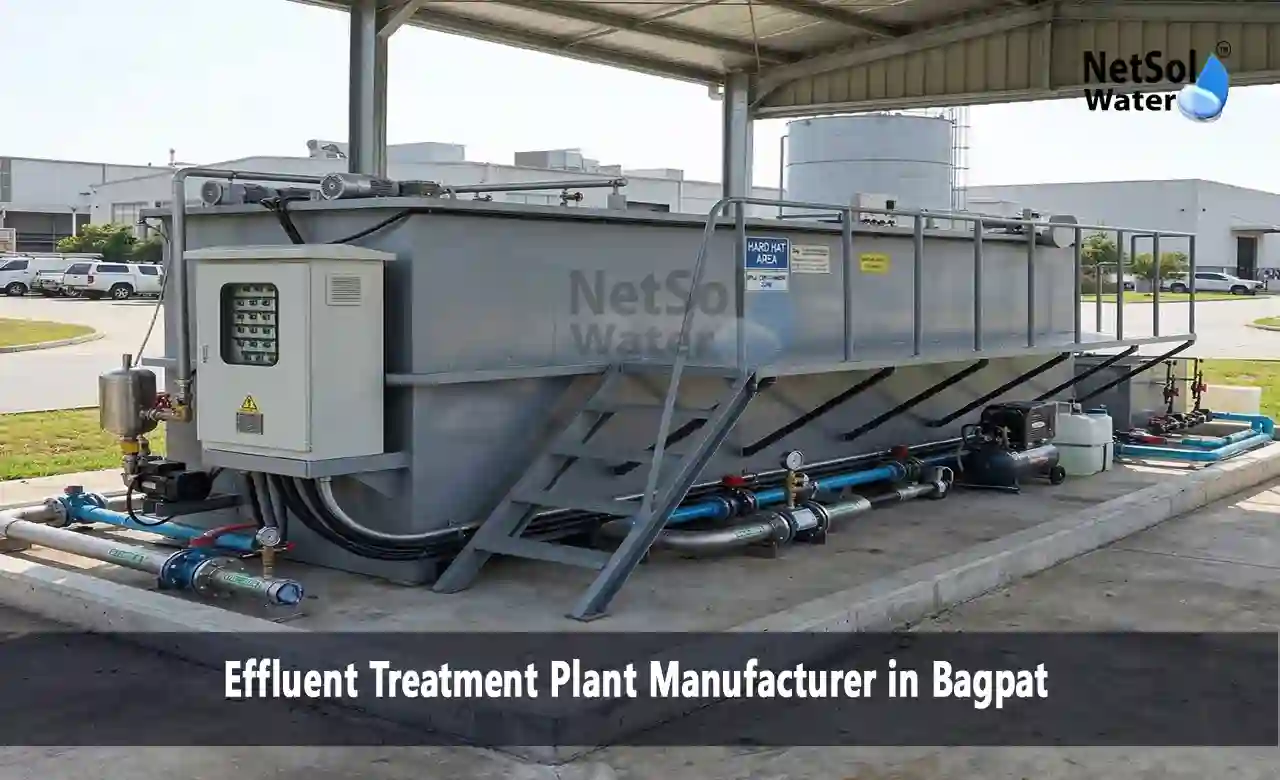
Effluent Treatment Plant Manufacturer in Bagpat
Bagpat has always been known for its agricultural land and sugarcane fields. But over the last several years, the industrial side of the district has grown quietly and steadily. Sugar mills, paper units, food processing facilities, textile workshops, and small manufacturing setups have all expanded. And with that expansion comes a problem that does not announce itself loudly but builds up over time: industrial wastewater.
Every factory produces effluent. The chemicals, dyes, heavy metals, oils, and organic waste dissolved in that water do not disappear on their own. If they are not treated properly before being released, they move into the soil, into drains, and eventually into the groundwater that farmers and families in the area depend on every single day.
We are Netsol Water, an ISO 9001:2015 certified industrial water and wastewater treatment company with over 1500 ETP and ZLD systems commissioned across Uttar Pradesh, Rajasthan, and Haryana since 2012. We have been working with industries in Bagpat and across the wider UP region for over a decade, and this guide is written to help factory owners understand what proper effluent treatment involves, what it costs, and what happens when it gets delayed.
What Is an Effluent Treatment Plant and Why Is It Legally Mandatory?
An Effluent Treatment Plant is an industrial wastewater treatment system designed to remove physical, chemical, and biological pollutants from factory discharge before it is released into the environment or reused within the facility. It processes raw industrial effluent through a series of treatment stages - screening, equalization, chemical treatment, biological treatment, filtration, and disinfection - producing treated water that meets UPPCB prescribed discharge norms.
Under the Water (Prevention and Control of Pollution) Act, 1974 and the Environment Protection Act, 1986, every industry in Uttar Pradesh that generates wastewater must obtain UPPCB Consent to Operate and demonstrate that its effluent meets the prescribed discharge standards before being released. Operating a facility without a functional ETP, or with one that consistently fails compliance tests, is a legal violation that carries escalating consequences - from fines and show-cause notices to facility closure orders.
This is not a theoretical risk. UPPCB has significantly increased its inspection frequency in industrial zones across UP over the last three years, and Bagpat district has seen a corresponding rise in compliance-related notices issued to sugar, textile, and food processing units. Getting ahead of this is substantially less expensive than responding to it under pressure.
What Happens If You Delay ETP Installation?
This is a question worth answering honestly because many factory owners keep pushing the decision down the road. Here is what actually unfolds when ETP installation gets delayed - not in the worst-case scenario, but in the typical one.
1. In the first few months
Nothing dramatic happens immediately. Wastewater continues to be discharged without treatment into drains, open land, or nearby water channels. The visible impact is minimal at this stage, which is exactly why the delay feels justified. The problem is invisible, so it does not feel urgent.
2. Within 6 to 12 months
Soil around the discharge point begins showing contamination. Nearby agricultural land may show reduced crop quality or unexplained yield drops. Locals start noticing changes in borewell water - colour, odour, or taste. Complaints are filed, sometimes directly with the UPPCB, sometimes through the district administration. Your facility's name enters a complaint register.
3. At the 1 to 2 year mark
This is when it gets serious. A UPPCB inspection is triggered - either by the complaints or during a routine industrial zone check. A show-cause notice arrives. At this point you are looking at fines that start at Rs. 10,000 and escalate depending on the severity and duration of the violation, a mandatory compliance deadline with a fixed timeline to install treatment, the possibility of a temporary production shutdown until compliance is demonstrated, and legal notices that become part of your facility's official regulatory record.
4. Beyond two years of non-compliance
Repeated violations lead to escalating consequences. The UPPCB can recommend permanent closure of facilities that consistently fail to meet discharge norms, and district courts in UP have upheld such orders in several documented industrial cases. At this point, the cost of getting compliant - done under pressure, with a deadline, and with a compliance history working against you - is significantly higher than it would have been from the start. And you are doing it under conditions that make it very difficult to make good engineering decisions.
The straightforward calculation: a 25 KLD standard ETP installed today costs between Rs. 12 lakh and Rs. 18 lakh depending on your effluent type. A compliance-driven installation after two years of violations, combined with fines, legal costs, and production downtime, routinely exceeds Rs. 30 to 40 lakh. The delay costs more than the solution.
How Does an Effluent Treatment Plant Work?
A modern industrial ETP handles wastewater through structured stages, each targeting a specific category of pollutants. Understanding the process helps you evaluate whether a proposed design is actually suited to your effluent - or whether a manufacturer is cutting corners.
Stage 1 - Preliminary screening
Large solids, fibres, plastic, and floating debris are removed physically using bar screens and mechanical separators. Oil and grease are separated in dedicated skimming chambers at this stage. This step protects every piece of equipment that follows from physical damage and clogging. Skipping or undersizing this stage is one of the most common causes of downstream equipment failure in cheaply designed ETPs.
Stage 2 - Equalization
Industrial effluent does not flow at a constant rate or arrive with consistent composition throughout a production day. A morning shift in a dyeing unit produces very different wastewater from an afternoon shift. An equalization tank collects and mixes incoming wastewater to create a stable, uniform feed before it enters treatment. Without this buffer, downstream equipment receives unpredictable chemical and hydraulic loads and performs poorly. Every well-designed ETP includes adequate equalization - the tank volume should reflect at least six to eight hours of peak flow.
Stage 3 - Chemical treatment
By Stage 3, the water looks cleaner but still carries its most stubborn contaminants invisibly - dissolved heavy metals, synthetic dyes, and fine colloidal particles that no physical filter can catch. This is where chemical treatment takes over. Coagulants are dosed into the flow, binding these particles into visible clumps called flocs that settle to the bottom of the clarification tank as sludge. The sludge is removed and handled separately. For textile, dyeing, and paper industries in Bagpat, this stage is the difference between water that looks treated and water that actually meets UPPCB colour and heavy metals norms. pH correction is also managed here, because the downstream biological stage requires a specific pH window to function correctly.
Stage 4 - Biological treatment
Dissolved organic matter - the BOD and COD load in your effluent - is broken down by microorganisms in the biological treatment stage. The technology we select depends on your specific effluent profile and site conditions. MBBR, or Moving Bed Biofilm Reactor, suits compact sites that need efficient biological treatment in a smaller footprint. SBR, or Sequential Batch Reactor, handles facilities with fluctuating effluent volumes particularly well. Extended Aeration works reliably for moderate organic loads in sugar and food processing applications. Each of these technologies has strengths for specific effluent types - the selection should be based on your actual BOD and COD data, not on what a manufacturer happens to build most often.
Stage 5 - Secondary clarification
After biological treatment, the water still carries suspended biological sludge and residual solids. Secondary clarification tanks allow these to settle out and be removed before the water moves to final polishing. The sludge from this stage is returned to the biological reactor to maintain the active microbial population or removed for dewatering and disposal.
Stage 6 - Filtration and disinfection
Sand filters remove fine particulates and residual suspended solids. Activated carbon filters address residual colour and odour compounds. UV treatment or chlorination destroys remaining pathogens. The treated water leaving this stage meets UPPCB discharge norms and is ready for either safe discharge to approved drains or reuse within the facility. Our sugar mill ETPs consistently reduce BOD from 3,000 to 5,000 mg/L in raw effluent to below 30 mg/L in treated discharge - meeting the UPPCB standard of 30 mg/L for inland surface water discharge.
ZLD vs Standard ETP: Which System Does Your Industry Require?
This is the question industries ask most often when planning wastewater treatment, and the answer has both a technical dimension and a regulatory one. Getting this wrong at the planning stage either results in a system that does not meet your UPPCB consent conditions or a significantly over-engineered investment that was never required.
What is a standard ETP?
A standard ETP treats industrial effluent through the multi-stage process described above and produces treated water that meets UPPCB discharge norms. That treated water is then either discharged into approved drains or water bodies, or reused within the facility for non-critical purposes like floor washing, green area irrigation, or cooling tower make-up. A standard ETP is suitable for most industries where the treated effluent quality meets discharge limits and the UPPCB consent conditions do not specify zero liquid discharge. For most food processing units, sugar mills, paper units, and general manufacturing facilities in Bagpat, a well-designed standard ETP is the appropriate and sufficient solution.
What is a ZLD system?
ZLD stands for Zero Liquid Discharge. In a ZLD system, no treated wastewater is discharged outside the facility under any circumstances. Every litre of water is treated, recovered, and recycled back into the production process. The only output is dry solid waste or a concentrated sludge suitable for further processing or controlled disposal. ZLD systems include all the stages of a standard ETP, plus a Membrane Bioreactor or Ultrafiltration unit for advanced suspended solids removal, Reverse Osmosis for further TDS reduction and water recovery, and a Multi Effect Evaporator or Mechanical Vapour Recompression unit to recover the remaining water from the RO concentrate. The recovered water from a well-designed ZLD system achieves 80 to 85 percent recycling of total influent - meaning a facility that previously consumed 100 KLD of fresh water now requires only 15 to 20 KLD to maintain the same production.
Textile dyeing units, pharmaceutical manufacturers, and certain chemical industries in UP are mandated by UPPCB to install ZLD systems. If your facility operates in one of these sectors, your UPPCB consent conditions will specify ZLD compliance explicitly. For any other industry that is unsure of its specific requirements, checking the consent conditions directly or speaking to an experienced ETP manufacturer who works regularly with UPPCB submissions is the fastest path to clarity.
Industries in Bagpat That Need an Effluent Treatment Plant
Bagpat has a specific industrial mix and each sector generates wastewater with very different characteristics. A properly designed ETP or ZLD system is matched to the effluent profile of the industry it serves - not to a generic specification that manufacturers apply across every project.
1. Sugar mills and distilleries
Sugar mill effluent carries extremely high BOD loads from molasses, spent wash, and fermentation residues. Raw BOD levels of 3,000 to 8,000 mg/L are common. Without treatment, this kind of discharge depletes dissolved oxygen in receiving water bodies rapidly, killing aquatic life and rendering water unusable for irrigation within a significant radius. Our biological treatment systems for sugar applications consistently achieve BOD reduction to below 30 mg/L, meeting UPPCB norms for surface water discharge.
2. Textile and dyeing units
Wastewater from dyeing and bleaching operations contains synthetic dyes, dissolved salts, surfactants, and processing chemicals. Colour removal is the most visible and technically demanding challenge here - it requires a specific combination of chemical coagulation and biological treatment, and sometimes ozonation or advanced oxidation for deep colour reduction. Units generating coloured effluent in UP are frequently flagged in UPPCB inspections because the discharge is visually obvious in receiving drains. These units are also among those most commonly required to install ZLD systems.
3. Food processing units
Dairy plants, vegetable processing units, and packaged food facilities discharge water high in fats, oils, proteins, and suspended solids. This type of effluent creates severe odour problems within days if left untreated and has high BOD loads that respond well to biological treatment. Food processing ETPs also need to meet FSSAI-adjacent quality requirements for any treated water that is reused in the facility. Our food processing ETPs are designed to meet both UPPCB discharge norms and FSSAI process water reuse standards.
4. Paper and pulp units
Paper mill effluent carries high COD, suspended fibres, lignin, and processing chemicals. The colour of paper mill discharge is also a UPPCB compliance issue. These units require strong biological treatment supplemented by chemical treatment for colour and COD, plus sludge dewatering systems to manage the significant solid waste volumes that paper manufacturing generates.
5. Metal fabrication and electroplating
Electroplating and metal finishing wastewater contains heavy metals including chromium, zinc, nickel, lead, and cadmium. Chemical precipitation is essential at this stage - heavy metals cannot be removed biologically. The sludge produced from heavy metal precipitation is classified as hazardous waste under the Hazardous Waste Management Rules and requires storage in lined areas and disposal through authorised TSDF facilities. This is a critical compliance dimension that many smaller manufacturers overlook at the design stage.
6. Pharmaceutical units
Active pharmaceutical compounds, solvents, and chemical residues make pharma effluent particularly resistant to conventional biological treatment. Many of these compounds are toxic to the microorganisms that perform biological treatment, which means the biological stage must be carefully designed and operated. Pharmaceutical manufacturers in UP are among those most consistently required to install full ZLD systems, given the potential for pharmaceutical residues in groundwater and the sector's exposure under the National Green Tribunal's guidelines.
Real Cost of an Effluent Treatment Plant in Bagpat
One of the biggest frustrations industries face is receiving quotes that are either vague or wildly inconsistent between manufacturers. The variation is real - but it is driven by legitimate engineering differences, not arbitrary pricing. Here is a transparent look at what drives ETP costs and what realistic ranges look like for standard configurations.
What drives the capital cost?
Effluent volume in KLD is the primary cost driver - bigger tanks, larger pumps, more civil work, and more membrane area all scale with volume. Effluent complexity is the second major factor. Treating heavy metals or synthetic dyes costs significantly more than treating simple organic waste from a food plant, because the chemical treatment systems and sludge handling infrastructure are more complex. The technology chosen - particularly the difference between a standard ETP and a ZLD system - has the largest single impact on total cost. ZLD systems typically cost 2.5 to 3.5 times more than an equivalent standard ETP because of the RO and evaporator systems they incorporate. Civil work requirements, site accessibility, and existing infrastructure at your facility are the remaining cost variables.
Indicative price ranges for standard ETPs
1 to 25 KLD capacity: Rs. 6 lakh to Rs. 20 lakh approximately. Suitable for small to medium food processing units, small textile workshops, and light manufacturing. Basic pre-treatment, biological treatment, and sand filtration included.
25 to 100 KLD capacity: Rs. 20 lakh to Rs. 65 lakh approximately. Covers medium-scale factories, dairy units, paper mills, and larger textile operations. Full chemical and biological treatment, secondary clarification, and automated controls.
100 to 300 KLD capacity: Rs. 65 lakh to Rs. 1.5 crore approximately. Large manufacturing units, sugar mills, and multi-product facilities. Advanced biological systems, sludge dewatering, and SCADA monitoring.
300 KLD and above: Rs. 1.5 crore and upward depending on process complexity. Industrial clusters, large sugar and distillery units, and facilities with hazardous effluent streams.
The cost that nobody talks about
A cheap ETP that does not actually meet UPPCB discharge norms will cost far more over its operating life than the money saved at purchase. Failed compliance tests require expensive retrofitting. UPPCB conditions may require complete process redesign. The legal and operational cost of non-compliance notices and production shutdowns can easily exceed Rs. 20 to 30 lakh. When you are evaluating quotes, the right question is not which supplier is cheapest - it is which supplier can demonstrate that their systems consistently pass UPPCB compliance tests after commissioning and in ongoing operation.
Netsol Water publishes this pricing information because we believe the industries we work with deserve a transparent starting point. Every project we quote is preceded by a laboratory analysis of your effluent, and the proposal we submit is designed specifically around those results - not around a margin target on standard equipment.
About Netsol Water
We are Netsol Water, an ISO 9001:2015 certified industrial water and wastewater treatment company headquartered in Noida, Uttar Pradesh. Since 2009, we have designed, manufactured, and commissioned more than 500 Effluent Treatment Plants and ZLD systems across industries in UP, Rajasthan, Haryana, and Maharashtra. As a trusted Effluent Treatment Plant Manufacturer in Uttar Pradesh, we are one of India's most recognised names in industrial RO plant manufacturing and we bring the same engineering rigour to every ETP we build.
Our team includes process engineers with 10 to 18 years of specialised experience in industrial effluent treatment across sectors including textiles, sugar, food processing, pharmaceuticals, electroplating, and paper manufacturing. We do not use generic system templates. Every plant begins with laboratory analysis of your specific effluent - measuring BOD, COD, TSS, pH, heavy metals, colour, and flow characteristics - and the design follows from those results.
Here is what that looks like in practice:
• We test your effluent first in our in-house laboratory before recommending any system or sizing any equipment.
• We design every plant for your specific effluent profile, site conditions, and UPPCB consent requirements. No two plants are identical.
• We use the technology that your effluent genuinely requires - MBBR, SBR, MBR, ZLD with MEE or MVR - not the technology we happen to manufacture most efficiently.
• We handle the complete project scope: site survey, process design, civil support, equipment manufacturing, installation, commissioning, and UPPCB compliance testing.
• Every system we commission is designed and tested to meet current UPPCB discharge norms before handover.
• We offer Annual Maintenance Contracts and remain engaged through the operational life of the plant. Our regional service team covers Bagpat and surrounding districts with a typical response time under 24 hours.
• We build systems from 10 KLD to 1,000+ KLD, serving industries across the full capacity range.
Our sugar mill ETPs in the Bagpat region have reduced BOD from raw levels of 3,000 to 5,000 mg/L to below 30 mg/L consistently. Our textile ZLD installations achieve 80 to 85 percent water recovery, significantly reducing fresh water consumption and eliminating discharge entirely. These are not claims - they are outcomes we can document from commissioned projects.
Frequently Asked Questions
What is an Effluent Treatment Plant and how does it work?
An Effluent Treatment Plant (ETP) is an industrial wastewater treatment system that removes physical, chemical, and biological pollutants from factory discharge before it is released into the environment or recycled within the facility. It processes effluent through sequential stages: preliminary screening removes solids, equalization stabilises the flow, chemical treatment removes heavy metals and colour, biological treatment reduces BOD and COD, secondary clarification removes sludge, and final filtration and disinfection produce water meeting UPPCB discharge norms.
Is an Effluent Treatment Plant mandatory for industries in Bagpat?
Yes. Under the Water (Prevention and Control of Pollution) Act, 1974 and the Environment Protection Act, 1986, all industrial units in Uttar Pradesh that generate wastewater must obtain UPPCB Consent to Operate and install an adequately designed ETP. Operating without a compliant ETP is a legal violation that can result in show-cause notices, fines, mandatory production shutdown, and in cases of repeated non-compliance, permanent closure orders.
What is the cost of an Effluent Treatment Plant in Bagpat?
The cost of an ETP in Bagpat ranges from approximately Rs. 8 lakh for a basic 10 KLD standard system to Rs. 1.5 crore and above for a 100 to 300 KLD installation. A ZLD system for the same capacity range costs 2.5 to 3.5 times more than a standard ETP. The primary cost drivers are effluent volume in KLD, effluent complexity (heavy metals and dyes are more expensive to treat), technology selection, and civil work scope at your site. Netsol Water provides a detailed quotation after a free laboratory analysis of your effluent.
What is the difference between a standard ETP and a ZLD system?
A standard ETP treats effluent to meet UPPCB discharge norms and allows the treated water to be discharged into approved drains or water bodies. A ZLD (Zero Liquid Discharge) system goes further - no treated water is discharged externally at all. Every litre is treated, recovered through Reverse Osmosis and evaporation stages, and recycled back into the production process. ZLD systems achieve 80 to 85 percent water recovery but cost significantly more than standard ETPs. Textile dyeing units, pharmaceutical manufacturers, and certain chemical industries in UP are specifically mandated by UPPCB to install ZLD systems.
How long does it take to install an ETP in Bagpat?
A packaged standard ETP for a small to medium industrial unit (10 to 50 KLD) typically takes 6 to 10 weeks from confirmed order to commissioning, including manufacturing, civil support, installation, and initial testing. Larger custom-designed systems (100 KLD and above) require 12 to 20 weeks depending on civil scope and process complexity. ZLD systems have the longest timelines because of the multiple technology stages involved. Netsol Water provides a project schedule at the time of order so you can plan production operations around the installation period.
What BOD and COD levels can a Netsol Water ETP achieve?
Our ETPs are designed and tested to meet UPPCB discharge norms, which specify BOD below 30 mg/L and COD below 250 mg/L for inland surface water discharge. In practice, our sugar mill installations reduce influent BOD from 3,000 to 5,000 mg/L to below 30 mg/L. Our textile and dyeing ETPs reduce COD from 800 to 2,500 mg/L in raw effluent to below 250 mg/L. Specific performance guarantees are specified in our project contracts and tested during UPPCB compliance testing after commissioning.
Does Netsol Water help with UPPCB consent documentation?
Yes. Our team assists with the preparation of UPPCB Consent to Establish and Consent to Operate applications, including the process flow diagrams, effluent treatment design documents, and inlet and outlet water quality data required for submissions. We also support clients during UPPCB inspection visits by providing calibrated sensor data, laboratory test results, and operational records. For clients requiring UPPCB renewal documentation, we offer ongoing compliance support as part of our AMC programmes.
Can Netsol Water upgrade an existing ETP that is not meeting UPPCB norms?
Yes, this is one of the most common engagements our team handles. Many industries have ETPs that were originally installed by lower-cost manufacturers and are now failing compliance tests. Our engineers conduct a full process audit - sampling influent and effluent, testing equipment performance, reviewing the original design against actual effluent characteristics - and then prepare a targeted upgrade plan. Common interventions include pre-treatment redesign, biological system optimisation, additional chemical dosing controls, and in some cases a partial rebuild of the most critical treatment stages. An upgrade is almost always less expensive than a full replacement, and significantly less disruptive to production.
What happens to the sludge generated by an ETP?
Every ETP generates sludge from the chemical and biological treatment stages. The volume and classification of sludge depends on your industry and effluent type. Organic sludge from food processing and sugar mills can be dewatered using filter press or centrifuge equipment and disposed of as non-hazardous solid waste or used as compost. Sludge from electroplating and metal fabrication ETPs is classified as hazardous waste under Schedule I of the Hazardous Waste Management Rules and must be stored in lined areas and disposed of through UPPCB-authorised Treatment, Storage, and Disposal Facility (TSDF) operators. Netsol Water designs the sludge management system as an integral part of every ETP project - it is not an afterthought.
Get Your ETP Right the First Time
Industrial wastewater is not a problem that improves on its own. Every month of delay adds to the contamination building around your facility, increases your UPPCB exposure, and makes the eventual compliance process more expensive and stressful. The decision to install a properly designed ETP is one of the most straightforward investments an industry owner in Bagpat can make for long-term operational stability. It protects you legally, protects the environment your community depends on, and in most cases pays for itself within three to five years through water recycling savings and avoided regulatory costs.
We have been doing this across Uttar Pradesh for over fifteen years. We know what UPPCB inspectors look for in Bagpat's industrial zones. We know how sugar mill effluent differs from textile discharge and what each genuinely requires to be treated effectively. And we know that a system designed on real water data, built with properly specified equipment, and commissioned correctly will run reliably for a decade or more without the recurring expense of reactive repairs and compliance retrofits.
Tell us your effluent volume, your industry type, and your site location. We will carry out a free laboratory analysis of your wastewater, prepare a process outline matched to your actual effluent characteristics, and give you an honest, itemised cost estimate - all before you make any financial commitment. No vague quotes, no generic packages, and no disappearing after the sale.
Contact Netsol Water
Phone: +91-9650608473
Email: enquiry@netsolwater.com
Service Area: Bagpat, Meerut, Baghpat, Muzaffarnagar, Shamli, Ghaziabad, Hapur, and all industrial districts of Uttar Pradesh
Capacity Range: 10 KLD to 1,000+ KLD - Standard ETP, ZLD, MBR, SBR, MBBR systems