

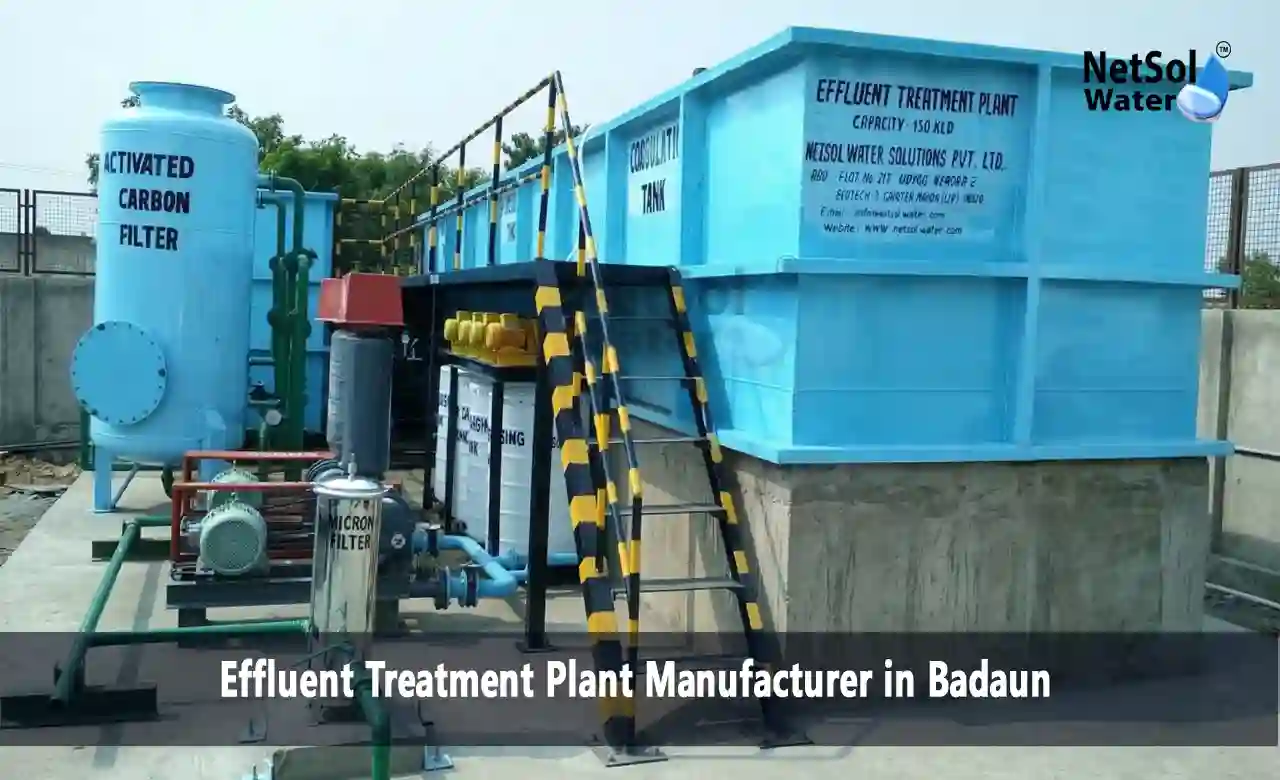
Effluent Treatment Plant Manufacturer in Badaun
An Effluent Treatment Plant in Badaun is an industrial wastewater treatment system that removes pollutants - including chemicals, suspended solids, heavy metals, oils and organic matter - from effluents generated by rice mills, food processing, textile, and chemical industries before safe discharge or reuse, as required under UPPCB and CPCB regulations.
Why Badaun Industries Need an Effluent Treatment Plant?
Badaun is a growing industrial hub in Uttar Pradesh, home to rice mills, food processing plants, small-scale chemical units, textile dyeing facilities and packaging industries. Each of these sectors generates wastewater that is fundamentally different from domestic sewage - carrying high concentrations of BOD, COD, heavy metals, oils, dyes and organic pollutants.
Left untreated, this industrial effluent can contaminate groundwater, degrade agricultural land, and expose industries to penalties under the Water (Prevention and Control of Pollution) Act, 1974. The Uttar Pradesh Pollution Control Board (UPPCB) requires all red and orange category industries to install a functioning ETP before they can receive or renew their Consent to Operate (CTO).
Beyond compliance, a well-designed ETP helps industries reduce fresh water consumption by enabling treated water reuse for cooling, washing, and other non-potable applications - directly cutting long-term operational costs.
ETP Cost in Badaun - Capacity-Wise Price Guide
ETP costs in Badaun vary based on daily wastewater volume, effluent type, treatment technology, automation level, and civil construction requirements. Here is a capacity-wise breakdown to help you budget your project.
1. Small Industries - 1 to 25 KLD
Estimated Cost: Rs. 6 lakh to Rs. 25 lakh
This range covers small manufacturing units, food processing facilities and workshops. These compact systems typically include an equalization tank, chemical dosing unit, and basic biological treatment. Because civil construction requirements are minimal, the overall project cost stays relatively low.
2. Medium Industries - 50 to 100 KLD
Estimated Cost: Rs. 30 lakh to Rs. 80 lakh
Medium-scale industries such as textile plants, pharmaceutical manufacturers, and mid-size food processing units fall in this range. These ETPs include larger treatment reactors, aeration systems, sludge management units, and in some cases tertiary filtration for water reuse.
3. Large Industrial Plants - 200 KLD and Above
Estimated Cost: Rs. 1 crore to Rs. 4 crore or more
High-capacity ETPs for large industrial complexes include advanced biological reactors, chemical treatment units, sludge dewatering systems, and membrane filtration. Industries in critically polluted zones may also require Zero Liquid Discharge (ZLD) systems, which add significantly to the overall cost. As a general benchmark, ETP installation in India costs between Rs. 0.60 lakh and Rs. 2 lakh per KLD, depending on treatment complexity and level of automation.
Factors That Affect ETP Cost in Badaun
Several variables determine the final installation cost of an Effluent Treatment Plant. Understanding these factors helps industries plan more accurately and avoid unexpected expenses.
• Effluent Characteristics: Wastewater with high COD, heavy metals, textile dyes, or oil content requires multi-stage treatment, raising both equipment and operating costs.
• Treatment Technology: Advanced technologies like Membrane Bioreactor (MBR), Moving Bed Biofilm Reactor (MBBR), or Sequencing Batch Reactor (SBR) deliver better treated water quality but cost more upfront than conventional activated sludge systems.
• ZLD Requirement: Industries under UPPCB Zero Liquid Discharge directives need additional evaporation and recovery equipment, which significantly increases total project cost.
• Plant Capacity (KLD): Larger plants require bigger tanks, pumps, and blower systems. However, cost per KLD generally decreases at higher capacities due to economies of scale.
• Automation and Online Monitoring: PLC-based automation with OCEMS (Online Continuous Effluent Monitoring Systems), mandatory for red-category industries under CPCB guidelines, increases upfront costs but reduces manpower needs and improves compliance reliability.
• Civil Construction: Site-specific factors - soil conditions, available space, existing infrastructure - directly affect the cost of tanks, foundations, and piping.
ETP Process Flow - How Industrial Wastewater is Treated
A standard ETP follows a multi-stage process, each stage targeting specific categories of pollutants. Netsol Water designs every plant around the actual effluent profile of your industry, ensuring no treatment stage is over- or under-designed.
• Stage 1 - Screening and Equalisation: Raw effluent passes through screens to remove large solids. An equalisation tank then balances fluctuating flow rates and pollutant loads before treatment begins.
• Stage 2 - Primary Treatment (Chemical): Coagulation and flocculation remove suspended solids, oils, and colloidal matter. A primary clarifier separates settled sludge from the partially clarified water.
• Stage 3 - Biological Treatment: Organic pollutants are broken down by microorganisms using aeration-based systems. The specific technology - ASP, MBBR, MBR, or SBR - is selected based on effluent type and available space.
• Stage 4 - Secondary Clarification: Treated water is separated from biological sludge. Sludge is either recycled back into the biological reactor or forwarded to the sludge handling system.
• Stage 5 - Tertiary Treatment (Optional): Sand filtration, activated carbon filtration, and UV disinfection bring treated water to reuse quality for cooling towers, cleaning, and horticulture.
• Stage 6 - Sludge Management: Sludge is thickened and dewatered using a filter press or centrifuge, then disposed of as per UPPCB Hazardous Waste Management Rules.
UPPCB and CPCB Compliance Standards for ETPs in Badaun
All industrial ETPs in Badaun must meet standards set by the Uttar Pradesh Pollution Control Board (UPPCB) and the Central Pollution Control Board (CPCB). These are the key compliance requirements:
• Treated effluent discharge standards for inland surface water: BOD not more than 30 mg/L, TSS not more than 100 mg/L, and pH between 6.5 and 8.5
• Consent to Operate (CTO) under the Water (Prevention and Control of Pollution) Act, 1974
• Online Continuous Effluent Monitoring System (OCEMS) mandatory for red-category industries
• Zero Liquid Discharge (ZLD) compliance required for distilleries, pulp and paper units, and certain textile industries in critically polluted areas
• Hazardous sludge disposal records to be maintained under the Hazardous Waste Management Rules
Netsol Water designs all ETPs to meet or exceed these regulatory thresholds, ensuring your plant passes UPPCB inspections without operational disruption.
How to Choose the Right ETP for Your Industry in Badaun
Selecting the right ETP comes down to four steps. Following this process ensures you invest in a system that is correctly sized, technically appropriate, and fully compliant from day one.
1. Get your effluent tested. A laboratory analysis of your wastewater reveals the exact BOD, COD, TSS, heavy metals, and pH levels that the ETP must address. This is the single most important input for any ETP design.
2. Determine your daily wastewater volume in KLD. Your flow rate sets the minimum plant capacity. Always account for peak production days and room for future capacity expansion.
3. Define your discharge or reuse goal. Whether you need to meet UPPCB discharge norms only, or recover water for industrial reuse, your objective determines which treatment stages are required.
4. Work with a qualified local ETP manufacturer. A manufacturer with experience handling UPPCB permit procedures can design a system that is both technically effective and administratively compliant.
Why Choose Netsol Water as Your ETP Manufacturer in Badaun
Netsol Water is a water and wastewater treatment company serving industries across Uttar Pradesh, including Badaun, Bareilly, Moradabad, and surrounding districts. With over 15 years of ETP design and installation experience and more than 500 treatment plants delivered across sectors including rice processing, food manufacturing, chemicals, textiles, and pharmaceuticals, we bring proven expertise to every project.
• End-to-end service covering effluent analysis, system design, civil construction, installation, commissioning, and annual maintenance contracts
• Full technology range: ASP, MBBR, MBR, SBR, physico-chemical treatment, ZLD, and hybrid systems
• All plants designed to meet current UPPCB and CPCB discharge standards
• Energy-efficient designs that minimise power consumption and reduce operating costs
• After-sales support including on-site maintenance, operator training, and compliance documentation assistance
Frequently Asked Questions
Q: What is the cost of an ETP in Badaun?
A: ETP cost in Badaun ranges from Rs. 6 lakh for small units (1 to 25 KLD) to Rs. 4 crore or more for large industrial plants (200 KLD and above). The final price depends on daily wastewater volume, effluent composition, treatment technology selected, and the level of automation required.
Q: Which industries in Badaun need an ETP?
A: Rice mills, food processing plants, textile dyeing units, chemical industries, pharmaceutical manufacturers, and packaging plants all generate industrial wastewater that must be treated before discharge as per UPPCB norms.
Q: What are the UPPCB discharge standards for industrial effluent?
A: As per CPCB and UPPCB guidelines, treated effluent must meet BOD of 30 mg/L or less, TSS of 100 mg/L or less, and a pH between 6.5 and 8.5 before discharge into surface water. ZLD norms apply to certain red-category industries in critically polluted areas.
Q: How long does ETP installation take?
A: A small ETP of 10 to 25 KLD typically takes 4 to 8 weeks. Medium and large plants of 50 KLD and above require 3 to 6 months, depending on civil construction scope, equipment procurement lead time, and commissioning.
Q: Can treated effluent be reused?
A: Yes. With tertiary treatment technologies such as membrane filtration and reverse osmosis, treated wastewater can be reused for cooling towers, equipment washing, and other non-potable industrial processes. This significantly reduces dependence on fresh water.
Q: What is ZLD and does my plant need it?
A: Zero Liquid Discharge (ZLD) means no effluent leaves the plant boundary. It is mandatory for certain industries located in critically polluted areas as notified by CPCB and UPPCB. Netsol Water designs ZLD-compliant ETP systems for industries under this directive.
Q: Why choose Netsol Water as your ETP manufacturer in Badaun?
A: Netsol Water provides end-to-end ETP solutions covering effluent analysis, system design, installation, commissioning, and after-sales maintenance. All our systems are built to comply with current CPCB and UPPCB standards, backed by 15 years of field experience across Uttar Pradesh.
Conclusion
As industries in Badaun continue to grow, responsible wastewater management is both a legal obligation and a sound business decision. The right ETP protects natural water resources, keeps your operations compliant with UPPCB and CPCB regulations, and can reduce costs through industrial water recycling.
As a leading Effluent Treatment Plant Manufacturer in Uttar Pradesh, Netsol Water offers custom-designed, regulation-compliant ETP solutions for industries of all sizes across Badaun and the wider Uttar Pradesh region. Whether you are setting up a new plant or upgrading an existing system, our engineers design the most cost-effective treatment solution based on your specific effluent characteristics and industry requirements.
Get a Free ETP Consultation for Your Badaun Industry
Operating a rice mill, food plant, chemical unit, or textile facility in Badaun? Our UPPCB-certified engineers will analyse your effluent, recommend the right ETP capacity and technology, and provide a detailed project cost estimate at no charge.
Call: +91-9650608473, Email: enquiry@netsolwater.com