

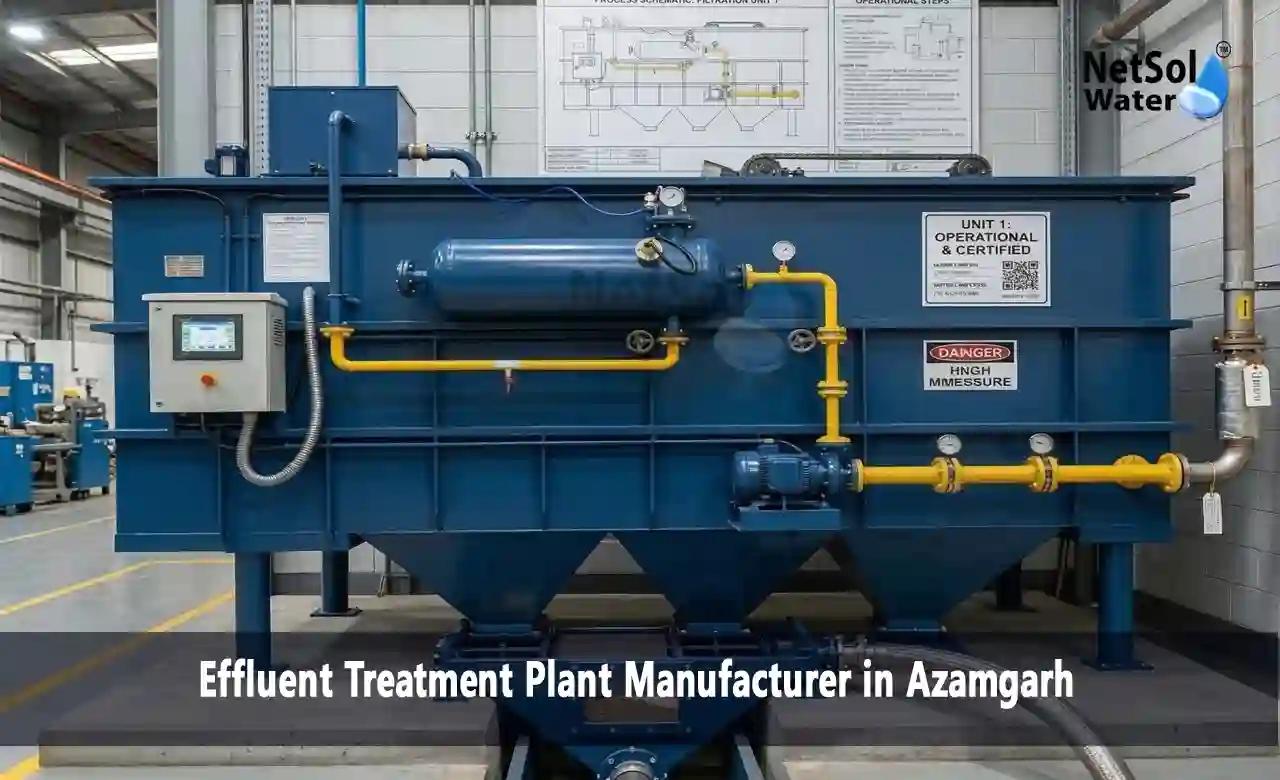
Effluent Treatment Plant Manufacturer in Azamgarh
An Effluent Treatment Plant in Azamgarh is an industrial wastewater treatment system that removes chemicals, heavy metals, dyes, and organic pollutants before discharge - ensuring full compliance with UP Pollution Control Board and CPCB norms. Netsol Water is a trusted Effluent Treatment Plant Manufacturer in Azamgarh, with 500+ plants installed across Uttar Pradesh.
Azamgarh is emerging as one of Uttar Pradesh's fastest-growing industrial districts. Rice mills, food processing units, textile dyeing factories, pharmaceutical units, and chemical manufacturers are all expanding their operations - and with that growth comes a critical challenge: industrial wastewater.
Unlike household sewage, industrial effluent contains high concentrations of chemicals, dyes, heavy metals, oils, and biological oxygen demand (BOD) loads that can devastate groundwater, farmland, and aquatic ecosystems if released untreated. The UP Pollution Control Board (UPPCB) mandates that all industrial units maintain compliant Effluent Treatment Plants - failing to comply can result in plant shutdowns, heavy penalties, and legal action.
Netsol Water, a specialist Effluent Treatment Plant Manufacturer in Uttar Pradesh, designs and installs custom effluent treatment systems for industries of all sizes in Azamgarh. Our plants meet CPCB discharge standards, reduce your water consumption through recycling, and are built to operate reliably for 15+ years.
Why Do Industries in Azamgarh Need an Effluent Treatment Plant?
Industries in Azamgarh generate wastewater with pollutant levels far beyond what natural water systems can absorb safely. Here is why investing in a proper ETP is not optional - it is essential:
1. Legal compliance: The UP Pollution Control Board requires all industrial units to treat wastewater to prescribed BOD, COD, TSS, and pH limits before discharge. Non-compliant plants face closure notices, fines up to ?1 lakh per day, and criminal prosecution under the Environment Protection Act, 1986.
2. Protection of farmland and groundwater: Azamgarh's economy is heavily agricultural. Untreated effluent from rice mills, textile units, and chemical plants seeps into irrigation channels and aquifers - contaminating crops and drinking water for surrounding villages.
3. Water recycling and cost savings: A well-designed ETP can recover 60–80% of treated water for reuse in cooling, washing, and non-potable processes - cutting your freshwater procurement costs significantly.
4. Corporate responsibility and market access: Export-oriented industries and businesses supplying to large retailers increasingly need environmental compliance certificates. An ETP is often a prerequisite for ISO 14001 certification and export approvals.
How Netsol Water Designs Effluent Treatment Plants for Azamgarh Industries
Every industry produces effluent with a unique chemical and physical profile. A textile dyeing unit's wastewater is nothing like a rice mill's - and a one-size-fits-all plant will fail to meet discharge norms. Here is our process:
Step 1 - Effluent characterisation: We collect and analyse your wastewater samples to measure BOD, COD, TSS, TDS, pH, heavy metal concentrations, and specific contaminants like dyes or phosphates.
Step 2 - Custom system design: Based on the analysis, our engineers design a treatment train - selecting the right combination of primary, secondary, and tertiary stages - sized precisely for your daily discharge volume (KLD).
Step 3 - Civil and mechanical installation: Our team handles all civil construction, equipment installation, electrical connections, and pipeline work. We offer both on-site construction and prefabricated modular systems.
Step 4 - Commissioning and compliance testing: Before handover, we run the plant through its full load cycle, test treated water against UPPCB discharge standards, and provide you with compliance documentation.
Step 5 - AMC and O&M support: We offer Annual Maintenance Contracts (AMC) and operator training so your plant runs reliably long after installation.
What Technologies Are Used in Effluent Treatment Plants?
Netsol Water uses a multi-stage treatment approach, selecting technologies based on your specific effluent composition. Here is how each stage works:
1. Primary Treatment - Physical separation
The first stage removes large solids and stabilises flow. It includes bar screens to filter debris, oil and grease traps, and an equalisation tank that buffers flow variations so downstream processes receive a consistent load. This stage typically removes 20–40% of suspended solids.
2. Secondary Treatment - Biological degradation
Microorganisms break down dissolved organic matter. We deploy three core biological technologies depending on your BOD/COD levels:
• Activated Sludge Process (ASP) - standard for moderate organic loads; cost-effective for capacities above 50 KLD
• Moving Bed Biofilm Reactor (MBBR) - compact, highly efficient; ideal for space-constrained industries
• Sequential Batch Reactor (SBR) - best for variable-flow industries; delivers excellent nutrient removal
3. Chemical Treatment - Coagulation and flocculation
Chemicals like alum, polyelectrolyte, or ferric chloride are dosed to bind suspended particles and heavy metals into large flocs that settle out in a clarifier. This stage is essential for textile, pharmaceutical, and chemical manufacturing effluents with high metal content.
4. Tertiary Treatment - Polishing for reuse or ZLD
For industries targeting water reuse or zero liquid discharge (ZLD), treated water passes through pressure sand filters, activated carbon filters, and - where required - reverse osmosis (RO) systems. This produces near-potable quality treated water for safe recycling or discharge to sensitive watercourses.
How Much Does an Effluent Treatment Plant Cost in Azamgarh?
ETP cost in Azamgarh depends on four primary factors: plant capacity (KLD), pollutant concentration, treatment technology selected, and automation level. The table below provides indicative cost ranges for 2026–27:
|
Plant Capacity |
Industry Type |
Estimated Cost (INR) |
Key Technologies |
|---|---|---|---|
|
10–25 KLD |
Rice mills, food processing, small workshops |
INR10 lakh – INR25 lakh |
Primary + chemical treatment |
|
30–100 KLD |
Textile, pharmaceutical, medium industrial |
INR30 lakh – INR90 lakh |
Biological (MBBR/SBR) + tertiary |
|
150+ KLD |
Large manufacturing, chemical plants |
INR1 crore – INR3 crore+ |
Full tertiary + RO + ZLD option |
Note: All costs are indicative and subject to detailed effluent analysis, site conditions, and civil construction requirements. Contact Netsol Water for a free site assessment and accurate quote.
What factors affect ETP installation cost?
• Effluent characteristics (BOD, COD, TDS, heavy metal load, dye content)
• Required treated water quality - discharge vs. reuse vs. ZLD
• Land availability and civil construction complexity
• Level of automation (manual, semi-auto, fully automated SCADA)
• Sludge dewatering and disposal requirements
• Proximity to UPPCB-approved effluent disposal points
A detailed effluent analysis report is essential before any cost estimation. Skipping this step leads to undersized or incorrectly designed plants that fail compliance tests.
Top 3 Effluent Treatment Plant Manufacturers in Azamgarh (2025)
1. Netsol Water - Best for Custom ETP Design
Founded in Uttar Pradesh, Netsol Water has installed over 200 effluent treatment plants across UP, serving industries from small rice mills to large pharmaceutical manufacturers. We are specialists in custom ETP design - every plant is engineered around your specific effluent profile, not a generic template.
• Specialisation: Custom ETP design for textile, food processing, pharmaceutical, and chemical industries
• Capacity range: 5 KLD to 500+ KLD
• Key strength: In-house design, civil, mechanical, and electrical execution - single-vendor accountability
• Certifications: ISO 9001:2015, UPPCB approved vendor
• Support: Annual Maintenance Contracts, operator training, 24/7 breakdown support
2. Urban STP Plant - Best for Large-Scale Turnkey Projects
Urban STP Plant is one of India's largest energy and environment engineering companies, headquartered in Pune. For large industrial clients in Azamgarh requiring turnkey ETP solutions with a national service network, Thermax offers robust large-scale systems - though their minimum project size typically begins at ?1 crore+, making them less accessible to small and medium industries.
• Specialisation: Large-scale turnkey ETP and ZLD systems
• Key strength: Extensive national presence and green facility management packages
• Best suited for: Heavy industries, large manufacturing plants with complex effluents
3. Sewage Treatment Plants - Best for Membrane and Recycling Technology
Sewage Treatment Plants is a publicly listed water treatment company known for advanced membrane filtration, ion exchange systems, and zero liquid discharge solutions. Their ETP plants are widely used in pharmaceutical, textile, and large manufacturing facilities. Their technology-driven approach suits industries targeting high water recovery or ZLD compliance.
• Specialisation: Membrane filtration, ion exchange, ZLD systems
• Key strength: Strong R&D capability; suited for complex, high-TDS effluents
• Best suited for: Pharmaceutical, chemical, and export-oriented industries with stringent discharge norms
Frequently Asked Questions About ETP Plants in Azamgarh
Q1. Is an Effluent Treatment Plant mandatory for industries in Azamgarh?
Yes. Under the Water (Prevention and Control of Pollution) Act, 1974 and the Environment Protection Act, 1986, all industrial units discharging wastewater in Uttar Pradesh must install a functioning ETP and obtain a Consent to Operate (CTO) from the UP Pollution Control Board. Operating without a compliant ETP can result in plant closure and penalties.
Q2. What is the minimum ETP capacity required for a small industry in Azamgarh?
For small industries such as food processing units, rice mills, and small workshops generating up to 25 KLD of wastewater, a plant with 10–25 KLD capacity is typically sufficient. Netsol Water offers compact modular ETPs starting from 5 KLD designed specifically for space-constrained small industries.
Q3. How long does it take to install an ETP in Azamgarh?
Installation timelines depend on plant size. A small 10–25 KLD system can be installed in 4–6 weeks. Medium plants (30–100 KLD) typically take 8–12 weeks. Large plants above 150 KLD may require 3–6 months for full civil construction and commissioning.
Q4. Can treated ETP water be reused within the factory?
Yes. With tertiary treatment (sand filtration + activated carbon + RO), treated water can reach near-potable quality and be recycled for cooling towers, floor washing, gardening, and boiler feed water - reducing freshwater consumption by 60–80%.
Q5. What is the ETP cost per KLD in Azamgarh?
As a rough benchmark, ETP installation costs in Azamgarh range from ?80,000 to ?1.5 lakh per KLD depending on treatment complexity, automation level, and civil construction requirements. A detailed site survey and effluent analysis are required for accurate pricing.
Q6. What pollutants does an ETP remove from industrial wastewater?
A properly designed ETP removes biochemical oxygen demand (BOD), chemical oxygen demand (COD), total suspended solids (TSS), total dissolved solids (TDS), heavy metals (lead, chromium, mercury), oil and grease, phosphates, nitrates, and industry-specific pollutants like dyes, phenols, and cyanides.
Q7. Does Netsol Water provide ETP maintenance services in Azamgarh?
Yes. Netsol Water offers Annual Maintenance Contracts (AMC) covering preventive maintenance, consumable replacement, operator training, UPPCB compliance monitoring, and 24/7 breakdown support for all ETP plants installed by us in Azamgarh and surrounding districts.
Q8. How do I get UPPCB consent for my ETP in Azamgarh?
Netsol Water assists clients through the complete UPPCB consent process - from effluent analysis and plant design documentation to filing the Consent to Establish (CTE) and Consent to Operate (CTO) applications. Our compliance team has experience with UPPCB requirements specific to Azamgarh district.
Conclusion
Azamgarh's rapid industrialisation makes proper effluent management not just a regulatory requirement but a fundamental responsibility to the region's farmers, communities, and water bodies. As a reliable Effluent Treatment Plant Manufacturer in Azamgarh, Netsol Water designs systems that meet CPCB norms, recover water for reuse, and operate reliably with minimal downtime.
Netsol Water brings 15+ years of wastewater treatment expertise to every project in Azamgarh. We design systems that meet CPCB norms, recover water for reuse, and operate reliably with minimal downtime. Whether you need a compact 10 KLD plant for a rice mill or a full-scale 500 KLD system for a textile complex, we deliver the right solution - on time, on budget, and fully compliant.