

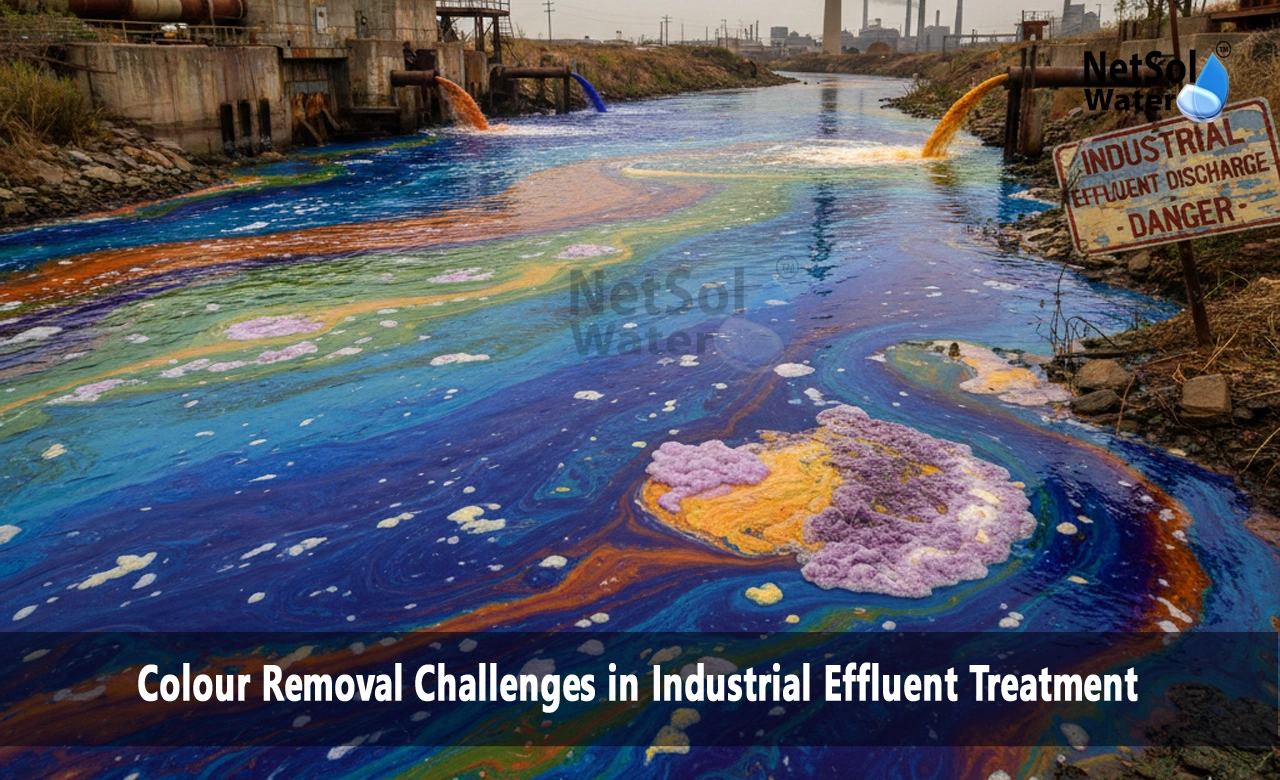
Colour Removal Challenges in Industrial Effluent Treatment
One of the most apparent and controlled parameters of the discharge of industrial effluent is colour. Although other pollution indices like BOD, COD and suspended solids may be within approved limits, coloured effluent usually draws the attention of the regulators and general audiences. Highly coloured wastewater is usually produced in industries like textiles, dyes, chemicals, pharmaceuticals, pulp and paper and food processing industries. Removing colour problems are especially problematic due to the fact that colour is not a solitary pollutant, but rather a multifaceted expression of dissolved organic substances, dyes, pigments and reaction by-products. The use of effective colour removal cannot be achieved by the use of conventional means of treatment alone without further elaborate knowledge on the effluent chemistry.
The Nature of Colour in Industrial Effluent
1: Sources of Colour Formation
Industrial effluent contains colour as a result of synthetic dyes, natural organic compounds, oxidation products and complex aromatic structures. Colour in most instances is brought about by the compounds that are employed to resist fading making them naturally hard to damage during the treatment of wastewater. These colour-causing molecules do not easily settle, and are usually dissolved.
2: Correlations of Colour and COD
Although colour and COD are usually correlated, they do not always act in a similar mannerin the course of treatment. Most colour-causing compounds are over-proportionately impacting visual pollution although they represent a lower proportion of COD. Consequently, effluent can still satisfy COD discharge regulations and yet fail colour standards, which indicates one of the major colour removal problems.
3: Process variability Effect
Raw materials, formulations and schedules of production are often altered in industrial processes. These differences modify dye chemistry, molecular weight, and solubility resulting in variable intensity and composition of colours. Systems with average conditions tend to fail when the colour loads are high.
Key Colour Removal Challenges in Industrial Effluent Treatment
1: Low Biodegradation of Colour-Causing Compounds
Lots of dyes and coloured organics cannot be degraded biologically. Traditional aerobic biologic treatment can eliminate the organic load but mostly does not change the colour. Partially, even biodegradation enhances colour in certain cases, as intermediates of the compounds are formed.
2: Unproductiveness of Traditional Chemical Treatment
Removal of colour using chemical coagulation and flocculation is much common,however its success largely relies on the chemistry of the effluent. Poor colour removal and too much sludge production is caused by the incorrect choice of the chemical to be used or dosing. The solubility of some dyes does not diminish following harsh treatment by chemicals.
3: Great Chemical Consumption and Sludge Production
Ever trying to overdose chemicals to remove colour causes enormous quantities of chemical sludge. This adds to the cost of operation, makes the handling of sludge more difficult and disposal more difficult without ensuring the uniform reduction of colour.
4: Effects of High TDS and Salinity Interference
Dissolved solids are highly dissolved and this decreases the efficacy of many colour removal processes. High salinity disrupts the process of coagulation, adsorption, and biological activity. This complicates the removal of colour particularly in effluents of textile dyeing and chemical manufacturing units.
5: Poor Performance in Different Colour Shades
The systems used in the treatment process in one colour group may not be effective in other colour groups. Dark colours, reactive dyes and mixed streams of colours respond differently when subjected to the same conditions of treatment. This is one of the most intractable colour removal problems that industrial ETPs are challenged with.
Process Limitations which influence Colour Removal
1: Inappropriate Equalization and Mixing
The imbalanced distribution of coloured effluent leads to the localisation of high colour concentration. In the absence of proper equalization, the shock loads to downstream units minimise the efficiency of treatment and cause variable outlet colour.
2: Limited Contact Time
In a lot of colour removal processes, chemical reactions or adsorption takes enough time to take place. Smaller reactors or high hydraulic loading diminish the reaction time resulting in an incomplete colour removal.
3: Selection of technology on the basis of cost and not chemistry
The capital cost is a major determinant of the choice of treatment processes that may lead to poor colour control. Colour elimination requires chemical-based design as opposed to non-selective treatment methods.
Strategies to overcome Colour Removal Problems
1: Maximized chemical treatment plan
Removal of colours is best done by proper choice of coagulants, flocculants and pH depending on the chemistry of dyes. Adaptive dosing and regular testing of jars enhance the level of removal and regulate the generation of sludge.
2: High-order Oxidation Processes
Complex colour-causing molecules are reduced to the simpler and less visible ones by advanced oxidation processes. The use of these processes is especially successful with non-biodegradable dyes, but the processes should be strictly regulated to prevent the waste of energy and chemical used.
3: Adsorption-Based Treatment
Activated carbon and other adsorbents can be used to polish colour, particularly where the regulatory limits are severe. Nevertheless, adsorption systems need to be adequately regenerated or replaced at least to be cost-effective.
4: Hybrid Treatment Systems
Physico-chemical treatment with biological or advanced processes can be combined, and then the most stable results can be obtained. The hybrid systems cover various colour fractions one at a time and do not use one mechanism.
Best Practices that enhance Colour Control
1: Trend Analysis and Continuous Monitoring
Following colour trends instead of independent test outcomes will make it easy to detect the deviation in the process at an early stage. This is due to the fact that there will be consistent data analysis hence corrective measures will be taken at the right time to prevent compliance problems.
2: Reactive Operation Process Stability
Stable influent conditions and prevention of emergency dosing of chemicals enhance the long-term colour removal capabilities. Stability may prove to be more effective as compared to aggressive short-term interventions.
Conclusion
Colour removal challenges in industrial effluent treatment stem from the complex, variable, and often non-biodegradable nature of colour-causing compounds. Traditional treatment systems will hardly be enough to guarantee uniform colour compliance. The successful control of colour involves a mixture of good effluent characterisation, choice of process based on chemistry, complex integration of treatment, and strict operation. Industrial effluent treatment plants will have higher compliance rates, reduced operating stress and be sustainable over a long period when colour removal is treated as a fundamental design and functional goal instead of secondary parameter.
Do you need an advice or assistance on selecting the best water and waste water treatment unit? We have solutions for all your problems!
Let us know your problem, our experts will make sure that it goes away.
For an assistance or related query,
Call on +91-9650608473 Or write us at enquiry@netsolwater.com